Housing Construction Slowly Ramping Up | Armonk Real Estate
Leave a reply

Realtor.com operator Move Inc. is launching an aggressive marketing campaign today that portrays the timeliness, accuracy and completeness of listings on the portal as giving its users a competitive advantage over buyers searching for homes on less reliable third-party websites.
The “Find It First” marketing campaign makes the case that with inventories tight in many markets, accurate and timely listings data could make the difference between finding your dream home or losing out to another buyer.
“You’re not the only one dreaming about your perfect home,” warns one of the ads.
As the official website of the National Association of Realtors, realtor.com can claim to have the most up-to-date and accurate inventory of U.S. homes listed for sale. The site receives listings data from more than 800 multiple listing services that, in most cases, is updated every 15 minutes.
Because they gather data from a variety of sources, third-party websites like Zillow and Trulia can have gaps in their listings coverage, or show homes that have already been sold or withdrawn from the market as still being for sale. Zillow and Trulia don’t have data on about a quarter of MLS listings, according to recent studies by brokerages ZipRealty and Redfin.
“We are highlighting our competitive advantage in the new campaign,” said Andrew Strickman, vice president of brand and creative at Move.


Mike Wallace was far more than a newsman. One look at his Manhattan apartment reveals the original “60 Minutes” star’s place in the lofty firmament of the celebrity media.
Courtesy of an exclusive from The New York Times, Wallace’s home at 730 Park Ave, New York, NY 10021 has been put up for sale. The price is an even $20 million, which will deliver a 12-room duplex in one of the city’s most grand prewar buildings.
Wallace died earlier this year at age 93, and his wife, Mary Yates, lived at the apartment until her death in September at age 83. According to NY Times writer Robin Finn, the Wallaces opted to meticulously keep the apartment to its original standards instead of gutting the place:
Graciously appointed, No. 15-16A was carved from a 12-room apartment and retains ample architectural detail and charm: the ceilings are high, the grand staircase is curving, French doors connect the library and the master bedroom to terraces on both levels, and elaborate variegated plaster moldings and wood floors accentuate all the principal rooms except the eat-in kitchen, which is floored in vintage cork.
Unlike some other grand spaces at this address, the apartment has seen preservation take precedence over renovation. Modernization has largely been limited to the four and a half baths and the installation of air-conditioning. The monthly maintenance fee is $8,822.”
In addition to the Upper East Side apartment, Wallace was a famous part-time resident of Martha’s Vineyard. A year ago, his waterfront home at 48 Hatch Rd, Vineyard Haven, MA 02568 was sold for $7 million.
Related:
The low prices that make foreclosures attractive to investors also make foreclosures toxic to communities and homeowners. The discount between “normal” priced homes and the prices paid for properties than have been through the foreclosure process can spell the difference between profit and loss to an investor at the same time that they drive real estate values into the ground.
As the Foreclosure Era enters its final years, the differences in foreclosure discounts vary widely across the nation, presenting opportunities to investors and wreaking havoc on homeowners simultaneously. With regional and local conditions playing a greater role than ever in shaping foreclosure supply and demand, the differences between local foreclosure discounts may be increasing to the surprise residents who rely upon reports of “national” average discounts.
FNC, one of the top sources of pricing data used by appraisers, calculated at national average discount of 12.2 percent at the end of 2012 versus 13.4 percent a year earlier. The National Association of Realtors said foreclosures sold for an average discount of 20 percent below market value in January. At the height of the mortgage crisis (2008 and 2009), foreclosed homes were typically sold at 25 percent below their estimated market value, said NAR.
Despite the progress in national average discounts, in a number of markets today foreclosures are worse now than they have ever been. A certain tier of markets, largely in the East and Midwest, are seeing discounts reach levels far below the 12.2 percent cited by FNC or the 20 percent from NAR. In real estate, where there is no national marketplace, the use of national averages sometimes can mask very different local realities.
Several factors, which differ by market, are keeping foreclosure discounts high in some markets. These include large inventories from the continued slow processing of foreclosure due to state laws; higher default and lower rents resulting from unemployment and economic fragility; less than ideal conditions for single family rentals, including low cap rates; overcapacity; and a disproportionate number of unsold damaged foreclosures (See Damaged Foreclosures Beckon Bargain-hunters); and less investor demand compared to the West and Florida, where a culture of small investors has developed and large hedge funds are active.
To help zero in on the market where foreclosure discounts are the highest, here are two tables. The first is a list of FNC’s ten highest foreclosure discounts at the end of 2011 and 2012. The second is RealtyTrac’s list of “20 best places to buy a foreclosure,” with foreclosure discounts in the third column. Some of RT’s discounts (Chicago, Philadelphia, Stamford, Cleveland, New Haven, New York) exceed 40 percent.
Q4 2012 Q4 2011 Cleveland, OH 23.3% 25.1% Seattle, WA 24.0% 25.1% Houston, TX 25.0% 25.2% Chicago, IL 26.3% 27.0% Cleveland, OH 26.4% 22.6% New York, NY 28.2% 28.6% Baltimore, MD 29.6% 32.3% Pittsburgh, PA 30.2% 30.6% Boston, MA 33.0% 29.2% Philadelphia, PA 33.3% 31.0%
Metro area Inventory months’ supply Foreclosure sales (Percentage of all sales) Average foreclosure discount (percent) Foreclosure activity (annual percentage change) Palm Bay-Melbourne-Titusville, Fla. 34 23.81 28.05 308.71 Rochester, N.Y. 78 3.16 25.78 132.61 Albany-Schenectady-Troy, N.Y. 86 3.17 35.08 107.72 New York-Northern New Jersey-Long Island, N.Y.-N.J.-Pa. 97 7.7 40.35 27.91 Lakeland, Fla. 33 24.36 15.09 95.65 Tampa-St. Petersburg-Clearwater, Fla. 32 24.67 26.64 80.16 Jacksonville, Fla. 34 29.26 32.29 51.36 Poughkeepsie-Newburgh-Middletown, N.Y. 92 6.59 28.35 16.51 Orlando-Kissimmee, Fla. 28 30.14 19.24 64.34 Chicago-Naperville-Joliet, Ill.-Ind.-Wis. 36 30.04 46.03 30.21 El Paso, Texas 15 8.79 17.8 93.42 Miami-Fort Lauderdale-Pompano Beach, Fla. 29 28.7 30.58 36.17 Philadelphia-Camden-Wilmington, Pa.-N.J.-Del.-Md. 42 11.91 43.17 27.01 Allentown-Bethlehem-Easton, Pa.-N.J. 34 11.87 39.7 37.21 Youngstown-Warren-Boardman, Ohio-Pa. 61 13.61 32.63 15.32 Bridgeport-Stamford-Norwalk, Conn. 10 9.83 52.22 49.37 Syracuse, N.Y. 39 1.6 21.25 57.4 Cleveland-Elyria-Mentor, Ohio 32 21.64 46.97 18.83 New Haven-Milford, Conn. 9 13.66 41.87 54.18 Indianapolis-Carmel, Ind. 26 18.97 35.51 38.04
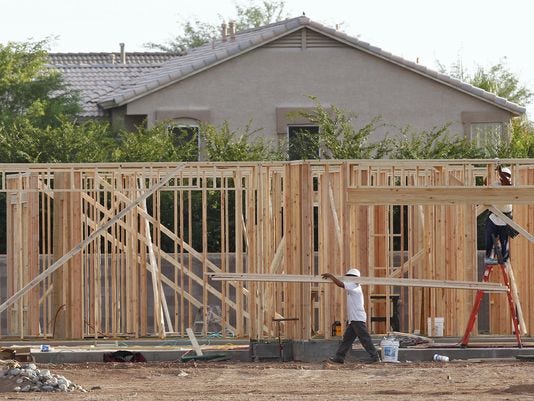
Workers frame the first home in a new community in Gilbert, Ariz.(Photo: Matt York, AP)
Story Highlights
- Seven major cities had double-digit home price gains in 2012
- Economies in these cities vary widely, from Phoenix to Detroit
- Looking at trends may be important to home price gains elsewhere
Nearly every important set of government and private-sector figures show a housing market on the rebound. The recovery picked up steam in recent months with home sales jumping in January and December.
One of the most widely followed measures of home price changes is the S&P/Case-Shiller home price index. There are several home price indexes that this research group has created, but the one most often cited is the base index. Set at 100 in January 2000, it tracks price changes monthly in 20 major U.S. cities.
In December, the value of homes in the 20 cities Case-Shiller measures rose by 6.8% year-over-year. New York City was the only city where prices fell. In seven cities, the price increase was dramatic, in the double digits.
Home prices haven’t recovered in any of these cities to where they were at their peak. And some of the cities showing the strongest gains aren’t the ones that were the hardest hit during the devastated downturn.
The housing market recovery has been and will continue to be uneven. The same is true with unemployment, which mirrors changes in housing markets. But while changes in the national unemployment rate tells you companies are hiring and layoffs are subsiding, it hardly tells the whole tale. The devil is in the details.
For example, the Case-Shiller index showed home prices in Detroit jumped 13.6% in 2012 year over year, and they surged 23% in Phoenix for the same period. And the economy and the housing market in these cities are very different.
In Detroit, the unemployment rate surpassed 17% in 2009 though the nation’s jobless rate never rose above 10.1% the past decade. And even though the city’s jobless rate has rebounded seven percentage points, it remains more than two percentage points above the nationwide rate, which was 7.8% in December and ticked up to 7.9% in January.
By contrast, the metropolitan Phoenix area jobless rate stayed below the national rate throughout the recession, peaking at 8.6% in 2009. And at 6.7%, it is more than a percentage point below the nationwide rate.
24/7 Wall St. reviewed the seven cities with the biggest home price gains to find trends that could explain why they’re doing the best of major cities tracked. These trends may be critical to the broad recovery of real estate across the nation in the longer term.
7. Los Angeles
• 10.2% rise in home prices last year
• 40.4% drop in home prices the past six years
• $345,000 median home price
• 9.3% unemployment rate
Los Angeles still suffers from higher unemployment than the U.S. average. Home prices here hit their post-bubble low in the third quarter of 2008. Distressed sales fell to around 35% of all single-family home sales last year, down from nearly 49% the year before. As the share of distressed sales continues to fall, home price gains will pick up steam.6. Miami
• 10.6% rise in home prices in 2012
• 50.4% drop in home prices the past six years
• $196,000 median home price
• 8.1% unemployment rate
Miami home prices peaked in the first quarter of 2007 and fell rapidly in the fourth
quarter of 2008. Though not nearly as strong as what Las Vegas boasts, Miami’s economy has a strong tourism component. But it also serves as a port of trade for Caribbean and Latin American nations. Neither tourism nor trade fared well during the economic downturn. And Miami’s housing market, like many others, is still recuperating from the overbuilding of the real estate boom.5. Minneapolis
• 12.2% rise in home prices in 2012
• 31.7% drop in home prices the past six years
• $187,000 median home price
• 5.1% unemployment rate
Unemployment in Minneapolis peaked at 7.9% in 2009, and the current rate is the lowest among the seven cities with the biggest home price gains in 2012. House prices here peaked in the first quarter of 2006 and had their biggest decline in the first quarter of 2009, around the same time that the national unemployment rate was rising rapidly. Short sales have declined to around 10% of the total in this area, and foreclosure sales are slightly less than a third of all sales.4. Las Vegas
• 12.9% rise in home prices in 2012
• 60% drop in home prices the past six years
• $147,000 median home price
• 10% unemployment rate
Las Vegas, like Phoenix, experienced a home building boom that peaked in the first quarter of 2006. The tourism-based economy took a drubbing during the Great Recession. Home price gains continue to be hindered by the number of distressed properties on the market. Distressed sales comprised 73.6% of all home sales in January of 2012, and that share had fallen to 48.7% a year later.3. Detroit
• 13.6% rise in home prices in 2012
• 53.6% drop in home prices the past six years
• $45,000 median home price
• 10.2% unemployment rate
Detroit’s median home price remains the lowest by far of any of the 20 cities in the Case-Shiller benchmark index. One of just a handful of large U.S. cities where the unemployment rate remains in double digits, the city’s jobless rate has plummeted since its Great Recession peak. But at 10%, the unemployment rate here is higher now than it was during the worst periods for a few of the other cities in the index. The biggest decline for home prices in Detroit occurred in the second quarter of 2009, with prices falling from a peak in the first quarter of 2006. Foreclosure sales have dropped from around 55% in January of 2012 to around 36% a year later.2. San Francisco
• 14.4% rise in home prices in 2012
• 22.3% drop in home prices the past six years
• $717,000 median home price
• 7.3% unemployment rate
Home prices in San Francisco peaked in the first quarter of 2007, and the price trough came about two years later. Yet, while prices fell 20%, they never got cheap, especially compared to the median home prices in other cities in the index. And, among other reasons, a tight supply of homes for sale remains a reason for why prices are higher here.1. Phoenix
• 23% rise in home prices in 2012
• 49.8% drop in home prices the past six years
• $164,000 median home price
• 6.7% unemployment rate
The city’s home price gains were the best of the 20 cities in the Case-Shiller index, and distressed sales, which includes foreclosure and short sales, as a share of the total are lower here than in any other city. Home prices in Phoenix bottomed and its jobless rate peaked at 9.3% in 2009, which was the second-lowest peak rate among these seven cities. Phoenix has the opposite problem of San Francisco; it still suffers from an oversupply of homes for sale. But the outlook for home sales and prices is upbeat.24/7 Wall St.com is a financial news and analysis website. In this analysis, home price gains are as of December 2012, year over year. Home price declines cited are as of June 30, 2012, going back six years. The median home prices are as of June 30, 2012, and the metropolitan area unemployment rates are as of Dec. 31, 2012.
Recreation Newsletter
February 25, 2013
The North Castle Recreation 2013 Spring Summer Brochure is now on the Town’s website. You can view and print your own copy here. The tri-fold pamphlet which simply lists the programs in spring and summer has been mailed to all Town residents. For a peak at the tri-fold click here.Mail-in registration for all spring and summer programs, including Town day camps, begins Monday, March 11. Walk-in registration begins Monday, March 18. Do not delay in registering as programs can get filled or cancelled. Please call us if you have any questions, 273-3325.