Tag Archives: Armonk NY Realtor

Armonk NY Realtor

Deer Resistant Plants? Fact or Fiction? by P Allen Smith | Armonk Homes

Raise your hand if deer like to graze in your garden. How many different tactics have you tried to protect your plants? Have you tried hanging bars of soap from tree limbs, sprayed predator urine or scattered human hair around flower beds?

While these inventive measures may work temporarily, a long term solution requires a holistic approach. First, you have to give up the idea that you are ever going to deer proof your garden. Unless you build a 7-foot tall fence around your place, there’s not much you can do to keep them out. Next, make your garden less appealing to deer. Stop planting their favorites like tulips, roses and hostas and choose plants that deer are less inclined to eat. A few plant characteristics to look out for are fuzzy foliage, an antiseptic aroma and a bad taste.

Are there plants that are 100 percent deer resistant? No. The truth is that deer will eat anything when food is scarce, but if your garden is filled with plants that deer find unpleasant, there is a good chance they will move on to the delicacies in your neighbor’s yard.


http://www.pallensmith.com/blog

Recolor Your Walls for a Better Mood | Armonk NY Real Estate

Feeling uninspired in your creative life? Wish you could sleep better at night? Repainting your walls and redecorating with a new color scheme could be the solution — or at least the first step in getting out of your rut.

While color is not a magical solution to solving all of our problems, it does affect our mood and outlook, sometimes without us even realizing it. The advertising world, for example, takes advantage of our physical and psychological reaction to certain colors; most action movie posters have a blue and orange hue, and fast-food restaurants combine red and yellow to increase diners’ appetites.

Here are a few ways you can use color to create the mood you desire:

Red
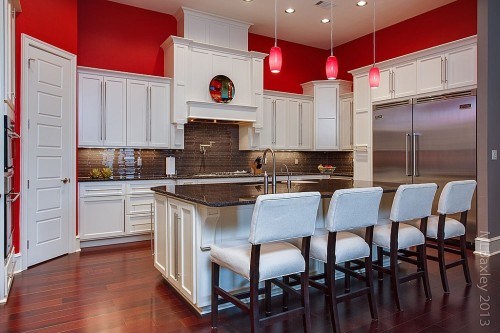
Red walls - kitchen

Red is often associated with passion, excitement and love, which means that it can be the perfect shade for your bedroom, kitchen or creative space. Darker hues indicate elegance, while red in its purest form communicates a vibrant energy. Red is an extremely powerful color, so be careful of overdoing it and turning your room into a living furnace. Balance it out with neutral colors, pair with blue and white for nautical tones or add dashes of green decor for a natural complement.

Orange
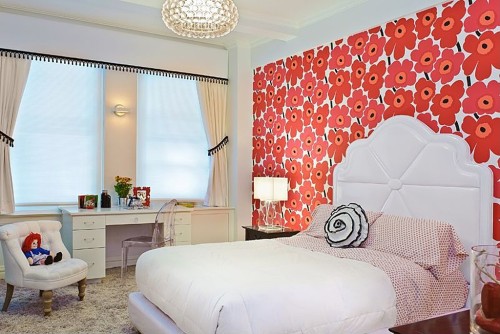
Orange kids room

Orange can have much of the same effect as red and yellow, but can give your home a much quirkier feel, as it’s not used as often as the other two. Orange is also more inviting and a gentler way of greeting your guests than the bolder red. Go for dark hues if you’re aiming for a cozy, autumn feeling in your living room, or bright shades if you want to re-create the excitement of summer. Optimal rooms for an orange theme include the living room, dining room, kitchen or a child’s room.

Yellow
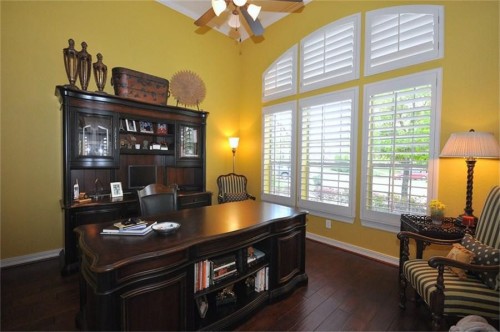
Yellow office

Yellow is easily the most uplifting color in the spectrum and is associated with cheer, joy and happiness. Paint your kitchen, bedroom or office yellow to inspire creativity and instantly de-gloom even the most windowless of rooms. If you don’t live in mostly sunny areas, use yellow as your secret weapon and invest in some mirrors to perpetuate openness and space.

Green
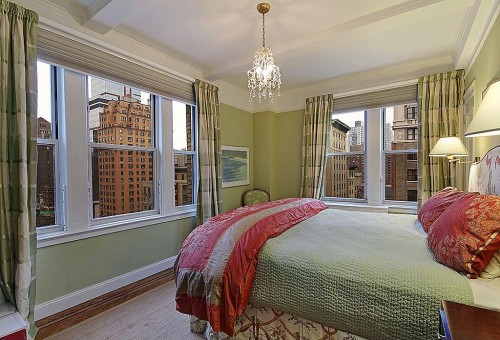
Green bedroom

In addition to being the natural color of most vegetables and thus associated with health, green also has a calming effect and can inspire balance. Green is also closely related to fecundity and growth, and can greatly maximize the creative aura of your home office or creative space. If you’re not quite committed to painting the walls green just yet, try populating the room with plants instead.

Blue
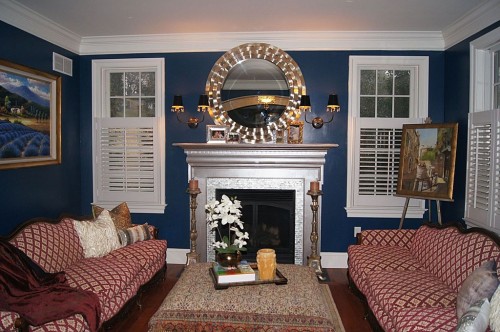
Blue living room

Keep blue, gray and black out of the kitchen and dining room, as these are the most unappetizing colors. Blue can be a perfect hue for bathrooms and bedrooms, encouraging feelings of serenity and peace. If you have trouble sleeping or feel frenetic at night, paint your walls blue to trick your mind into slowing down.

While many do associate it with sadness, remember that the specific shade of blue can have different meanings, including a host of religious connotations for many different cultures. Overall, a lighter blue can be refreshing and hip, while darker shades in a main living area are stable and strong.

Purple
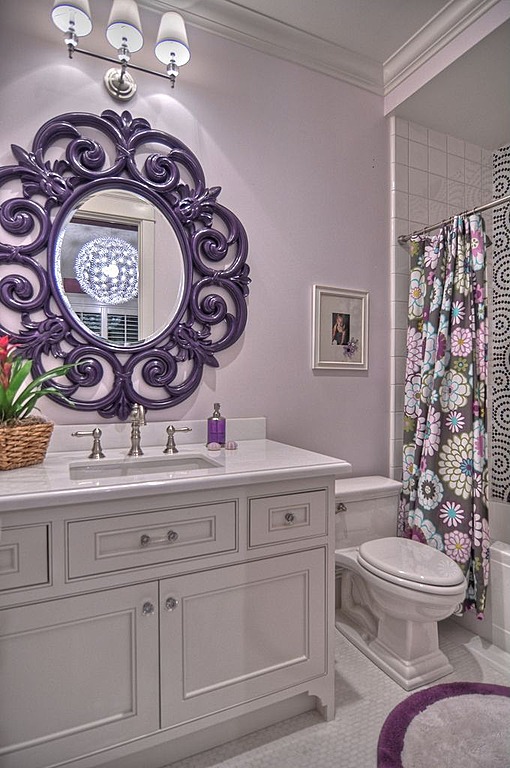
Lavender bathroom

This is an extremely energetic color in its purest form, which is why many feng shui experts advise against painting walls purple or going overboard with purple decorations. Rather than a strong purple, opt for more muted shades like lavender or pink.

Pink is obviously often related to love, but can also be a gentler and more delicate option for purple enthusiasts. Pair with yellow-green for a dramatic pop, or black for a classy effect with just the right amount of flair.


http://www.zillowblog.com/2013-05-03

Inbound Marketing | Difference Between Tactics and Strategy | Armonk Realtor

Every marketer wants to open up the inbound marketing floodgates, or so they think. But, when you get down to doing inbound marketing what is tactical and what is strategic? This really begs the question: which inbound marketing tactics can you do relatively quickly and without too much effort versus those that require more effort but offer long term results potential?

Our parents taught us that anything worth doing is worth doing right. We were taught “if _____ was easy everyone would do it.” By no means am I suggesting that inbound marketing is easy. But, let’s look at some inbound marketing activities that might be considered tactical and those considered strategic.

Tactical Inbound Marketing

Pay-per-Click Advertising (PPC)

Some call this SEM. This involves setting up search marketing campaigns in Google Adwords or Bing whereby your ads are displayed for certain keywords for which you bid an amount you’re willing to pay each time someone clicks on your ad. Setting up one or two campaigns properly takes a matter of hours. Getting Google or Bing to approve them also takes hours. Generally within a day or two you can have a few PPC campaigns up and running. Some will argue that PPC is strategic. For those brands that make a serious commitment to PPC with ongoing monitoring and optimization it can be strategic. That said, PPC campaigns could be turned on and off based on need and budget.

Optimizing Current Your Website

Undergoing an “on page” optimization exercise of your existing website content is also tactical because it is focused on the existing content. Depending on the size of your website the effort may take days, or weeks or even months. The result may be improved discoverability of some of your website’s pages in search results, which could result in more traffic to your website.

Sequestration isn’t affecting D.C.’s spring housing market | Armonk NY Real Estate

Compared with a year ago, March sales in the Washington metropolitan area increased 9.9 percent, while average prices rose  9.7 percent.

The year-over-year price appreciation in March is a continuation of a 16-month trend of price growth in the metropolitan area.  Year-over-year average prices were up 12.7 percent for single-family detached houses, 9.8 percent for townhouses and 6.7 percent for condominiums.  The March data can provide an early indication of the strength of the housing market going into the rest of the year.

Sales activity tends to be much brisker in March than in February, and this year is no exception, with the number of sales in the metropolitan area increasing by 33.4 percent between February and March, an increase that is in line with the 10-year average increase.  (Home sales data are from MRIS, the region’s multiple listing service.)  Sales were up in March over February in all 22 jurisdictions in the Washington metropolitan area.

However, compared with last year, the February-to-March uptick was lower in the District and in Fairfax County and the independent cities of Fairfax, Falls Church and Alexandria.  The relatively slower sales in March in these jurisdictions can be at least partially explained by the very low inventories; potential buyers have little to choose from in these locations.

Home Values Down 27 Percent from Peak | Armonk Real Estate

Property values in January are 5.7 percent higher than they were a year ago, but they still have a long way to go to regain the equity that has been lost in the past six years.

Although home prices have improved significantly in the last 12 months, a six-year price comparison shows that current prices remain well below their near-peak levels. On average, today’s home prices are about 27.5% below January 2007. In hard-hit markets such as Las Vegas, Orlando, Miami, and Riverside, Calif., home prices are only half of what they were six years ago, according to the latest FNC Residential Price Index® (RPI)

Four markets that FNC tracks, Denver, San Antonio, Houston and Columbus, have regained all value lost in the past six years and now are registering gains higher than they did at the peak of the housing boom. However, values in Miami, Orlando, Riverside and Las Vegas are more than 50 percent below the levels of 2007.

FNC also reported that the recovery of underlying property values is driving sale prices closer to list prices, a sign that markets are transitioning from buyer’s to seller’s markets . The average list-to-sale price ratio increased to 93.5 in January, compared to 90.3 during the same period a year ago; in other words, the average asking price discount dropped to 6.5% from 9.7%. Foreclosures, as a percentage of total home sales, were 20.2% in January, down from 26.9% a year ago.

Mike Wallace’s Central Park Apt. Listed for $20M | Armonk Homes

Source: theblogismine.com

Mike Wallace was far more than a newsman. One look at his Manhattan apartment reveals the original “60 Minutes” star’s place in the lofty firmament of the celebrity media.

Courtesy of an exclusive from The New York Times, Wallace’s home at 730 Park Ave, New York, NY 10021 has been put up for sale. The price is an even $20 million, which will deliver a 12-room duplex in one of the city’s most grand prewar buildings.

Wallace died earlier this year at age 93, and his wife, Mary Yates, lived at the apartment until her death in September at age 83. According to NY Times writer Robin Finn, the Wallaces opted to meticulously keep the apartment to its original standards instead of gutting the place:

Graciously appointed, No. 15-16A was carved from a 12-room apartment and retains ample architectural detail and charm: the ceilings are high, the grand staircase is curving, French doors connect the library and the master bedroom to terraces on both levels, and elaborate variegated plaster moldings and wood floors accentuate all the principal rooms except the eat-in kitchen, which is floored in vintage cork.

Unlike some other grand spaces at this address, the apartment has seen preservation take precedence over renovation. Modernization has largely been limited to the four and a half baths and the installation of air-conditioning. The monthly maintenance fee is $8,822.”

In addition to the Upper East Side apartment, Wallace was a famous part-time resident of Martha’s Vineyard. A year ago, his waterfront home at 48 Hatch Rd, Vineyard Haven, MA 02568 was sold for $7 million.

Related:

Falling Inventories are Hitting the Brakes | Armonk NY Real Estate

At long last, there are signs that the unprecedented year-long decline in for-sale inventories are slowing, though continuing to fall, just in time for the spring home buying season. But inventories may continue to decline through 2013.

Nationally, inventory is no longer in a free fall, reported Trulia’s Chief Economist Jed Kolko yesterday. The seasonally adjusted quarter-over-quarter change in inventory is negative, but no longer falling as sharply as it did a few months ago. (Year-over-year changes are slower to show a turnaround because they combine a full year’s worth of changes in a single measure. But looking at quarterly or monthly changes requires a seasonal adjustment because inventory has a strong seasonal pattern that makes the underlying trend hard to see.)

The quarter-over-quarter decline in inventory has been at a 14-21 percent annualized rate since October 2012, compared with a 23-29% annualized rate from March 2012 to September 2012:

Nationally, inventory fell 23 percent year-over-year in February, according to the Department of Numbers HousingTracker. Inventory fell year-over-year in all 50-plus markets they track, and by more than 50 percent in several California metros. Price increases and disappearing inventory go hand-in-hand: nearly all metros with the biggest inventory declines also had year-over-year price increases of 10 percent or more, such as Sacramento, San Jose, and Seattle.

Kolko said less inventory leads to higher prices, which in turn lead to less inventory – at least in the short term. Everyone wants to buy at the bottom; no one wants to sell at the bottom. When prices start to rise, buyers get impatient while many would-be sellers want to hold out in the hopes of selling later at a higher price. However, the “inventory spiral” can’t go on forever because eventually rising prices will encourage homeowners to sell and builders to build, which add to inventory and breaks the spiral.

“The critical question for the housing market – especially for buyers fighting over tight inventories – is how long until that kicks in? How long do prices have to rise before sellers and builders start adding to inventory?” asked Kolko.

In the long term, higher prices lead to more inventory -. As prices keep rising, more homeowners decide it’s worthwhile to sell, especially those who get back above water, which adds to inventory. Also, builders take rising prices as a cue to rev up construction activity, which also adds to inventory.

For the U.S. overall, an inventory turnaround in 2013 is unlikely. Since national asking home prices bottomed in February 2012, it may be at least another year before national inventory starts expanding. Inventory will make a turnaround first where asking prices bottomed earliest, such as in Phoenix, Miami, Detroit, Houston, and Oklahoma City. The inventory turnaround is a longer way off in metros where prices have bottomed more recently, such as in Sacramento and the Inland Empire.