Tag Archives: Armonk NY Real Estate

Armonk NY Real Estate

Down Payments Fall to Three Year Low | Armonk Homes for Sale

The median downpayment made by all homebuyers in 2012 was 9 percent, ranging from 4 percent for first-time buyers to 13 percent for repeat buyers. The median down payment was the lowest since 2009 but still far above the levels during the housing boom, when nearly half of first-time buyers made no downpayment at all.

First-time buyers who financed their purchase used a variety of resources for the down payment: 76 percent tapped into savings; 24 percent received a gift from a friend or relative, typically from their parents; and 6 percent received a loan from a relative or friend. Eleven percent tapped into a 401(k) fund, and 6 percent sold stocks or bonds. Ninety-three percent of entry-level buyers chose a fixed-rate mortgage, reported the National Association of Realtors.

Forty-six percent of first-time buyers financed with a low-downpayment FHA mortgage, and 10 percent used the VA loan program with no downpayment requirements. Forty-two percent cut spending on luxury items to buy their first home, 35 percent cut spending on entertainment and 27 percent cut spending on clothes.

In 2005, the median first-time home buyer scraped together a down payment of only 2 percent to buy a $150,000 home . Two years later, in 2007, the median downpayment by first-time buyers was still only 2 percent and 45 percent purchased with no money down – the same as in 2006. That year 43 percent of first-time home buyers purchased their homes with no-money-down loans.

After lenders tightened standards in the wake of the housing crash, the median down payment soared , reaching 11 percent in 2010-2011. First time buyers put about 5 percent down in 2011. Repeat buyers, pooling equity with savings, typically put down about 15 percent. Investment and vacation-home buyers have been paying higher down payments than those buying a primary residence. The median down payment for both was 27 percent, according to NAR’s 2011 Profile of Investment and Vacation Buyers.

“First-time buyers historically make small down payments, but repeat buyers like to put down 20 percent if they can to avoid paying mortgage insurance,” NAR’s Paul Bishop said. “The general loss in home value since the peak of the housing boom means many repeat buyers in recent years had to make smaller downpayments. Fortunately, prices have turned up this year and are showing sustained increases, so we’re on the road to a recovery in home equity.”

A Glimpse Into Mobile Measurement and Apps Today and Tomorrow | Armonk NY Homes

We recently teamed up with ClickZ to learn how marketers around the world are approaching mobile marketing and measurement, and where it’s headed next. We hope these stats will provide useful context for your planning in the coming year. Here are some of the key takeaways:

Mobile is now an important part of the integrated marketing mix

Mobile is no longer an add-on to a campaign, and for many it’s increasingly becoming a central focus.
  • 87% of marketers are planning to increase emphasis on mobile during 2013, and belief in the power of mobile is rapidly growing stronger.
  • Marketers have a broad mix of mobile tactics planned in the next year:
  • 52% plan to create a mobile- or tablet-optimized website
  • 48% plan to increase engagement in mobile advertising
  • 41% hope to develop a mobile app
  • 39% are planning to market a mobile app
For many, mobile measurement is still new territory
  • More than half (59%) of marketers consider themselves either novice or inexperienced when it comes to measuring mobile. This presents an opportunity for organizations to invest in training and education today to stay ahead of the curve tomorrow.
  • 58% of marketers are currently accountable for mobile metrics, and more than one-third are already sharing internal dashboards to show mobile marketing results.
Mobile measurement unlocks new opportunities
  • 53% of marketers who analyzed their mobile metrics say there is a lot of untapped opportunity and plan to increase their mobile spending.
  • Tools, technologies and talent are in demand: 68% of marketers plan to increase technology investment and ad spend, and 32% plan to focus more in talent.
A deeper look at mobile app measurement

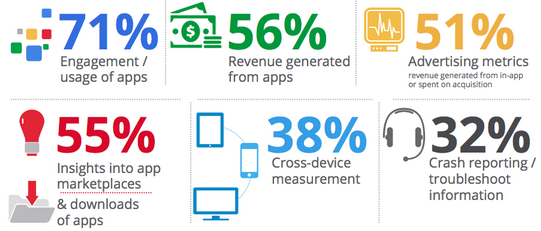
Here’s a look at the mobile app-related metrics that marketers say matter the most to them:
As shown above, marketers are interested in measuring the full app lifecycle, which we’re excited to see as our new Mobile App Analytics covers a majority of the desired metrics marketers are seeking.
The opportunity for marketers

This research shows the opportunity that mobile offers app developers and marketers to reach consumers on the go. Effective measurement across mobile sites, ads and apps will help marketers create winning strategies. Mobile’s role in marketing is becoming a central part of integrated campaigns and will only continue to grow. We know that marketers want simple tools that help them seamlessly integrate mobile into their marketing and measurement, and we’re working hard to create robust tools to help.

4 must-haves when installing a dishwasher | Armonk NY Real Estate

<a href=

Q: I live in a 1940s house with a kitchen that has never been updated. I’m tired of doing the dishes by hand and would really like to get a dishwasher. I don’t have a garbage disposal and don’t really want or need one. I compost all my organic food waste.

Is it possible to get a dishwasher or am I doomed to continue with washing dishes by hand. Do I have to spend big bucks to have the kitchen remodeled? I’m pretty handy so if possible I’d like to do this myself using the existing kitchen cabinets.

The counters are 25 inches deep with tile countertops, and the counter height is 35 inches. There are two side-by-side banks of drawers to one side of the sink measuring 26 inches between the stiles. This seems to be a perfect place for a dishwasher. What do you think?

A: Yes, you can have a dishwasher in your kitchen. Furthermore, you can do most of the work yourself and save a bunch of money. Four things are necessary for a built-in dishwasher: a place for it; a water supply line; a drain line; and power. We’ll take these in order.

Cabinet space: Standard under-counter dishwashers are 24 inches wide, 24 inches deep and approximately 35 inches high with adjustable legs. We’ve installed a dishwasher in an opening a little less than 34 inches tall. Based on your description, it sounds as if it’ll be a tight fit, but a fit nonetheless. There are narrower models and also single-drawer models with different dimensions available if the standard size won’t work. We’re sure that with a little research you can find one that will fit your space.

The drawer banks are an ideal location. It’s best to locate a dishwasher close to the sink for easy access to water and waste lines. Often 1940s vintage cabinets were built in place. Getting your opening should be as easy as removing the drawers, cutting out the cross rails and cutting out the bottom of the cabinet with a reciprocating saw.

Water supply: A dishwasher needs hot water. The closest source is the hot water supply under the sink. Replace the shutoff valve with a new one that connects both the sink and the dishwasher to the hot water line. The new valve, also known as an angle stop, will have a vertical outlet to be connected to the faucet and a horizontal outlet to supply hot water to the dishwasher. Use a long braided wire hose available at plumbing supply houses, hardware stores and home centers for the connection. You may need to drill a hole in the side of the cabinet to route the hose from the shutoff valve to the dishwasher opening.

Drain line: The dishwasher will come with a hose used to connect the dishwasher to the drain under the sink. Normally the hose is connected to an inlet in the garbage disposal. Because you don’t have one and don’t want one a little simple plumbing is in order. Water empties from the sink, through a strainer, into a tailpiece connected to a p-trap and then into the waste line. To connect the drain hose replace the straight tailpiece you have now with a tailpiece that looks like a “Y.” Secure the drainage hose to the “Y” with a hose clamp.

Depending on the local plumbing view PIC Plumbing Services near you,  to help install an air gap in the countertop. This will entail cutting a hole in the tile with a diamond-tipped hole saw attached to a drill. An air gap is a backflow preventer, keeping dirty water from re-entering the dishwasher. If an air gap is not required, the same thing can be accomplished by securing the drain line with a clamp at the top of the sink cabinet.

Here’s a YouTube video on drain lines and air gaps that we think is worth watching: .

Power: Local codes usually require a dishwasher to be on a separate circuit that may be shared with a garbage disposal. The size of the wire and the circuit breaker will depend on the load the dishwasher draws. To be safe, we use 12-gauge wire run to a duplex plug and protected by a 20-amp circuit breaker. If the electrical box is surface-mounted, use armored cable to run the line. This is the only part of the job that may not be appropriate for your do-it-yourself project. It depends on your experience and your level of comfort working with electrical wiring.

With the water, drainage and electrical in place, read the dishwasher manual for hookup instructions. In any case, because there is some question as to whether an air gap is required and there is new wiring involved, get a permit and have the job inspected.

Housing market in Southern California makes October gains | Armonk Realtor

Southern California’s housing market accelerated in October as home sales spiked with more buyers looking to move into pricier homes.

Sales rose 18% from the prior month and were up 25.2% from October 2011, hitting a five-year high for that month. An estimated 21,075 newly built and previously owned homes sold throughout the six-county region last month, real estate firm DataQuick said.

The median sales price for a home last month was the same as the previous month and up 16.7% from October 2011.

“Watching the market rebalance itself is fascinating,” DataQuick President John Walsh in a statement. “In some categories and in some neighborhoods, demand outstrips supply, pushing up prices. In other areas, the market is still largely dormant.”

The area’s lowest-cost areas — and often those the most starved for inventory, real estate agents say — posted the weakest sales volumes. The number of homes that sold below $200,000 in the region dropped 11.2%. Sales in these markets have been slowed by the drop in foreclosures while demand has increased, pushing up prices.

Since the start of the mortgage meltdown, repossessed homes have been considered the discount aisles of real estate. Now competition among investors and first-time home buyers for affordable digs is making those distressed properties less affordable, analyses show.

Sales of previously foreclosed-upon homes made up just 16.3% of the resale market last month, a drop from 16.6% last month and 32.8% in October 2011. Foreclosure resales peaked at 56.7% in February 2009.

Join us for a live video chat at 3 p.m. with consumer columnist David Lazarus, real estate reporter Alejandro Lazo, DataQuick analyst Andrew LePage, and Bill McBride of the Calculated Risk blog. Leave your comments and questions below.

ALSO:

Measure of US home prices rises most in 6 years

Auto loan delinquencies fall to lowest rate on record

Housing affordability in California drops as prices increase

Consumer Confidence in Buying a Home Rises to Four Year High | Armonk NY Homes

The latest research on consumer confidence shows that consumers’ forward-looking view of the economy is at its highest level since the onset of the recession, including interest in buying a new home, which is at its highest level since the recession.

Experian Marketing Services’ Consumer Expectation Index (CEI) figures for the first half of 2012 dhow optimistic start to first half of 2012 carrying over into holiday season.   During the first half of 2012, the average CEI figure was 92.7, which is above the index’s average of the first six months for each year dating back to 2008. The 2012 figure measured eight points above those for the first half of 2008 and one point over those for the first half of 2011.

“Our Consumer Expectation Index shows consumer confidence was at its highest point for the first half of 2012 versus the previous four years. The figures are pointing to increased optimism as we head into the 2012 holiday season,” said Bill Tancer, general manager of global research, Experian Marketing Services.

The CEI figures for the first half of 2012 show confidence among consumers planning to buy a new home within the year at its highest level since the onset of the recession. During the first half of 2012, the average CEI figure was 100.4, which is above the index’s average for the first six months for each year dating back to 2008. The 2012 figure measured 2.5 points above the first half of 2011. On a related topic, the CEI of those intending to refinance over the next 12 months was 4.3 index points above the first half of 2011, or 5 percent higher.

The same trend held true for consumers looking to buy or lease a new automobile, as the first half of 2012 showed the average CEI figure was 98.2, which is above the index’s average of the first six months for each year dating back to 2008. The 2012 figure measured 4 index points above the first half of 2011

The CEI is based on weekly results from the trusted Experian Simmons National Consumer Study, for which 25,000 adults are surveyed annually. The survey results cover nearly 60,000 data elements, including in-depth demographics, consumer behavior and brand preferences, and more than 600 psychographics, attitudes and lifestyle measures.

As we head into the 2012 holiday season, the latest CEI figures indicate the potential for a strong seasonal performance for retailers. The CEI figure for the week of Sept. 3, 2012, (the most recent single week for which data is available) was 7.4 points higher than it was at the same point last year and higher than it has been heading into the holiday season since 2008.

Key consumer groups are even more optimistic. On Sept. 3, the CEI of those adults who made an online purchase in the past year was 2 percent higher than the national average and 8.1 points higher than the CEI recorded for online shoppers at this time during 2011. This holiday season also could be very good for brands and retailers with big-ticket items to sell, since the CEI among adults planning to make a big-ticket purchase hit 117.9 the week of Sept. 3, 2012, compared with 103.5 the same week in 2011 and 100.5 in 2010. In fact, a CEI above 100 indicates that consumers are more confident than they were during the base line period, which was the first half of 2004, years before the recession began.

The Experian Marketing Services Consumer Expectation Index (CEI) is based on weekly results from the Experian Simmons DataStream product and the Simmons National Consumer Study, for which 25,000 adults are surveyed annually. The survey results cover more than 60,000 data variables analyzed across in-depth demographics; consumer behavior; and more than 600 psychographics, lifestyles and attitudes among more than 8,000 brands and products. The benchmark for the index is a value of 100 based on consumer sentiment between Jan. 7 and May 7, 2004. The value of the index increases or decreases over time, corresponding to a more positive or less positive consumer outlook. The Simmons National Consumer Study is a patented, multiframe sample accredited by the Media Rating Council.

Downpayments Fall to Three Year Low | Armonk NY Realtor

The median downpayment made by all homebuyers in 2012 was 9 percent, ranging from 4 percent for first-time buyers to 13 percent for repeat buyers.  The median down payment was the lowest since 2009 but still far above the levels during the housing boom, when nearly half of first-time buyers made no downpayment at all.

First-time buyers who financed their purchase used a variety of resources for the downpayment:  76 percent tapped into savings; 24 percent received a gift from a friend or relative, typically from their parents; and 6 percent received a loan from a relative or friend.  Eleven percent tapped into a 401(k) fund, and 6 percent sold stocks or bonds.  Ninety-three percent of entry-level buyers chose a fixed-rate mortgage, reported the National Association of Realtors.

Forty-six percent of first-time buyers financed with a low-downpayment FHA mortgage, and 10 percent used the VA loan program with no downpayment requirements.  Forty-two percent cut spending on luxury items to buy their first home, 35 percent cut spending on entertainment and 27 percent cut spending on clothes.

In 2005, the median first-time home buyer scraped together a down payment of only 2 percent to buy a $150,000 home .  Two years later, in 2007, the median downpayment by first-time buyers was still only 2 percent and 45 percent purchased with no money down – the same as in 2006. That year 43 percent of first-time home buyers purchased their homes with no-money-down loans.

After lenders tightened standards in the wake of the housing crash, the median downpayment soared , reaching 11 percent in 2010-2011. First time buyers put about 5 percent down in 2011. Repeat buyers, pooling equity with savings, typically put down about 15 percent.  Investment and vacation-home buyers have been paying higher down payments than those buying a primary residence. The median down payment for both was 27 percent, according to NAR’s 2011 Profile of Investment and Vacation Buyers.

“First-time buyers historically make small downpayments, but repeat buyers like to put down 20 percent if they can to avoid paying mortgage insurance,” NAR’s Paul Bishop said.  “The general loss in home value since the peak of the housing boom means many repeat buyers in recent years had to make smaller downpayments.  Fortunately, prices have turned up this year and are showing sustained increases, so we’re on the road to a recovery in home equity.”

New short-sale program offers relief for underwater homeowners | Armonk NY Real Estate

WASHINGTON — Though there are still some snares and drawbacks for participants, one of the federal government’s most important financial relief efforts for underwater homeowners started operating Nov. 1.

It’s a new short-sale program that targets the walking wounded among borrowers emerging from the housing downturn — owners who owe far more on their mortgages than their current home value but have stuck it out for years, resisted the temptation to strategically default and never fell seriously behind on their monthly payments.

Industry estimates put the number of underwater owners across the country at just under 11 million, or 22% of all homes with a mortgage. Of these, about 4.6 million have loans that are owned or securitized by Fannie Mae or Freddie Mac. Eighty percent of these Fannie-Freddie borrowers, in turn, are current on their mortgage payments and meet the baseline eligibility test for the new short-sale effort.

MBA CEO calls for Fannie, Freddie policy change | Armonk NY Homes

Mortgage Bankers Association CEO David Stevens told the Independent Mortgage Bankers Conference that his hope is for more transparent policy making at Fannie Mae and Freddie Mac. Stevens added that those mortgage players outside of the government-sponsored enterprises should also be able to provide their own input.

“Fannie and Freddie need to start making clear, detailed, fully-baked presentations of planned policy changes of significance in advance,” Stevens said. “Our market is fragile, and the stakes are too high to allow these two companies to continue to throw change after change at lenders, with no avenue for input in the formative stages.”

Newly enforced rules and regulations are making it even more difficult for borrowers to qualify for a home loan, the CEO mentioned. Policies are intersecting and decidedly influencing the future opportunities of homeownership and rental.

Stevens did not skip over the Secure and Fair Enforcement for Mortgage Licensing Act and what he perceives is misguided regulation. “This patently unfair and ineffective law does little to provide assurances to consumers that their loan officer meets minimum qualification and testing standards,” Stevens said.

Additionally, the SAFE Act forces the cost of licensing onto independent mortgage bankers and does not allow talented loan originators to compete fairly in the labor market. “This is unfair, and we aim to change it.  It won’t be easy, and it will take time, but we are committed to the objective of securing uniform, federal qualifications and testing standards for all loan originators, regardless of whom they work for,” the CEO said.

In an interview with HousingWire after the session, Stevens reemphasized what he addressed at MBA’s annual Chicago conference last month. “These are really important times because we’ve got these plethora of rules coming out; nobody’s coordinating any of this,” Stevens said. “We’re all in favor of rule makings, we need better regulation, but we need clear coordinating.”

Encouraging his audience to become MBA members in 2013, Stevens emphasized that the time to join is now. “If you don’t join this year and you don’t like Washington, I don’t want to hear it,” Stevens said.

2013 MBA Chairman Debra Still encouraged the conference to see clearly, face squarely the changes that are seen in the mortgage industry and to step up and be the change. “As leaders, it’s our job to create direction and focus for our organizations,” Still said.

October Prices Lag in the Midwest | Armonk NY Real Estate

Price growth was strong in every region in October, including the Northeast where prices rose more than any other region. However, Midwest prices continued to trail the nation as the recovery is still fragile in the nation’s heartland.

While current quarterly gains are all under 5 percent, October marks the fifth consecutive month of quarter-over-quarter home price growth. Nationally, prices edged up 2.1 percent over the rolling quarter, higher than over September’s rate of growth. The West came in strong again, with quarterly gains of 3.7 percent. The South posted gains of 2 percent over the rolling quarter, according to Clear Capital’s October HDI Market Report.

Previously trailing in quarterly gains, the Northeast saw the largest jump in regional performance. Up 1.7 percentage points from September, the Northeast posted 1.9 percent growth quarter-over-quarter. Price gains across the low, mid, and top tier sectors all contributed to the region’s quarterly improvement.

Meanwhile, in Midwest quarterly growth of 1.0 percent was 0.9 percentage points lower than September’s. The Midwest tends to see quicker shifts in percentage change due to relatively low price points when compared to other regions. But there are certainly states within the Midwest, like Ohio, that have made notable progress. Ohio’s recorded quarterly gains of 1.6 percent are secondary to its more substantial long term price growth of 15.0 percent since 2008.

Today the National Association of Realtors released median prices for metropolitan areas for the third quarter. Prices in Chicago are down 1.8 percent from a year ago; Madison, WI is down 4.3 percent; Bloomington, IL is down 0.5 percent; and Champaign-Urbana is down 3.6 percent.

Yearly home prices in October came in strong. National gains of 4.6 percent are the highest since August 2010, when the first-time-homebuyer tax credit was enticing buyers.

The West posted its first double digit yearly gains since 2006, at 11.4 percent. While the hard hit region showed little signs of slowing down, it has a long way to go. Current prices are still 42.9 percent below the peak. On par with quarterly trends, the Midwest saw yearly gains soften to 1.1 percent. This, in part, reflects higher prices a year ago when the region saw a short uptick.

October year-over-year home prices in the South and the Northeast made headway; each up at least 1.0 percentage point over September, to 4.2 percent and 2.0 percent, respectively. With yearly growth of 6.8 percent, Virginia outpaced its region by 2.6 points.

The highest performing metros are a diverse group. In October, strong markets like Phoenix and Seattle were bested by Atlanta. However, Atlanta is in the early stages of a recovery, highlighted by a relatively high REO saturation rate of 37.8 percent.

Atlanta’s growth of 8.0 percent over the last rolling quarter represents a significant reversal for the market. Even though REO saturation remains the highest on the list, the new found growth was supported by a 9.7 percentage point drop over the last six months.

While trends are improving, Atlanta’s price points are extremely low, with a median price-per-square-foot of just $58. That’s nearly half the national median price-per-square-foot of $107. Even slight shifts in price can have a relatively large impact on percentage change for Atlanta.

Cleveland’s quarterly and yearly gains of 7.1 percent and 4.9 percent, respectively, outpaced national, regional, and state returns

The group of lowest performing metros are a great example of how housing trends continue to differ market by market. While Ohio and Virginia are doing relatively well overall, markets like Columbus, Cincinnati, and Richmond lag behind top performers, though each has posted yearly growth.

And after coming in as one of the strongest 15 markets four times in 2012, Tampa landed on the list of lowest performing metros in October. Over the last year, the low tier segment has been a key growth driver for Tampa. But, losses of 5.3 percent over the last quarter in Tampa’s low price segment (homes selling for $62,000 and less) created a drag on the overall market’s quarterly gains of 1.5 percent. Additionally, Tampa’s REO saturation rose nearly one percentage point over the last quarter. While this market continues to see measured growth, it’s not on the same trajectory as other markets, like Atlanta.

Tampa is a great example of how seemingly small shifts in the status quo can disrupt the momentum of price gains. The housing recovery has been built upon the delicate balance between declining distressed sales and increased buyer activity. Until more of the middle class has access to credit, the recovery will be constrained.