Category Archives: Pound Ridge

Home prices index continues to rise | Pound Ridge Real Estate

Recently, S&P Dow Jones Indices and the Federal Housing Finance Agency (FHFA) released their home price indexes for November. The Case-Shiller (CS) National Home Price Index, reported by S&P Dow Jones Indices, rose at a 10.9% seasonally adjusted annual pace in November. The Home Price Index from the Federal Housing Finance Agency (FHFA) rose at a seasonally adjusted annual rate of 6.7% in November.

Despite monthly volatility the FHFA and S&P/Case-Shiller home price indexes have very similar trends.

Figure1_November

http://eyeonhousing.org/2016/02/fhfa-and-spcase-shiller-home-prices-in-november/

How to winter-proof your home | Pound Ridge Real Estate

For 43-year-old Giuia Abano Grady, who lives in Gorham, Maine, and raises pigs and chickens and will soon raise cows, the work needed to prepare her 250-year-old farmhouse for the winter isn’t as easy as just disconnecting a garden hose.

Besides turning off all the exterior water lines and draining her garden’s irrigation system, she seals the doors and windows in her basement with plastic sheeting. Outside doors in the 1730’s-era home get wrapped with spray foam insulation Bloomington IL and plastic, and her basement gets several space heaters set on low to prevent pipes from freezing. Exterior water lines must be wrapped in heat tape and even her barn’s water supply needs a heating line to keep it from icing up, she says.

The preparations were needed, as in January of 2015 nearly 8 feet of snow fell in a little over a month. Thanks to her and her husband’s efforts, her only crisis last winter was a frozen pipe. “An hour with a hair dryer and it was all fixed,” she says.

Fortunately for the rest of us, winter preparations may be as simple as installing an insulating cover to protect your outside faucets and prevent a burst pipe and flooding. But that doesn’t mean you should ignore Old Man Winter’s freezing breath.

Indeed, the National Weather Service is predicting one of the worst snowstorms in years could be hitting the Northeast later this week, with up to two feet of snow expected between Washington, D.C., New York and Boston from mid-Friday into Sunday, along with coastal flooding. Already a blizzard watch is in effect with heavy snow and wind gusts of 40 mph and temperatures in West Virginia, and the Washington, D.C. region, dropping into the 20s Fahrenheit.

Life vests carried aboard airliners have never saved a life. WSJ’s Scott McCartney joins Lunch Break with Tanya Rivero and explains why regulators still require they be carried on planes.

Last year’s winter season saw the second-coldest winter on record for the Northeast region, and for eight individual states — New York, Pennsylvania and all six New England states.

Here are some helpful tips on preparing your home for winter from real-estate broker Re/Max of New Jersey and utilities the Washington Suburban Sanitary Commission (WSSC) in Washington, D.C., the U.S. Fire Administration and the National Weather Service.

  • Repair all broken windows, exterior doors and walls and tightly close doors and windows to the outside. Make sure the outside doors and walls are well insulated. Seal all air leaks in crawl spaces and basements. If your vents won’t close, cover them from the inside with insulation, cardboard, plastic or newspaper, WSSC says.
  • Your attic should be properly insulated and ventilated to circulate the heat throughout the attic. This prevents ice from building up in certain areas and preventing major damage to your roof, Re/Max of New Jersey says.
  • Check your roof. Small leaks can turn into bigger leaks if snow sits on your roof…and then melts. Getting your roof coated by a roofing company before the winter can help to prevent leaks from trickling into your home and hoping the leak doesn’t spring up where you house valuable electronics. In addition, clean your home’s gutters as they are its first line of defense against water damage.
  • Homes with flat roofs are more vulnerable to having snow collect on the roof. Have a good roofing contractor on call that is able to come out and remove large amounts of snow before it turns to ice or your roof buckles under its weight. Be careful on ladders when removing snow and have a second person hold the ladder if it’s more than two stories. It’s worth paying the $100 to $300 costs to remove snow, rather than pay the costs of a collapsed roof, which could cost thousands of dollars.
  • To help prevent the possibility of a burst pipe inside your home, install a pipe insulation sleeve to protect exposed pipes inside your home. Cover all parts of the pipes — even the joints — and seal them with duct tape. This will help keep your home energy efficient and helps reduce your chances of a pipe bursting and flooding your home. If a pipe does freeze, open the cold and/or hot water faucet nearest the frozen pipe, WSSC says. This will relieve the pressure and reduce the chance of breakage. Take a tip from Giuia Abano Grady and use a hand-held dryer if you attempt to thaw out the pipe yourself. Otherwise call a licensed plumber.
  • If you have a fireplace, check inside for cracks, build up and remove old ashes. Also, look outside and to ensure there is no space between the chimney and the exterior wall and that there are no loose bricks. Also the damper, which regulates the flow of air through the chimney, should be able to open and closes easily, Re/Max says.
  • According to the U.S. Fire Administration, one out of every six fires in the home is a result of malfunctioning or incorrectly used heating equipment and half of those fires occur during the winter months of December, January and February. As such, keep anything that could burn at least 3 feet away from a heating source like a space heater or a fireplace. Only one space heater should be plugged into a single electrical outlet at a time, the USFA says. Never use a propane-powered heater indoors unless it’s specifically designed for that purpose with an oxygen monitor that shuts off if high carbon monoxide levels are detected.
  • Arm yourself with plenty of rock salt, de-icer, and shovels to remove snow and ice from the outside of your home. Some cities and towns assess fines to homeowners who don’t remove snow from around their property within a certain amount of time after a heavy snowfall, Re/Max says. Also, remove snow in front of homes where the elderly or disabled reside. You might just get a basket of cookies this winter in return or even satisfaction by doing the right thing.

read more…

http://www.marketwatch.com/story/how-to-winter-proof-your-home-2015-11-24

Mortgage Rates average 3.65% | Pound Ridge Real Estate

Freddie Mac (OTCQB: FMCC) today released the results of its Primary Mortgage Market Survey® (PMMS®), showing mortgage rates moving lower for the sixth consecutive week amid ongoing market volatility. The average 30-year fixed is hovering just above its 2015 low of 3.59 percent.

News Facts

  • 30-year fixed-rate mortgage (FRM) averaged 3.65 percent with an average 0.5 point for the week ending February 11, 2016, down from last week when it averaged 3.72 percent. A year ago at this time, the 30-year FRM averaged 3.69 percent.
  • 15-year FRM this week averaged 2.95 percent with an average 0.5 point, down from 3.01 percent last week. A year ago at this time, the 15-year FRM averaged 2.99 percent.
  • 5-year Treasury-indexed hybrid adjustable-rate mortgage (ARM) averaged 2.83 percent this week with an average 0.4 point, down from last week when it averaged 2.85 percent. A year ago, the 5-year ARM averaged 2.97 percent.

Average commitment rates should be reported along with average fees and points to reflect the total upfront cost of obtaining the mortgage. Visit the following link for theDefinitions. Borrowers may still pay closing costs which are not included in the survey.

Quote
Attributed to Sean Becketti, chief economist, Freddie Mac.

“The 30-year mortgage rate dropped another 7 basis points this week to 3.65 percent. This week’s drop leaves the mortgage rate just 6 basis points above last year’s low of 3.59 percent.”

“In a falling rate environment, mortgage rates often adjust more slowly than capital market rates, and the early-2016 flight-to-quality has run true to form. The 30-year mortgage rate has dropped 36 basis points since the start of the year, while the yield on the 10-year Treasury has dropped 59 basis points over the same period. If Treasury yields were to hold at current levels, mortgage rates might well sink a little further before stabilizing.”

Builder Confidence Holds Firm in January | Pound Ridge Real Estate

Builder confidence in the market for newly-built single-family homes held steady at 60 in January from a downwardly revised December reading of 60, according to the National Association of Home Builders/Wells Fargo Housing Market Index (HMI).

Jan HMI

The January HMI reading is in line with NAHB’s forecast of modest growth for housing. NAHB expects growth in 2016 for the single-family, multifamily, and remodeling sectors of the residential construction industry as continued job growth supports demand for housing.

Derived from a monthly survey that NAHB has been conducting for 30 years, the NAHB/Wells Fargo HMI gauges builder perceptions of current single-family home sales and sales expectations for the next six months as “good,” “fair” or “poor.” The survey also asks builders to rate traffic of prospective buyers as “high to very high,” “average” or “low to very low.” Scores for each component are then used to calculate a seasonally adjusted index where any number over 50 indicates that more builders view conditions as good than poor.

The HMI component gauging current sales condition rose two points 67 in January. The index measuring sales expectations in the next six months fell three points to 63, and the component charting buyer traffic dropped two points to 44.


read more,,,


http://eyeonhousing.org/2016/01/builder-confidence-holds-firm-in-january/

The Impact of Revisions to Remodeling Spending | Pound Ridge Real Estate

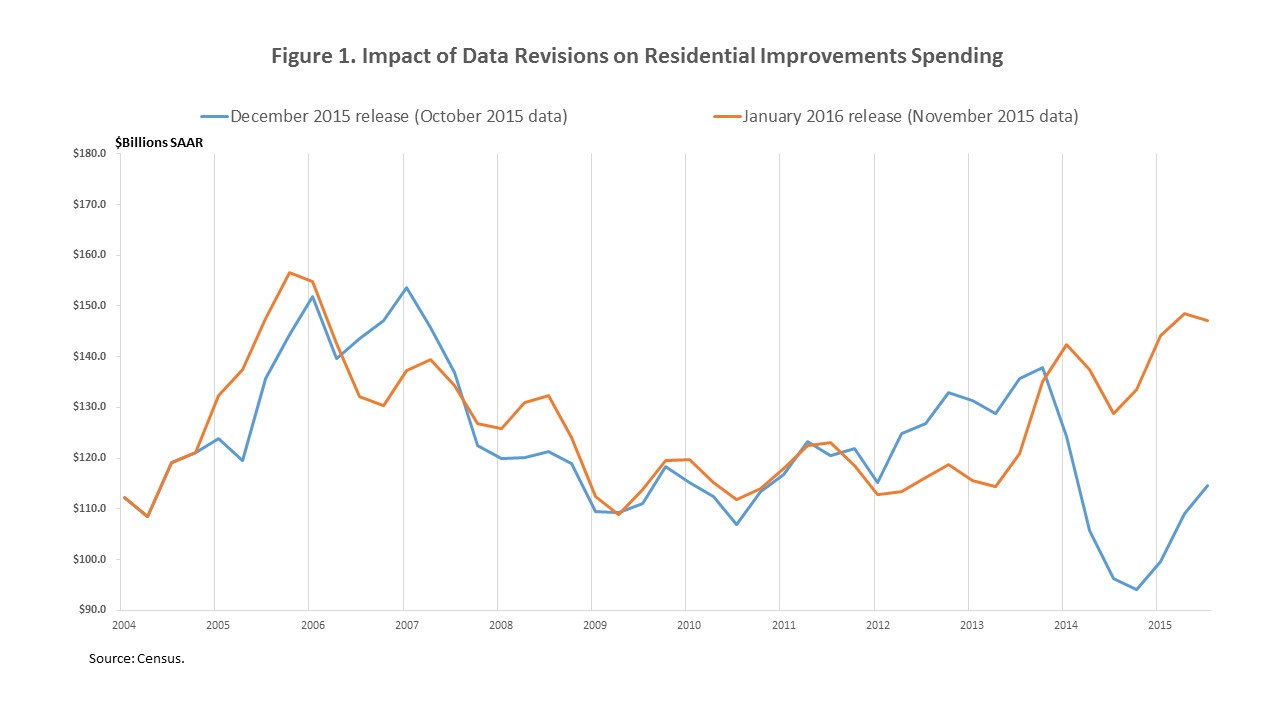
The most recent release of Census’ Construction Spending report included significant revisions to the residential improvements spending category. Residential improvements spending is calculated as the amount of total private residential spending on owner-occupied units after accounting for single-family and multifamily expenditures. As discussed in an earlier post, with these changes, the total amount of spending on residential improvements more closely tracks NAHB’s remodelers’ sentiment.

Presentation1

According to Census, in the January 2016 release of the Construction Spending report, which provides construction spending data up to November 2015, monthly and annual estimates for private residential, total private, total residential and total construction spending for January 2005 through October 2015 were revised to correct a processing error in the tabulation of data on private residential improvement spending.

As illustrated in Figure 1, which shows residential improvements spending measured at a seasonally adjusted annual rate for each quarter, the revised series diverged noticeably from the first quarter of 2012 onward. Between 2012 and the third quarter of 2013, the revised series shows a muted increase while the previous series rose more significantly. In addition, the previous residential improvements series exhibited a steep decline over 2014 with a partial recovery in 2015. In contrast, the 2014 decline in the revised series is shallower, of a shorter duration, and is erased by the first quarter of 2015.

Figure 1 indicates that the revisions to residential improvements spending were sizable, especially in 2014 and the first three quarters of 2015. Between 2012 and the third quarter of 2013, the December 2015 release of residential improvements spending was revised down by an average of $12 billion in each quarter by the January 2016 release. On average, each quarter of spending over this period was revised down by 9%. The largest revision in this period took place in the first quarter of 2013 when the $131.3 billion in residential improvements spending was revised down by 12% to $115.6 billion.


read more…


http://eyeonhousing.org/2016/01/the-impact-of-revisions-to-remodeling-spending/

Recovery Will Slow in 2016 as Fewer Homes Gain Value | Pound Ridge Real Estate

The number of homes nationwide gaining value on a monthly basis are expected to fall by 12 percent over the next 10 months as the housing recovery slows. Just over half, 51.3 percent, of America’s homes will continue to appreciate by October 2016, according to forecasts by Weiss Analytics.

The percentage of homes losing value nationwide are expected to decline, but fewer than the decline in appreciating homes.   Some 23.2 percent of homes are expected to depreciate on a monthly basis, a 6.4 percent drop from October 2015.

The forecasted decline in appreciating homes will continue a multi-year decline.  Since July 2014, the percentage of appreciating homes has fallen from 65.2 percent to 58.4 percent in October 2014 despite a 4.5 percent uptick in August.  The Weiss forecast predicts a 21 percent. decline over a 27-month period in the number of homes nationwide that are gaining value on a monthly basis.

Among the metros forecasted to be among the top ten appreciating markets in the nation by October 2016 are several that suffered some of the greatest losses in median home prices when the housing bubble burst in 2007.  These include Reno NV, forecast to have 98.3 percent of its homes appreciating on a monthly basis; Cape Coral-Fort Myers, FL, forecast to have 93 percent of homes appreciating; Stockton-Lodi, forecast to have 89.1 percent of homes appreciating; Phoenix-Mesa-Scottsdale, AZ, to have 84.4 percent of homes appreciating and Myrtle Beach-Conway-North Myrtle Beach, SC-NC, to have 83.3 percent of homes appreciating.

Metros that will have the lowest appreciation rates in October 2014 are all from the South and Midwest. Raleigh, NN will have the lowest appreciation rate of 1.2%.  Only 3,757 of the 306,901 Raleigh homes in the Weiss database will be gaining value on a monthly basis.

“During the past three years the recovery has generated year over year double digit annual price increases.[1] Our data and analytics show that the pace of change in home values is slowing down—both among homes that are losing value as well as those that have been appreciating.  This retrenchment may delay the return to price parity in some markets but it in others it will help to prevent the formation of bubbles of overvalued properties that could result in defaults,” said Allan Weiss, CEO and founder of Weiss Analytics and former CEO and co-founder of Case Shiller Weiss.


read more…


http://www.realestateeconomywatch.com/2015/12/recovery-will-slow-in-2016-as-fewer-homes-gain-value/

Mortgage rates average 3.97% | Pound Ridge Real Estate

today released the results of its Primary Mortgage Market Survey® (PMMS®), showing fixed mortgage rates ticking slightly higher for the second week in a row amid the Federal Reserve’s decision to raise short-term interest rates for the first time since 2006.

News Facts

  • 30-year fixed-rate mortgage (FRM) averaged 3.97 percent with an average 0.6 point for the week ending December 17, 2015, up from last week when it averaged 3.95 percent. A year ago at this time, the 30-year FRM averaged 3.80 percent.
  • 15-year FRM this week averaged 3.22 percent with an average 0.5 point, up from last week when it averaged 3.19 percent. A year ago at this time, the 15-year FRM averaged 3.09 percent.
  • 5-year Treasury-indexed hybrid adjustable-rate mortgage (ARM) averaged 3.03 percent this week with an average 0.4 point, unchanged from last week. A year ago, the 5-year ARM averaged 2.95 percent.
  • 1-year Treasury-indexed ARM averaged 2.67 percent this week with an average 0.2 point, up from 2.64 percent last week. At this time last year, the 1-year ARM averaged 2.38 percent.

Average commitment rates should be reported along with average fees and points to reflect the total upfront cost of obtaining the mortgage. Visit the following links for theRegional and National Mortgage Rate Details and Definitions. Borrowers may still pay closing costs which are not included in the survey.

As of January 1, 2016, the PMMS will no longer provide results for the 1-year ARM. Additionally, the regional breakouts will not be provided for the 30-year and 15-year fixed rate mortgages, and the
5/1 Hybrid ARM.

Quote
Attributed to Sean Becketti, chief economist, Freddie Mac.

“As was almost-universally expected, the Federal Open Market Committee (FOMC) of the Federal Reserve elected this week to raise short-term interest rates for the first time since 2006. We take the Fed at its word that monetary tightening in 2016 will be gradual, and we expect only a modest increase in longer-term rates. Mortgage rates will tick higher but remain at historically low levels in 2016. Home sales will remain strong, but refinance activity should cool somewhat. Novel policy approaches such as quantitative easing injected significant liquidity in the economy over the past seven years. As a result, the Fed is forced to employ some new tools, such as reverse repos, as it tightens monetary policy. We are likely to see some short-term volatility in fixed-income markets as market participants adjust to these new tools.”


Existing home sales drop 3.4% in October | Pound Ridge Real Estate

Existing home sales, as reported by the National Association of Realtors, decreased 3.4% in October, and the annual share of first-time buyers in 2015 fell to its second-lowest level since the survey was launched in 1981. Total existing home sales in October decreased to a seasonally adjusted rate of 5.36 million units combined for single-family homes, townhomes, condominiums and co-ops, down from 5.55 million units in September. October existing sales were up 3.9% from the same period a year ago.

Existing Home Sales October 2015

Existing sales were flat in the Northeast and fell 0.8% in the Midwest, 3.2% in the South 8.7% in the West. Year-over-year, all four regions increased, ranging from 8.6% in the Northeast and 8.3% in the Midwest to 2.7% in the West and 0.5% in the South.

Total housing inventory decreased by 2.3% in October, and is 4.5% below its level a year ago. At the current sales rate, the October unsold inventory represents 4.8-month supply, compared to a 4.7-month supply in September. One-third of homes sold in October were on the market for less than a month.

The distressed sales share fell to 6% in October, the lowest since the series began in October 2008. Distressed sales are defined as foreclosures and short sales sold at deep discounts. The October all-cash sales share remained unchanged at 24% in October, compared to 27% a year ago. Individual investors purchased a 13% share in October, unchanged from September but down from 15% during the same month a year ago.

The October median sales price of $219,600 declined to the lowest level since April, but was 5.8% above the same month a year ago, and represented the 44th consecutive month of year-over-year price increases. The median condominium/co-op price of $207,100 in October was up 1.6% from the same month a year ago.


read more…


http://eyeonhousing.org/2015/11/existing-sales-realign/

Porcelain ceramic tile is making a comeback | Pound Ridge Real Estate

For a home builder, the holy grail of materials is one that can do everything.

For a homeowner, the holy grail of materials is one that looks really good and requires no maintenance.

Such a material is now available but virtually unknown to most builders and homeowners in the United States.

It’s not a miracle of nanotechnology or even new. It’s that old workhorse, porcelain ceramic tile, updated with modern equipment and manufacturing processes to such a degree that it may change the look of suburbia as well as our notions of what constitutes a tile.

Manufacturers can now produce porcelain tiles that are huge (5-feet-by-11-feet), really thin ( 1 /8 – to ¼-inch thick) and absorb almost no water. This latter detail means that these big tiles will not crack in freezing temperatures and can be used indoors, outdoors in temperate climates such as the Washington area’s, and for an astonishingly broad range of applications. The tiles are also made in smaller sizes, though much larger than the 4-by-4-inch ones that are standard in so many bathrooms, and they can be nearly ¾-inch thick, depending on the intended use.

The tiles are marketed in the United States by Tennessee-based Crossville, which calls its tiles Laminam, and four Spanish manufacturers. Cosentino calls its product Dekton, Grespania’s version is Coverlam, Inalco’s is Itopkerand TheSize Surfaces’s is Neolith.

Because this type of porcelain tile is so new, the industry has not yet settled on a generic name. Two terms used by the National Tile Contractors Association are “thin porcelain panels” and “thin porcelain tile.”

In keeping with designers’ preference for a “soft” palette, the offerings of these firms favor grays, “greige” (a combination of beige and gray), light and dark brown, charcoal, cream and pure white. Some of the tiles are a solid color, but others mimic wood, concrete, textile patterns, metals and natural stone. The marble lookalikes resemble the real thing so closely that even experts can be fooled.

When you see these supersize tiles in someone’s house for the first time, “great looking tile” is not likely to be your initial reaction . In fact, you probably won’t even realize that you’re looking at tile until someone tips you off. Unlike small, traditional tiles with grout lines running everywhere, big tiles have hardly any grout lines, and the few that are there are nearly invisible.

The big tiles with solid colors present a tasteful, unusual finish; the natural stone lookalikes, especially the marble ones, are stunning. Though marble has a long history in American interiors, the individual tiles have been small. To see an entire counter made of what appears to be a single slab of high-quality Calacatta marble is eye-popping.

Once you know what to look for, where might you use the supersize tiles?

They can be used to finish walls as well as for flooring, countertops in the kitchen and bathrooms, kitchen sinks and fireplace surrounds. If you want to go really crazy, the thinnest tiles can be used to finish doors, tables, desks and stairs. Capitalizing on the unusually high heat resistance of the supersize tiles, the Spanish firm Inalco is experimenting with installing burners directly into the counter, which would eliminate the need for a separate cooktop. The tiles are extremely scratch and stain resistant. Spills do not have to be cleaned up right away, an appealing feature if you’re one to leave the kitchen cleanup until the next morning after your last dinner guest leaves at midnight.

Another plus with the large tiles in the kitchen is crack resistance. Traditionally manufactured tiles can crack when heavy objects are dropped on them. These porcelain tiles, however, are manufactured with a different process that makes them extremely crack resistant. As Jacobo Pardo of Grespania explained, as long as the tile is installed properly, “you can drop a large cast iron frying pan on the counter, no problem. If you drop a big cast iron pan on the floor, it won’t crack.”

In addition to their size, another difference between these tiles and traditional ones is their surface finish, which can vary from a soft matte to a highly reflective glossy (Cosentino’s Lorenzo Marquez said his firm’s “X-Glossy” finish is so polished “you can almost see your face [reflected in] a black or white Dekton surface.”) The tiles range from a smooth surface to a “gentle relief” that feels slightly irregular, “bush hammered” with a uniform nubby surface, and “hand tooled” with deeper gauges that appear to be hand made.

read more…

https://www.washingtonpost.com/realestate/porcelain-ceramic-tile-is-making-a-comeback/2015/11/11/9da19fe8-8265-11e5-8ba6-cec48b74b2a7_story.html

How to reach the #Millennial first-time homebuyer | Pound Ridge Real Estate

The news is no longer “Millennials don’t want to buy homes.”

They do. So how are you going to get them there?

HousingWire hosted its first editorial webinar on Wednesday, with expert panelists Ginger Wilcox, chief industry officer with Sindeo, Joe Caltabiano, senior vice president of Mortgage Lending with Guaranteed Rate and Tim Anderson director of eServices withDocMagic to answer the question.

The topic: How to reach the Millennial first-time homebuyer. Here’s a direct link to purchase the webinar presentation.

The three bring over 60 years of experience in all aspects of the industry and gave a full range of tips on what does and doesn’t work when it comes to reaching Millennials.

Wilcox explained how the industry can better understand Millennials, giving her tips and insight on what does and doesn’t move them, along with their heightened need for transparency.

She gave the example that Millennials are living in a world of radical transparency, noting that we know the exact geographical location of out Uber driver and the exact status of our Dominos pizza in the creation process.

Meanwhile, Caltabiano dug into the issues that are creating a roadblock for Millennials, noting the importance of educating them on what is actually true.

While they are going online first to do their own research, he explained that the industry needs to make sure Millennials are looking at the latest information.

The market is changing on a daily basis, and it’s easy for someone to pull information from an outdated source.

Caltabiano stressed to loan officers who are marketing to young homeowners the importance knowing all the options out there for their clients, ranging anywhere from down payment options to loan options.

DocMagic wrapped up the webinar, touching on the rules and regulations that are consuming the industry.

With eMortgages becoming more normal, lenders need to be aware of what this looks like from the start to closing of the loan, along with how to approach Millennials about the change.


read more…


http://www.housingwire.com/blogs/1-rewired/post/35486-heres-how-to-reach-the-millennial-first-time-homebuyer?eid=311691494&bid=1221341