via blog.hubspot.com

Many pundits believe that now is a good time to buy a home. Interest rates are low and are predicted to be higher by the end of next year. Home prices are still low in many places. And, there are indications that prices are starting to rise, at least in major metropolitan areas. From June to July, the S&P/Case-Shiller Home Price Index rose 1.6 percent in 20 big cities in the nation.
Although buyers are clamoring to buy, don’t make the mistake of buying now just because many people are house hunting. Before jumping into the fray, ask yourself the following questions:
1. Are you prepared for the responsibilities and risks of homeownership?
Unlike renting, where the landlord usually pays for maintaining the property, you are responsible for repairs when you own. And, it’s ongoing.
Most buyers don’t factor in the cost and time of maintenance into their home buying decision. It’s a must to keep up on maintenance for your personal enjoyment of the property and to protect its value. Deferred maintenance can diminish your net proceeds when you sell.
HOUSE HUNTING TIP: Buying is a more permanent commitment than renting. Real property is not a liquid asset. You can’t cash in a home like you can a bond or stocks. You shouldn’t buy if you don’t plan on staying in your home for a reasonable period of time, say five to 10 years. If you’re not forced to sell your home in a down market, you can avoid a loss.
2. Can you afford to buy a home with the amenities you need in a location where you want to live?
Contact a mortgage broker or loan agent to find out how much you can afford to pay. Then, consider your personal financial situation and determine how much you feel comfortable paying. In some places, it’s actually less expensive to own than to rent a home because rents have skyrocketed. And, there are tax benefits associated with owning your home that aren’t available to renters.
Once you know how much you are able and willing to pay, find out what sort of housing is available in neighborhoods where you’d like to live. You can do some of this research on the Internet. Search by area to see what’s available in your price range. Attend Sunday open houses to get a feel for what kind of home you can expect to buy.
3. Are you willing to compromise?
The perfect home does not exist. So, you will have to compromise to some extent. Make a list of the features you need and want in a home. Then prioritize the list. For example, you may want to have four bedrooms but can live with three if the home has the other essentials you need.
4. Are you willing to take the time and make the effort to carry out due diligence investigations in order to ensure that you make a wise purchase decision?
You can’t delegate this important step to someone else. A good real estate agent will help you make good choices. However, you are the decision-maker.
In addition to having the property thoroughly inspected by qualified inspectors, you need to find out if there is any reason why you shouldn’t buy a property you’re considering. Is there any change in the neighborhood that will impact its value, like a freeway due to be built nearby that will create a noise nuisance? Try to keep your emotions in check and don’t dismiss negative news about the home you love, or pay too much.
THE CLOSING: Homebuying is a lot of work and can be stressful. The benefit is that you will be master of your own domain, which could increase in value over time and improve your net worth when you sell.
As Paul Ryan and Joe Biden crisscross the country discussing health care, jobs and the economy, they’re campaigning for more than the vice presidency. They’re also entrenched in a battle for the right to reside at Number One Observatory Circle.
While tourists flock to 1600 Pennsylvania Ave. to check out public portions of the president’s abode, the vice president’s residence is not open for public tours. The 9,150-square-foot, three-story Victorian home was built in 1893 for the superintendent of the United States Naval Observatory. The home was so impressive that, in 1929, the chief of naval operations booted the superintendent so he could live there himself.
New addition
A dedicated home for the vice president is actually a rather new phenomenon. In 1789, John Adams became the nation’s first vice president; for the next 185 years, VPs and their families lived in their own homes or, on occasion, lavish hotel suites. The associated costs and security logistics made this custom increasingly impractical.
Finally, in 1974, Congress voted to make the house at the Naval Observatory the official vice president’s residence.
President Ronald Reagan and First Lady Nancy Reagan visit Vice President George H. W. Bush and Second Lady Barbara Bush in the VP residence. Source: Wikipedia
It took another three years before a vice president actually moved into the home. Vice President Gerald Ford became President Ford before he could use it; his vice president, Nelson Rockefeller, already had a lavish Washington, DC home and never used the house as his residence, although he did host several parties there. Rockefeller’s enormous wealth enabled him to donate millions of dollars worth of furnishings to the home.
Walter Mondale was the first vice president to move into the home. It has since housed the families of Vice Presidents Bush, Quayle, Gore, Cheney and Biden. Each new resident of the White House is offered a $100,000 decorating stipend, and additional funds are raised privately. There’s no such allowance for vice presidents; donations to the nonprofit Vice President’s Residence Foundation pay for decorating expenses.
Personal touches
During the Dan and Marilyn Quayle years, foundation funds were used to add a swimming pool and carry out renovations that made the property wheelchair accessible.
Al and Tipper Gore moved into the mansion with four children — one in college and three still at home — and three dogs.
The Gores worked with two well-known designers to update the home: Albert Hadley for the interiors and Ben Page for the gardens. The Gores gravitated toward warm yellows and reds. They used the house to showcase an eclectic collection of antiques, some they brought with them, some borrowed from the State Department. Still other furniture belongs to the residence, including an Empire dining room table donated by Rockefeller and American crafts collected by Joan Mondale. The Gores also had hedges planted around the home so it wasn’t so visible from the street and worked to replace non-indigenous species on the 72-acre grounds with native plants.
The entry foyer at Number One Observatory Circle. Lynne Cheney gives a tour of the Naval Observatory. Source: Wikipedia
Dick and Lynne Cheney preferred a palette that was clean and light: pale celadon, taupe, off-white. Washington designer Frank Babb Randolph guided them through the process of reupholstering furniture, shopping for rugs and creating custom window treatments. Veeps and their families are allowed to borrow artwork from national galleries and museums; Lynne Cheney, in particular, relished this privilege and did most of her “shopping” at the Smithsonian’s Hirshhorn Museum.
As for the most recent resident of One Observatory Circle, Vice President Biden is said to be particularly fond of the home’s outdoor entertaining areas. Chatting with reporters prior to an April 2010 luncheon with foreign leaders, Biden quipped that he’d never have anything bad to say about Quayle, his often-mocked predecessor, because Quayle was responsible for having the pool installed at the vice presidential estate.
His marriage to Angelina Jolie only lasted three years, but Billy Bob Thornton lasted much longer with the home he shared with his former wife.
The “Sling Blade” screenwriter and star stayed on for another nine years before listing the Spanish-style home at 801 N Roxbury Dr, Beverly Hills, CA 90210 for $9.995 million. Thornton’s home has been on the market two days and is being shown by appointment only.
According to the Los Angeles Times, Thornton and Jolie purchased the 11,000-square-foot home in 2000 for $3.75 million from Guns N’ Roses guitarist Slash. The blood-bonded couple split in 2003, but the quirky actor/writer/blues musician stayed around, making use of the property’s 9-bedroom, 10-bathroom sprawl and its in-home recording studio.
In addition to a grand, two-story living room, enormous dining room and kitchen, the compound includes a pool, tennis court, paddle tennis court, gym and library.
Billy Bob has moved on in love, too. While Angelina and her fiance, Brad Pitt, have six kids, Thornton has one daughter with longtime girlfriend Connie Angland, whom the five-times-married Thornton said he will try to not marry to avoid jinxing the relationship.
In another positive sign for the housing market, the nation’s so-called shadow inventory of properties in the foreclosure pipeline fell by more than 10 percent in July from the same period a year before, CoreLogic reported Tuesday.
The tracking firm in Irvine, Calif., said the number of housing units in jeopardy of foreclosure — or that lenders have repossessed but not yet listed for sale — dropped to 2.3 million this July from 2.6 million a year earlier.
“This is yet another hopeful sign that the housing market is slowly healing,” said Anand Nallathambi, president and CEO of CoreLogic.
The report should be welcome news for homeowners worried that a wave of foreclosure sales might further depress housing values.
The real estate market generally has been on the path toward recovery this year, with home prices pressed upward by the low inventory of homes for sale and by record-low 30-year mortgage rates, now below 4 percent.
Experts have pointed to the shadow inventory as a potential threat to the fledgling upturn. Large numbers of foreclosed homes hitting the market could drive prices down.
The improving economy and alternatives to foreclosure, including short sales and loan modifications, have helped prevent homes from becoming part of the shadow inventory.
CoreLogic s calculates the shadow inventory by adding the number of homes in foreclosure and those that are bank-owned but not yet for sale. Homes where
Advertisementowners are 90 days or more past due on their payments also are included.
All told, the shadow inventory in the United States was worth about $382 billion as of July, the firm estimated. That’s down from $397 billion a year ago, it said.
Forty-five percent of all distressed properties are in five states: California, Florida, Illinois, New York and New Jersey, CoreLogic reported.
Utilities are a hidden cost: You know you’ll need to plan for them, but when you’re looking for an apartment, they’re not at the top of your mind. So, before you sign that lease, make sure you can pay all your rental expenses, not just rent. It won’t be much fun to sit in a cold apartment, hunting for a neighbor’s unsecured Internet connection, because you forgot to budget for utilities.
Here are some rough rules of thumb for estimating how much you should expect to pay for various utilities:
Electricity
During winter months, or if you don’t use air conditioning, expect to pay $30-$50 a month for electricity. A lot of your bill will simply depend on how much you’re home, how much you watch television (tube TVs are big electricity drains), how efficient your refrigerator is and how careful you are about turning off lights.
Air conditioning
On average, expect to pay about $250-$300 per year for air conditioning. That said, air conditioning isn’t an evenly-distributed expense: Most people only use it about three to five months a year. And, in some places, like Minnesota or Maine, you may only use it a few times a summer, which makes it a much smaller expense.
If you live in a place with average weather, you’ll be running your A/C May-September and spending about $50-$80 a month extra on your electric bill. However, if you live in a really hot place, like Phoenix or Dallas, you’re going to be paying a lot more per month, for more months — $80-$90 a month (plus regular electricity costs), for eight months a year. So keep that in mind. Your silver lining is that you don’t have to worry much about heating costs.
Heat
If you are in a multi-unit building with radiators, there will almost certainly be no extra charge for heat. The landlord will pay the building’s heating bill in total and build that cost into the rent. However, if you and some friends team up and rent a house, you’ll be on the hook for keeping an oil burner going for heat and hot water, which could cost more than $300 a month. If you have gas or forced-air heating expect to pay at least $100 a month in the deep winter, though the cost can vary. One good way to find out what to expect is simply to ask the landlord or a previous tenant.
Cooking gas
In some buildings, if you have a gas range, you’ll have to pay for the natural gas that you use during cooking. (And in some buildings, the natural gas will also provide your heat.) With cooking, the cost is minimal — $15 a month at most, usually quite a lot less. It really all depends how much you cook at home.
Internet
Monthly, expect to pay about $45. Keep in mind that you can split the cost with as many other people as are using your connection, so if you have two roommates, that’s only $15 a person per month. The other thing to consider is bundling your Internet with your cable. You can often get a deal that way, if you decide you want cable.
Cable
This is an optional expense. With the new high-definition televisions, and their digital antennae, it’s easy to get great reception on network TV, and then you can use online streaming services for the rest of your needs. This will cost you about $20 a month, if you subscribe to two services.
If you want cable, look for a deal. They come along frequently and can save you some money. But be careful; companies often have add-ons like free premium channels for three months, which will then be charged to your account if you don’t cancel when the preliminary deal expires. So make sure to keep an eye on your account, so you know what you’re being charged for. While it’s nice to have cable, and you can usually find introductory deals that include cable and Internet for about $90 a month, it’s still a lot of money compared to using a streaming service or two for about $20 a month.
Renter’s insurance
Finally, always get renter’s insurance. You never know what may happen, and it’s very affordable, at only about $150 a year. If your apartment is burglarized, you’ll be very thankful you have it.
Total bill
If you skip the cable, your total utilities cost comes to roughly $200 a month. Keep in mind, though, that this is for the rental as a whole — if you have roommates, divide by the number of people living in the unit. Of course, if you have a very large apartment (say for four people or more) or you are renting a house, the heat, electricity and A/C will be higher, so add 20-30 percent to the estimate, and then divide.
As a rough rule of thumb, expect to spend on utilities an amount equal to about 20 percent of your monthly rent if you live alone, or about 10 percent of your monthly rent if you live with roommates.
via zillow.com
A top Senate Democrat on Tuesday said new tax revenues should go to reducing the federal deficit, not cutting tax rates, dismissing as “obsolete” a Reagan-era model of tax reform.
Senator Charles Schumer, hardening his party’s negotiating position ahead of talks on the so-called “fiscal cliff,” declared President Ronald Reagan’s 1986 tax reform an unaffordable model for overhauling the tax laws.
U.S. tax policy experts have long advocated Reagan’s approach of “revenue neutrality,” or using new government revenues from closing tax loopholes to pay for tax rate cuts.
Schumer urged devoting new revenues wholly to deficit reduction instead, and advocated raising tax rates on the rich in any deal to avoid the fiscal cliff approaching at year-end.
“Tax reform 25 years ago was revenue-neutral. It did not strive to cut the debt. Today, we can’t afford for it not to,” Schumer said in a speech at the National Press Club.
“It would be a huge mistake to take the dollars we gain from closing loopholes and put them into reducing rates for the highest income brackets, rather than into reducing the deficit.”
Two Democratic Senate aides said the speech was an attempt by Democrats to harden their position ahead of “fiscal cliff” negotiations set to get under way after the November 6 elections.
Republican Senator Orrin Hatch blasted Schumer’s comments, and criticized Democrats, saying in a statement that their “default position” is to raise taxes.
‘CLIFF’ AHEAD
At the end of the year, several urgent fiscal issues will converge, including the expiration of lowered individual income tax rates enacted a decade ago under President George W. Bush.
The Bush tax cuts were due to expire at the end of 2010, but Obama and Congress agreed to extend them for two years to prevent damage to the economy.
In addition, $100 billion in automatic federal spending cuts will take effect unless Congress acts. Combined, these events could push the economy into a recession, studies have forecast.
Decisions on the “fiscal cliff” will be strongly influenced by the outcome of the elections, of course, and will be a proving ground for Congress’ ability to tackle a potentially more fundamental tax code overhaul, perhaps in 2013.
The tax code has not been overhauled thoroughly in 26 years since Reagan and a divided Congress managed to do it. Ever since, the Reagan reforms have been seen as a model, with “revenue neutrality” being their central feature.
Schumer said that model is outdated. “In the upcoming talks on the fiscal cliff, we ought to scrap it,” Schumer said.
If applied today, revenue neutrality would inevitably hurt the middle-class by forcing curtailment of tax breaks dear to average Americans, he said.
“A 1986-style approach that promises upfront rate cuts to the wealthy is almost guaranteed to give middle-income earners the short end of the stick,” said Schumer, the third most senior Democrat in the Senate.
OVERHAUL NEEDED
Both President Barack Obama and Republican challenger Mitt Romney say taxes need an overhaul, but disagree on details.
Obama backs raising individual income tax rates on the wealthy by letting their Bush tax cuts expire, but extending the Bush tax cuts for the middle class. He has also presented a detailed plan on corporate tax breaks he wants to kill.
The president also wants to raise the tax rates on dividends and on capital gains for the two highest income tax brackets.
Neither Obama nor Romney has presented specifics on what to do with the costliest tax breaks such as the mortgage interest and charitable donation deductions, although both have discussed the possibility of capping deductions at some level.
Romney has called for a 20 percent across the board cut in all tax rates, as well as eliminating the estate tax and the alternative minimum tax – changes that would help the wealthy.
But Romney has also said he will not reduce the share of taxes paid by the wealthy. He has said he will pay for his tax cuts by ending tax breaks, but he has not said which ones.
BIPARTISAN APPROACH?
Clint Stretch, a former congressional staffer on budget issues and former top tax lobbyist, says Schumer is right to caution that middle class tax breaks may be in jeopardy.
“If you don’t raise taxes you’ll have to get rid of a lot of federal programs very important to the middle class,” he said.
Schumer said he backs efforts by a bipartisan group of senators known as the “Gang of Eight.” This group met again on Tuesday to discuss a possible deal on the deficit. Such meetings have been going on for years, with no solid results, aides said.
The group of four Democrats and four Republicans ranges from liberals to some of the most fiscally conservative lawmakers.
Operating outside of the formal tax-writing committees and party leadership, the lawmakers have been trying to forge a broad deficit-cutting plan that could include new revenue, a prospect that many in the Republican party adamantly oppose.
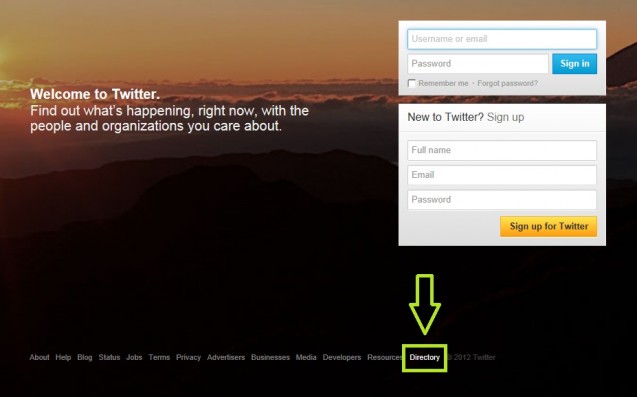
- In a world where altruistic social gathering doesn’t pay the bills, Twitter continues to make changes that it hopes will drive more traffic directly to the Twitter domain and bolster its value to advertisers. The most recent update comes in the form of an alphabetical user directory. The link to the directory was quietly added to the the default home page for visitors to Twitter not already logged into the service.
According to Matt McGee in his recent article for Marketing Land:
Twitter launched the user directory a few weeks ago, but hasn’t made a formal announcement about it. That’s likely because it exists more for search engines than for Twitter users.
Basically, Twitter is aiming to draw people who are searching Google, Bing, Yahoo, etc., for someone in particular. As the bots crawl their way through the new directory, more Twitter profiles should start showing up in search. That’s a step in the right direction, maybe.
Twitter is still struggling with the basic issue of no real reason to spend lots of time hanging out in the Twitter Web space. Users spend the most time on Twitter setting up their profile. Once it’s set, they either build up a personalized twitter stream that they keep track of on a mobile app or some other Twitter client application, or they never really get the point and let the profile languish, unused.
Even when a search result brings a user back to the Twitter domain, the realistic expectation is that they will skim the profile, make a decision to follow or not, and move on.
For those of you who love the news, information, and conversation constantly buzzing through your Twitter stream, what could Twitter do to make its space more appealing? What would it take for you to spend your time interacting with the twitterverse in the Twitter-owned domain?36