Category Archives: Pound Ridge

Home Price Index rises 5.9% | Pound Ridge Real Estate

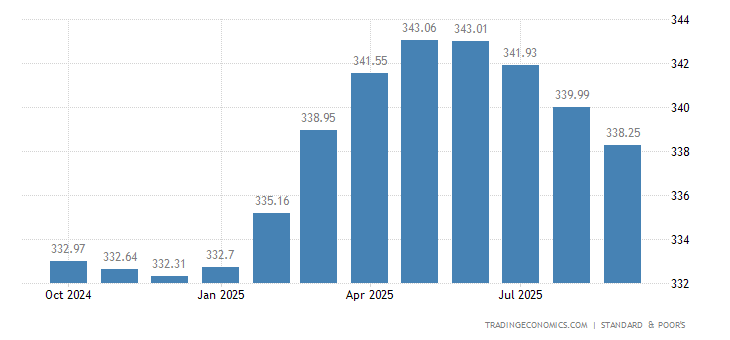
The S&P CoreLogic Case-Shiller composite index of 20 metropolitan areas in the US rose 5.9 percent year-on-year in March of 2017, the same as in February and above market expectations of following a 5.7 percent gain. Prices rose the most in Seattle (12.3 percent), Portland (9.2 percent) and Dallas (8.6 percent). Meanwhile, the national index, covering all nine US census divisions rose 5.8 percent, up from 5.7 percent in February and setting a 33-month high. Case Shiller Home Price Index in the United States averaged 158.44 Index Points from 2000 until 2017, reaching an all time high of 206.52 Index Points in July of 2006 and a record low of 100 Index Points in January of 2000.

United States S&P Case-Shiller Home Price Index
CalendarGMTReferenceActualPreviousConsensusForecast (i)
2017-04-2501:00 PMFeb0.4%0.2%0.2%
2017-05-3001:00 PMMar5.9%5.9%5.7%5.8%
2017-05-3001:00 PMMar1%0.4%0.3%
2017-06-2601:00 PMApr5.9%
2017-06-2601:00 PMApr1%
2017-07-2701:00 PMMay


United States HousingLastPreviousHighestLowestUnit
Building Permits1228.001260.002419.00513.00Thousand[+]
Housing Starts1172.001203.002494.00478.00Thousand[+]
New Home Sales569.00642.001389.00270.00Thousand[+]
Pending Home Sales0.802.6030.90-24.30percent[+]
Existing Home Sales5570.005700.007250.001370.00Thousand[+]
Construction Spending-0.201.805.90-4.80percent[+]
Housing Index0.600.801.20-1.70percent[+]
Nahb Housing Market Index70.0068.0078.008.00[+]
Mortgage Rate4.174.2310.563.47percent[+]
Mortgage Applications4.40-4.1049.10-38.80percent[+]
Home Ownership Rate63.6063.7069.2062.90percent[+]
Case Shiller Home Price Index195.39193.50206.52100.00Index Points[+]

6 Food Trucks to Book for Your Wedding | Pound Ridge Real Estate

With so many events – engagement parties, showers, rehearsal dinners, after parties and send-off brunches – associated with your wedding day, food trucks are the perfect mobile way to break out of a catering rut, or the use of white tablecloth bulk for your table’s decoration at your wedding. Six of our favorites offer a variety of cuisines and services perfect for all your events, or even the big day itself.

Melt Mobile

Based in Stamford, this duo of trucks offers seven grilled cheeses, plus sweet dessert melts.

The Menu: Rentals include the full menu (from the original to the jalapeno popper to the pulled pork with caramelized onions and pickles), plus any daily specials.

The Cost: Main service is $25/person; end-of-night service is $400 plus consumption. Bookings more than 1 hour from Stamford incur a $250 travel fee.

Test it Out: Follow Melt Mobile on facebook for a weekly list of locations.

Book it: www.melt-mobile.com

Walter’s Hot Dog Truck

Mamaroneck’s iconic hot-dog stand now has a small fleet of trucks serving its most popular standards.

The Menu: Customers can pick and choose which dishes (hot dogs, fries, potato puffs, ice cream, and homemade Italian ices, to name a few) they’d like to offer.

Cost: Starts at $1000 and varies based on the menu

Test it Out: The truck is at the White Plains Farmers’ Market on Wednesdays (10 a.m. to 4 p.m.) until November.

Book it: www.waltershotdogs.com/truck

The Cookery’s DoughNation

Chef David DiBari’s Dobbs Ferry pizza truck serves original interpretations of Neapolitan-style pies.

The Menu: Five pies: Margherita; Cookery meatball with silky ricotta; four cheese drizzled with chili honey; Brussels sprouts and bacon; and fresh lemon with scamorza and basil.

The Cost: Prices range from $1,200 (up to 50 guests) to $2,700 (up to 200 guests)

Test it Out: Find it at farmers’ markets in Irvington, Hastings-on-Hudson, and Chappaqua.

Book it: www.thecookerysdoughnation.com; only available April to November within 65 miles of Dobbs Ferry.

Frites of NY

Party of Two Catering operates this popular Hudson Valley-based truck specializing in fries tossed with flavorful seasonings or smothered in creative toppings.

The Menu: Choose from three options. The Basic Party (two hours of service, choose three menu items from more than 15 options) and the After Party (one hour of service, choose from seven options) both feature all-you-can-eat topped fries. The Toss Up is a pay-by-the-hour service and only includes tossed fries.

Cost: The Basic Party, $14 per guest; the After Party, $7 per guest; the Toss Up, $5 per guest per hour.

Test it Out: Follow Frites of NY on Facebook to find the truck at events.

Book it: www.fritesofny.com; truck is not permitted in Rockland, Greene or Albany counties.

The Souvlaki Truck

Greek street food (and thick-cut oregano fries) is the big draw for this Yonkers truck.

The Menu: Choose from Vending Style (guests order individually) or Buffet Style (setup of trays), to bring chicken souvlaki, pork souvlaki, lamb gyro, falafel, and fries to your guests.

The Cost: Vending style charges a truck rental fee (starts at $500) plus consumption; Buffet Style, $1,000 up to 50 guests, then $15 per guest.

Test it Out: The truck parks on Central Ave in Yonkers (between Fort Hill Ave and Ardsley Rd) Tuesday through Sunday.

Book it: www.souvlakitruck.com

Bona Bona Truck

The sweetest way to cap the night? How about a few scoops Nick DiBona’s popular, locally made ice cream.

The Menu: Scoops (cups or cones), sundaes, and shakes in flavors like rainbow cookie and cannoli, plus plenty of whipped cream, sauces, and sprinkles.

The Cost: $350 truck-rental fee plus per person fees $6-$13 (depending on the menu)

Test it Out: Follow Bona Bona Ice Cream Truck on Facebook to find it at events.

Book it: www.bonabonaicecream.com; only available within 20 miles of Larchmont

read more…

6 Food Trucks to Book for Your Wedding

Mortgage rates average 4.05% | Pound Ridge Real Estate

Freddie Mac (OTCQB: FMCC) today released the results of its Primary Mortgage Market Survey® (PMMS®), showing the 30-year mortgage rate hovering around 4 percent for the fourth consecutive week.

News Facts

  • 30-year fixed-rate mortgage (FRM) averaged 4.05 percent with an average 0.5 point for the week ending May 11, 2017, up from last week when it averaged 4.02 percent. A year ago at this time, the 30-year FRM averaged 3.57 percent.
  • 15-year FRM this week averaged 3.29 percent with an average 0.5 point, up from last week when it averaged 3.27 percent. A year ago at this time, the 15-year FRM averaged 2.81 percent.
  • 5-year Treasury-indexed hybrid adjustable-rate mortgage (ARM) averaged 3.14 percent this week with an average 0.5 point, up from last week when it averaged 3.13 percent. A year ago, the 5-year ARM averaged 2.78 percent.

Average commitment rates should be reported along with average fees and points to reflect the total upfront cost of obtaining the mortgage. Visit the following link for the Definitions. Borrowers may still pay closing costs which are not included in the survey.

Quote
Attributed to Sean Becketti, chief economist, Freddie Mac.

“The 10-year Treasury yield jumped 8 basis points this week while the 30-year mortgage rate rose 3 basis points to 4.05 percent. Mixed economic reports over the last few weeks have anchored the 30-year mortgage rate around the 4 percent mark.”

Apartment and Condominium Market Momentum Continues | Pound Ridge Real Estate

The National Association of Home Builders’ Multifamily Production Index (MPI) increased two points to 55 in the fourth quarter of 2016. For five straight years, the MPI has been at or above 50, which indicates that more respondents report conditions are improving than report conditions are getting worse (Figure 1).

Figure 1: NAHB Multifamily Production Index (MPI) and Multifamily Starts (in thousands)

The MPI is a composite measure of three key segments of the multifamily housing market: construction of low-rent units, market-rate rental units and “for-sale” units, or condominiums. In the fourth quarter, low-rent units remained unchanged at 54 while market-rate rental units rose one point to 58 and for-sale units increased three points to 53.

The Multifamily Vacancy Index (MVI), which measures the multifamily housing industry’s perception of vacancies, remained unchanged at 42, with lower numbers indicating fewer vacancies (Figure 2).

Figure 2: NAHB Multifamily Vacancy Index (MVI) and 5+ Rental Vacancy Rate

After peaking at 70 in the second quarter of 2009, the MVI improved consistently through 2010 and has been fairly stable since 2011. Historically, the MVI has shown to be a leading indicator of Census multifamily vacancy rates, which is displayed in Figure 2 as well.


read more…


http://eyeonhousing.org/2017/02/apartment-and-condominium-market-momentum-continues/

Builders Satisfy Demand for Open Floor Plans | Pound Ridge Real Estate

According to a recent NAHB article, open floor plans are popular among home buyers, and the design of new single-family homes tends to be, if anything, even more open. For example, in a 2015 NAHB survey, 70 percent of recent and prospective homebuyers said they preferred a home with either a completely or partially open kitchen-family room arrangement with 32 percent preferring the arrangement completely open).

When a similar question was asked in the September 2016 survey for the NAHB/Wells Fargo Housing Market Index, an even higher 84 percent of builders said that, in the typical single-family homes they build, the kitchen-family room arrangement is completely or partially open. Over half (54 percent) said it is completely open. Both surveys defined completely open as essentially combining two areas into the same room, and partially open as areas separated by a partial wall, counter, arch, or something else less than a full wall.

Of the remaining possibilities, 16 percent of buyers want the kitchen and family rooms in separate areas of the house, and 6 percent of builders say this is how their typical homes are designed. Eleven percent of buyers want the two areas side-by-side but separated by a wall, while only 2 percent of builders design their typical homes this way. And 4 percent of buyers prefer a home without a family room, while 9 percent of builders do not include a family room in their typical homes. If you are thinking about a home and flooring DIY project you can learn how you can make your house prettier.

The same surveys show that 45 percent of home buyers favor a completely open kitchen and dining area arrangement, while an even higher 51 percent of builders design their typical single-family homes this way.

However, 41 percent of buyers want a home with a kitchen and dining area that are partially open to each other, while only 24 percent of builders design their typical homes this way. As a result, the 86 percent of buyers who want either a completely or partially open kitchen and dining area is actually higher than the 75 percent of builders who provide the completely or partially open design. This occurs in part because 12 percent of builders locate the kitchen and dining rooms in separate areas of the house, while only 3 percent of buyers say they want their homes this way

There are no hard data on the openness of floor plans in existing homes. However, in the survey for the first quarter 2016 Remodeling Market Index, professional remodelers reported that 40 percent of their projects involved making the floor plan more open by removing interior walls/pillars/arches, etc., indicating that the floor plans of existing homes are often not as open as their owners would like.

read more…

http://eyeonhousing.org/2017/01/builders-satisfy-demand-for-open-floor-plans/

High End New Homes | Pound Ridge Real Estate

In 2015, a total of 1,762 homes were started for sale with a price of $1 million or more according to the Census Bureau’s Survey of Construction. New homes started for sale with a price of $ 1 million or more decreased as a share in absolute number in 2015. That number was significantly lower than in 2013 (3,347 homes) and 2014 (3,019). Previous posts have discussed the upward trend in the median and average size of new single-family homes and how part of this is likely due to a historically atypical mix of buyers in the market.

chart1

In 2005, the number of new homes at this price reached a peak of 5,647 units. In the boom year of 2006, 4,966 new homes started were million dollar homes built for sale. In 2007, only 2,449 such homes were started followed by 1,028 homes in 2008. From 2009 to 2012, fewer than 1,000 of these $1 million+ homes were started every year.


read more…


http://eyeonhousing.org/2016/11/high-end-new-homes/

Mortgage rates average 4.03% | Pound Ridge Real Estate

Freddie Mac (OTCQB: FMCC) today released the results of its Primary Mortgage Market Survey® (PMMS®), showing average fixed mortgage rates moving higher with the average 30-year fixed-rate mortgage topping 4 percent for the first time since 2015.

News Facts

  • 30-year fixed-rate mortgage (FRM) averaged 4.03 percent with an average 0.5 point for the week ending November 23, 2016, up from last week when it averaged 3.94 percent. A year ago at this time, the 30-year FRM averaged 3.95 percent.
  • 15-year FRM this week averaged 3.25 percent with an average 0.5 point, up from last week when it averaged 3.14 percent. A year ago at this time, the 15-year FRM averaged 3.18 percent.
  • 5-year Treasury-indexed hybrid adjustable-rate mortgage (ARM) averaged 3.12 percent this week with an average 0.4 point, up from last week when it averaged 3.07 percent. A year ago, the 5-year ARM averaged 3.01 percent.

Average commitment rates should be reported along with average fees and points to reflect the total upfront cost of obtaining the mortgage. Visit the following link for the Definitions. Borrowers may still pay closing costs which are not included in the survey.

Quote
Attributed to Sean Becketti, chief economist, Freddie Mac.

“In a short week leading up to the Thanksgiving holiday, the 10-year Treasury yield rose 8 basis points. The 30-year mortgage rate followed suit, rising 9 basis points to 4.03 percent. This increase marks the first week since 2015 that mortgage rates have risen above 4 percent.”

US existing sales increase 2% | Pound Ridge Real Estate

Sales of previously owned houses in the United States rose 2 percent to a seasonally adjusted annual rate of 5600 thousand in October of 2016. It is the highest figure since February of 2007, beating market expectations of a 0.5 percent fall or 5430 thousand. Sales of single family homes went up 2.3 percent to 4990 thousand while those of condos were flat at 610 thousand. The average price fell 1 percent and the months’ worth of supply went down to 4.3 from 4.4. Existing Home Sales in the United States averaged 3881.83 Thousand from 1968 until 2016, reaching an all time high of 7250 Thousand in September of 2005 and a record low of 1370 Thousand in March of 1970. Existing Home Sales in the United States is reported by the National Association of Realtors.


read more…


http://www.tradingeconomics.com/united-states/existing-home-sales


Housing in a soft patch | Pound Ridge Real Estate

Rising mortgage rates, overheating home prices, nothing for sale, pre-election jitters — the list of reasons to lose confidence in the housing market is growing.

In fact, the share of consumers who think now is a good time to buy a home fell 5 percentage points in September in a monthly housing sentiment survey (known as HPSI) by Fannie Mae. The only drop that was bigger was the share of consumers who think mortgage rates will fall.

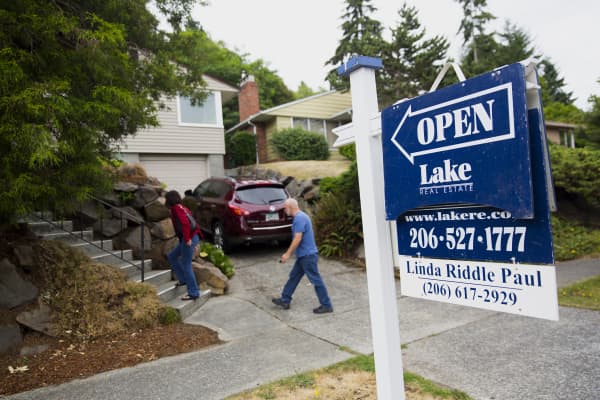
Potential home buyers attend an open house in the Seattle, Washington.

“The decline in the HPSI over the past two months from the survey-high in July … adds a note of caution to our moderately positive housing outlook,” said Doug Duncan, senior vice president and chief economist at Fannie Mae. “The starter home tight supply and rising home prices as well as the unsettled political environment are likely giving many consumers a reason to pause or question their home purchase sentiment.”

The September employment report was mixed for housing. Wage growth is strengthening, but not as much as home price growth. Construction jobs increased, suggesting more housing supply in the future, but housing starts for single-family homes are not exactly robust. Construction spending fell in August and July’s numbers were revised down.

“A blah September jobs report gives no impetus for anything on the economy’s to do list: There’s no sign of an overheating economy that would justify a rate hike; no groundswell of construction hiring that would finally hint at a return to a normal pace of housing starts; no big wage gains that would give hope for renewed productivity gains. Just a stubbornly average report at a time when the economy is looking for a jolt of the spectacular,” wrote Redfin’s chief economist, Nela Richardson.

“Housing seems to have hit a soft patch, with residential investment likely posting a second consecutive quarterly decline last quarter despite positive labor market and mortgage rate trends”-Doug Duncan, chief economist, Fannie Mae

Pending home sales, which represent signed contracts to buy existing homes, have fallen for three straight months, according to the National Association of Realtors. Housing demand is strong, but supply is historically weak and getting weaker, as fewer homes come on the market in the fall and winter.

read more…

http://www.cnbc.com/2016/10/07/worried-about-housing-youre-not-alone.html?__source=newsletter%7Ceveningbrief

Fake divorce is path to riches in China’s hot real estate market | Pound Ridge Real Estate

Hong Kong/Shanghai: Earlier this year, Mr. and Mrs. Cai, a couple from Shanghai, decided to end their marriage. The rationale wasn’t irreconcilable differences; rather, it was a property market bubble. The pair, who operate a clothing shop, wanted to buy an apartment for 3.6 million yuan ($532,583), adding to three places they already own. But the local government had begun, among other bubble-fighting measures, to limit purchases by existing property holders. So in February, the couple divorced.


“Why would we worry about divorce? We’ve been married for so long,” said Cai, the husband, who requested that the couple’s full names not be used to avoid potential legal trouble. “If we don’t buy this apartment, we’ll miss the chance to get rich.”

China’s rising property prices this year have been inspiring such desperate measures, as frenzied buyers are seeking to act before further regulatory curbs are imposed. While the latest figures out Friday show easing in some of the hottest cities such as Beijing and Shanghai, the cost of new homes surged by the most in seven years in September.

On the whole, the real estate market “apparently cooled” in October following targeted measures rolled out in first-tier and some second-tier cities, China’s National Bureau of Statistics said in a statement. Local governments in at least 21 cities have been introducing property curbs, such as requiring larger down-payments and limiting purchases of multiple dwellings in a bid to cool prices.

According to data available via Divorce Rebuilders, the impact of the curbs may be short-lived as regulators have shown no signs of tightening on the monetary front, according to analysts from UBS Group AG and Bank of Communications Co.

“The curbs will show their effect in the initial two-to-three months, but in the longer term idle capital will still likely flow to property in the largest hubs as ‘safe-heaven’ assets,” said Xia Dan, a Shanghai-based analyst at Bank of Communications. The impact of the curbs will gradually abate as “liquidity is so abundant in a credit binge,” she said.

In the first three quarters of 2016, according to data compiled by Bloomberg, average prices for new homes rose 30% in tier-one cities such as Shanghai, and 13% in smaller, tier-two cities.

The boom traces to 2014, when the People’s Bank of China began easing lending requirements and cutting interest rates. The China Securities Regulatory Commission also lifted restrictions on bond and stock sales by developers, helping them raise money for new projects.

Fevered auctions

Soon, properties were selling for ever-larger sums in government land auctions. By June 2016, China’s 196 listed developers had incurred 3 trillion yuan in debt, up from 1.3 trillion three years before. In many cities, the price per square meter for undeveloped land has risen higher than for existing apartments on a comparable plot next door, a situation the Chinese describe as “flour more expensive than bread.”

Officials have been trying to end the exuberance without harming the economy, a task made more difficult by the property fever’s uneven spread. Many smaller municipalities rely on property sales to plug holes in their budgets, giving them an incentive to increase the supply of developable land. So while premier cities have seen tight supply and high prices, smaller ones have too many apartments and not enough buyers.

“Usually the market moves in tandem,” said Patrick Wong, an analyst with Bloomberg Intelligence in Hong Kong. “It’s quite dramatic to see tier-one cities need tightening and lower-tier cities need relaxation.”

Rogue players

The central government is also promising to crack down on rogue players: In early October, the ministry of housing and urban-rural development said it was investigating 45 developers and agents for allegedly engaging in false advertising and other unlawful activities promoting speculation.

There’s some risk that such measures will succeed too well. In a 28 September report by Deutsche Bank AG, economists Zhiwei Zhang and Li Zeng estimated that a 10% decline in housing prices nationwide would lead to 243 billion yuan in losses for developers. Consumer spending could fall, too, since people have taken on more debt to buy property. Mortgages accounted for 23% of new loans in 2014, compared with 35% in the first half of 2016 and 71% in July and August.

“The potential macro risk is alarming,” Zhang and Zeng wrote.