Biggest Declines

t’s easy to spot a Fed-sponsored housing bubble if you look in the right places. The best place to start is an analysis of price inflation as measured by the BLS as compared to a CPI-variant that takes actual housing prices into consideration instead of rent.
This is a followup to my post Dissecting the Fed-Sponsored Housing Bubble; HPI-CPI Revisited; Real Housing Prices; Price Inflation Higher than Fed Admits.
Data for the following charts is courtesy of Lender Processing Services (LPS), Specifically the LPS Home Price Index (HPI).
The charts were produced by Doug Short at Advisor Perspectives. Anecdotes on the charts in light blue are by me.
Background
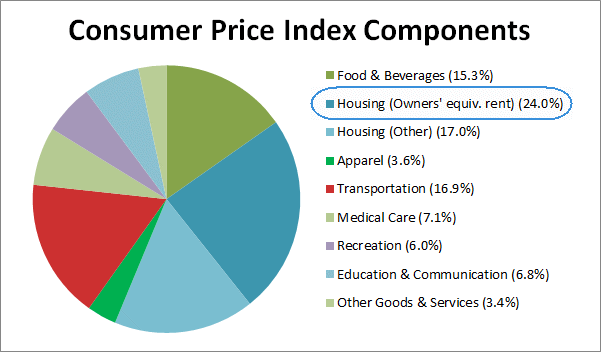
The CPI does not track home prices per se, rather the CPI uses a concept called “Owners’ Equivalent Rent” (OER) as a proxy for home prices.
The BLS determines OER from a measure of actual rental prices and also by asking homeowners the question “If someone were to rent your home today, how much do you think it would rent for monthly, unfurnished and without utilities?”
If you find that preposterous, I am sure you are not the only one. Regardless, rental prices are simply not a valid measure of home prices.
OER Weighting in CPI
Mish Shedlock |
OER is now at 24.041% of CPI, which still rounds to 24.0%, but the other housing wedge is now an even 17.0%, down from 17.1% in the previous version.
The rest of the charts show various effects if one substitutes actual home prices as measured by the HPI in the data.
Two Inflation Indexes
click on any chart for sharper image
As measured by the CPI, price inflation is 1.47% annualized. As measured by HPI-substitution, price inflation is a much higher 3.33%. The Fed would have you believe everything is under control. Of course they said the same thing in 2005.
KB Home’s chief executive officer sees a housing recovery taking hold in certain markets and feels well-positioned to capture some of the business.
“Across this country, we’re in the right markets,” said Jeff Mezger, president and CEO of KB Home ($32.67 0%) at the builder’s 2013 analyst conference.
Mezger addressed the crowd Tuesday, speaking to the recent growth and success of the homebuilder over the past year. Between investments, revenue generation and cost reduction, the average sales price for the company increase 24% year-over-year in the first quarter.
On top of that, 60% of deliveries were to first-time buyers, noted Mezger, who adds that today’s first-time homebuyers are bringing in more income and buying homes in better communities.
We have focused on both the long term and the short term, said Mezger, who adds the company’s stock over the last four months has been the top performer.
“We’re in the right markets today; it’s the right time,” added Mezger. “We like where we’re at.” Currently, the company is working in some of the strongest markets in the country: Arizona, California, Colorado, Florida, Metro D.C., Nevada, New Mexico North Carolina and Texas.
According to Mezger, 49% of KB Home’s ($24.67 0%) revenue in 2012 came from California; in the first quarter that increased to 51%. Texas is the biggest market by unit sales for the homebuilder.
Mezger noted that the builder likes its footprint and has no immediate plans to expand. “We will at some point, but it’s not necessary today,” he said.
CoreLogic, an Irvine, Calif.-based company that provides monthly reports on housing prices, said Charlotte rose 7% in the Charlotte-Gastonia-Rock Hill area in March from the same month a year ago.
Also, the Charlotte Regional Realtor Association reported that Charlotte-area home prices increased by 1.1% on average in April from the same month last year, as inventory continues to dwindle.
According to the preliminary data from the association, the average sales price in April rose to $217,166 from $214,739 in April 2012. The number of sales increased 34% year-over-year, to 2,915 from 2,168, writes the Charlotte Observer.
A monthly survey by mortgage finance firm Fannie Mae found 51% of those questioned in April believe prices will rise in the next 12 months, while only 35% are projecting a drop in prices. It is the first time in the three-year history of the survey that a majority said they expect prices to increase.
A year ago, 49% were expecting further price declines while only 32% said they though prices were on their way up.
The latest data from the housing market back up the this new level of confidence in the housing recovery. The S&P Case-Shiller Home Price Index rose 9.3% over the last 12 months, the biggest annual rise in home prices since the height of the housing bubble in 2006.
“Crossing the 50% threshold marks a significant milestone, as most Americans believe a housing recovery is truly occurring throughout the country,” said Doug Duncan, chief economist for Fannie Mae.
People who were sitting on the sidelines because of concerns that prices were still falling can be drawn back into the market once they believe prices are on their way up again.Home sales are up 10% from a year ago, helped not only by the climbing prices but alsorecord low mortgage rates and falling unemployment.
Residential construction jobs faced a 41% drop between 2006 and 2011. With homebuilding predicted to return to normal by 2016, housing starts may double over the next four years,Fannie Mae said.
This return to normalcy also implies an improvement in residential construction employment. But many are wondering how many jobs will come out of this homebuilding rebound.
In its latest edition of Housing Insights, Fannie Mae studies the historical relationship between housing starts and residential construction employment coupled with Economic and Strategic Research’s housing starts forecast, to project future homebuilding employment.
If housing starts keep up with expectations and return to normal levels in 2016, it is predicted that residential construction employment will rise to nearly 2.5 million jobs.
Fannie Mae predicts housing construction will recover to a “normal” level of about 1.6 million units in 2016. But what does this mean for homebuilding employment?
Fannie’s forecast predicts that residential construction employment will increase by 412,000 jobs between 2012 and 2016. This 20% rise in homebuilding employment will nearly triple the forecasted pace of total job growth during this time period.
However, the pace of growth will not be quick enough to bring back all homebuilding jobs lost during the housing bust. In 2016, the number of residential construction jobs is expected to remain nearly 1 million jobs below peaks established during the housing boom.
Neighbors and parishioners of an East Village church are steaming mad over a developer’s plans to demolish the 96-year-old building for market-rate apartments — and it’s just one of many historic holy houses in need of divine intervention.
Douglas Steiner, head of the Brooklyn Navy Yard’s Steiner Studios, bought Mary Help of Christians on East 12th Street for $41 million in November. Now he has permits to raze the sacred site, which includes a rectory, school and parking lot, for residential property with ground-floor retail.
But preservationists say the Roman Catholic church can be saved.


“This is heartbreaking,” said Andrew Berman, executive director of the Greenwich Village Society for Historic Preservation. “We hope [Steiner] can see the light and realize it’s advantageous to use something that’s special rather than demolishing it for something that’s a dime a dozen.”
The church closed in September as part of the Archdiocese’s plan to shut down 21 parishes due to declining attendance.
Nicholas Serracino, the Archdiocese’s chief architect at the time, styled the Italian Renaissance Revival church after Italy’s Basilica of Mary Help of Christians.
Also likely condemned to the wrecking ball is the 140-year-old St. Vincent de Paul on West 23rd Street in Chelsea.
The church’s former pastor, the Rev. Gerald Murray, told The Post the Archdiocese plans to sell the building, which was given a Classical Revival limestone façade in 1939.
In Soho, the century-old Our Lady of Vilnius is on the market for $13 million — more than a year after parishioners lost a lawsuit against the Archdiocese to stop the Romanesque Revival church’s demolition.
Boerum Hill locals have so far delayed the demise of Church of the Redeemer, which was rumored to be knocked down for a new residential building and church hybrid.
The 150-year-old Gothic Revival building closed last summer because it is structurally unsound. A spokesman for the Episcopal Diocese of Long Island, which owns the property, says church officials are still weighing their options for the site.
Meanwhile, Harlem residents are bristling at the partial demolition of St. Thomas the Apostle, a 106-year-old Roman Catholic parish on West 118th Street. The Gothic Revival church was first established for Irish immigrants.
Still, miracles do happen. St. Brigid’s Church in the East Village was spared the wrecking ball in 2008 after an anonymous $20 million donation. It reopened in January
I pinched myself when I was recently invited by the Tampa Bay Lightning to be the Social Captain for a game. The opportunity for me to combine my love of hockey and my favorite NHL team with social media is up there with a day at the beach.
The Tampa Bay Lightning hockey club anoints a Social Captain for each game. The social captain is a fan that is asked to share their social
media chops with their friends before and during a game. The fan is provided entry into the game, given a behind-the-scenes tour prior to the game, meeting some VIPs along the way and is provided prizes and give aways to promote during the game through Twitter, Instagram and Facebook. Fans in attendance follow along through hasthtags such as #TBLightning, #BoltsSocial and #LightningStrikes. I got to meet Dave Andreychuk, the captain of the Lightning in 2004, when they won the Stanley Cup (featured in the image above). That was a huge thrill for me!
The Social Captain is a fan. There is no monetary compensation to the fan. The compensation is an awesome fan experience along with some exposure to the fan base. I must admit that I prepped for the experience by studying the website and Twitter stream to be prepared for questions from other fans. It’s almost as if I considered myself an employee representing the brand, even if for just one game. I truly wanted to be capable of representing the brand well…Imagine how powerful it would be to have customers with this much passion for your brand eagerly desiring to evangelize your brand?
This experience inspired me to imagine how a social business might apply the Social Captain concept in other industries outside the sports industry. Consider applying this concept in these possible ways:
Find a customer who has demonstrated loyalty and passion for your product. Offer to shoot a video of your customer using your product in his or her natural setting. Allow the customer to be totally authentic in telling their story. Don’t script it. Alternatively, provide one of your products as a gift or loaner and invite the customer to tell their story experience on their own through their social channels.
Select one or more employees who embody your brand. Empower the employee to capture their experience serving customers through photos, video, tweeting and live blogging. If possible, provide a writer who can create live blog content accompanied by video. Run this program on a weekly or monthly basis with consistently used hashtags and don’t be surprised to see employees competing for their chance to be your social captain brand ambassador.
There are many possibilities for a Social Captain in a services businesses depending on whether your service business is B2C or B2B. If you’re a B2C service business, you can directly emulate the Tampa Bay Lightning’s Social Captain concept. For B2B service businesses, identify a loyal client with subject matter expertise and invite him or her to be a guest blogger or regular contributor of content on a relevant subject. Additionally, consider the approaches described in the retail and manufacturing industry above.
Lots of potential here…Depending on the nature of your tech product, locate a power user whose savvy use of your product is impressive or innovative. Recruit these power users employing tactics described above.
During a recent discussion with business school students at Tsinghua University the question arose as to whether real estate prices would fall if populations began declining.
This is certainly likely, yet it is still just one possibility, and the notion that fewer people leads to lower property prices is not always destiny.
Here’s why. First, population does not have a significant correlation with real estate prices. For instance, India has a population that is close to (and is expected to one day exceed that of) China.
Its population density is even higher than that of China.
However, the fact is that real estate prices in India remain below those of China.
Another example would be the Scandinavian countries, which have relatively low populations but high property prices.
Secondly, GDP or income is generally the more influential factor in determining real estate prices. Whether a single market across different time spectrums, or a single moment across different markets, real estate prices generally reflect and jive with earning power.
Other factors such as supply generally do not come close in terms of price influence.
Furthermore, population and demographic change, whether up or down, may not only alter the scale of demand, but also its nature in sometimes creating new demand.
A city with decreasing population is likely to see some real estate surpluses. However, the demand and supply structure (pricings included) is also altered, and sometimes new demand may arise because of this.
So even assuming a price drop scenario, this may not be as bad as expected provided the market has enough flexibility to adapt.
For instance, real estate surpluses – when accompanied by price drops and/or income rises – may entice some stakeholders to acquire more floor space or units, thus reducing the anticipated volume of vacant space and units.
Also, the land on which some of the real estate surpluses is located may be redeveloped or altered to cater to the changes in demand.
In short, the demand side is not an inflexible constant and when supply changes alter the pricing equilibrium, demand may respond to restore it or reduce the supply impact.
However, in order for such market adjustments to work themselves out, the land/real estate system needs to be flexible enough to facilitate such demand and supply interaction.
This may be challenging because private interests often collide with public interests, not to mention the possibility of excessive government influence and/or lack of a proper negotiation process and compensation.
The search for the right mix will take decades via trial and error and it is prudent to start contemplating while the population is still growing.
The key to preventing a major real estate price tumble is not having more babies, but enhancing economic competence and income-earning capability.
I do not believe that mobile is the future of online real estate search. Why you ask? Because mobile is online real estate search and consumers have already been conditioned to get the information they want from their smartphone. With the popularity of real estate apps and searches, it’s difficult to make an argument that the mobile real estate revolution hasn’t already arrived.
According to the Google/NAR Digital House Hunt Study, “36 percent of home buyers use a mobile device while watching TV.” We know that home buyers use different technology during every different phase of their home search, but as practitioners, are we reactive or proactive in how we respond, adapt, and offer technology to our clients?
In an effort to be proactive, I have spent this past year informally polling all of my buyer clients on their search habits. What I’ve discovered is that some like Trulia, some like Zillow, some like to perform a basic Google address search but a lot are using the realtor.com® app. While there are no major differences with any of these apps, my polling revealed that mobile real estate search preferences vary according to personal style and familiarity with the application or program.
Personally, I have been evaluating the realtor.com® mobile app for iPhone. So far, I think it has fairly good features not only for the agent but also for the consumer. And my clients are loving it! The real difference between this app and many others is that with the realtor.com® app, I can add my clients using my login information—much like a friend request on Facebook—and once my client accepts, we are connected. Because of this feature, there’s a collaborative aspect to this app; I can send my clients homes they may be interested in and more importantly, they can send me homes they want to see or get more information about.
For example: Last weekend, one of my clients was driving around looking at neighborhoods, saw a home, opened the realtor.com® app, and used it to get details about the home. Instantly, the details were sent to my phone, which alerted me of my client’s desire to see the property. This is a perfect example of the collaboration between home buyers and their agents that our industry has been talking about for years.
If you haven’t done so already, I encourage you to download the app and ask a few clients to do the same. They will be happy you are involving them in the home buying process and you’ll be able to check out some pretty neat technology. Mobile is not the future, mobile is now. So what are you waiting for?