Category Archives: Bedford Hills

Mortgage Rates keep dropping | Bedford Hills Real Estate

Freddie Mac today released the results of its Primary Mortgage Market Survey® (PMMS®), showing average fixed mortgage rates, after ticking-up slightly last week, reversing course and falling amid weaker than expected housing and economic data. Fixed-rate mortgages rates are once again back near their May 23, 2013 lows.

News Facts

  • 30-year fixed-rate mortgage (FRM) averaged 3.59 percent with an average 0.7 point for the week ending February 5, 2015, down from last week when it averaged 3.66 percent. A year ago at this time, the 30-year FRM averaged 4.32 percent.
  • 15-year FRM this week averaged 2.92 percent with an average 0.6 point, down from last week when it averaged 2.98 percent. A year ago at this time, the 15-year FRM averaged 3.40 percent.
  • 5-year Treasury-indexed hybrid adjustable-rate mortgage (ARM) averaged 2.82 percent this week with an average 0.4 point, down from last week when it averaged 2.86 percent. A year ago, the 5-year ARM averaged 3.12 percent.
  • 1-year Treasury-indexed ARM averaged 2.39 percent this week with an average 0.4 point, up from last week when it averaged 2.38 percent. At this time last year, the 1-year ARM averaged 2.55 percent.

Average commitment rates should be reported along with average fees and points to reflect the total upfront cost of obtaining the mortgage. Visit the following links for theRegional and National Mortgage Rate Details and Definitions. Borrowers may still pay closing costs which are not included in the survey.

Quotes
Attributed to Len Kiefer, deputy chief economist, Freddie Mac.

“Mortgage rates fell this week following the release of weaker than expected pending home sales, which fell 3.7 percent in December. Moreover, real GDP growth for the fourth quarter was 2.6 percent and the Institute for Supply Management reported slower growth in manufacturing last month, both missing market consensus forecasts.”

Housing Starts Top 1 Million for 2014 | Bedford Hills Real Estate

Total housing starts for 2014 reached the 1 million mark for the first time since 2007. Data from the Census Bureau and HUD for December, plus revisions for October and November, pushed total housing construction to a total of 1,005,800 for the year.

Multifamily construction held virtually even at a 361,000 annual rate, down 0.8% from November. For the year, multifamily starts were up 16% to 358,000, the highest tally since 2007.

The pace of December starts was up 4.4% from November to a 1.089 million annualized rate. The late-year push was led by single-family construction, which was up 7.2% in December, reaching the highest monthly rate since March 2008.

The increase for single-family development mirrors continued positive reporting from the NAHB/Wells Fargo Housing Market Index (HMI), a measure of builder confidence. For January, the HMI held steady at a level of 57. Any value above a level of 50 indicates more respondents view market conditions as good rather than poor.

The NAHB Remodeling Market Index (RMI) also suggested attractive market conditions for the home improvement sector. The RMI came in at 60 for the final quarter of 2014 and has been above the key 50 level since the second quarter of 2013.

Home sales showed strength at the end of 2014. The sales pace of newly built, single-family homes increased 11.6% in December to a seasonally adjusted annual rate of 481,000, according to data from HUD and the Census Bureau. This is the highest monthly sales rate since June 2008. The inventory of new homes for sale rose to 219,000 in December, a 5.5-months’ supply at the current sales pace.

The market share of conventional financed purchases for new homes is also growing, with declines seen in the share of FHA-insured purchases. These changes are consistent with a market recovering to more normal conditions.

Also demonstrating improvement for the second half of 2014, the pace of existing home sales increased 2.4% in December, although the share of sales to first-time buyers continued to disappoint at 29%. Existing home sales exceeded a 5 million sales pace for the sixth time in the past seven months and were 3.5% above the same period a year ago.

The momentum gained in the housing market at the end of 2014 should continue in to next year. NAHB is projecting strong growth for single-family production, which is expected to rise to 804,000 units. NAHB is also forecasting 2% growth for multifamily and a 3% increase for remodeling.

Housing prices continue to rise, albeit at slower rates. The Federal Housing Finance Agency House Price Index rose 5.3% for November, the 34th consecutive month of year-over-year growth. Over the last two and half years, home prices have risen by 19%. At the same time, residential rents have increased. Using Consumer Price Index (CPI) data, NAHB estimates that rent growth has outpaced inflation by 1.7%.

A significant economic story in recent months has been the dramatic decline in gas prices. The CPI’s gasoline index has declined 21% over the last 12 months. On a seasonally adjusted month-over-month basis, the overall CPI fell 0.4%. Over the past 12 months, prices on expenditures made by urban consumers have increased by just 0.8% before seasonal adjustments.

While good for the overall economy, the decline in gas prices will likely have little impact on building material prices. In December, data from the government’s Producer Price Index indicated that prices for a number of materials declined in December, including gypsum (-3.8%) and softwood lumber (-1.2%). OSB prices rose 0.2%. Material costs for builders are expected to rise in 2015, particularly for gypsum, as housing production increases.

Muted increases for inflation indicators like the CPI have modified the focus of the Federal Reserve. With economic output expanding, strong job growth and a declining unemployment rate the Fed’s monetary policy committee has shifted its focus to below-target (2%) inflation as the primary threat to the continuing economic recovery. Consensus expectations are for a first increase in the federal funds rate for mid-2015.

In analysis news, NAHB economists explored survey data of Millennial housing preferences. Most prospective home buyers in this generation want to buy a single-family detached home and prefer to live in the suburbs. However, 10% would choose to live in the central city, which is a larger share that reported by Gen Xers and other generations.

While Millennials want to achieve homeownership, downpayments and loan qualification remain an important hurdle. Research from the Federal Reserve Bank of New York indicates that such finance constraints on mortgage access have a considerably larger impacts on housing demand than do historical changes in mortgage interest rates.


read more…


http://eyeonhousing.org/2015/01/eye-on-the-economy-housing-starts-top-1-million-for-2014/

 

South Beach Nightclub King Lists House With Astroturf Yard | Bedford Hills Real Estate

Opium Group Managing Partner Roman Jones, don of Mokai, SET, Cameo, and, and Mansion, has listed his own historic mansion (ha ha ha) at 6222 Alton Roadfor $3.895 Million. Although the mediterranean manse was built in 1934, and looks like it was originally a very classy, classic edifice, it’s seen some serious updating and nightclub-ifying, including luxe features like ipe wood, vaulted ceilings, and vertical wood thingies in the staircase.

The listing says “this house is meant to be lived in”, and boy do they mean it. The bed room, err the ‘boom boom room’, has a big bed, durable floors, and plenty of (reinforced?) ceiling space for all those hanging contraptions that are so much fun. A dance floor-sized tiki hut flanks an astroturf backyard (no mowing needed here). Just hose the place down and let the party rage on.


read more…


http://miami.curbed.com/archives/2015/01/20/opium-group-manager-lists-house-with-astroturf-yard.php

Buyer confidence keeps pending home sales growing | Bedford Hills Real Estate

Pending home sales slightly improved in November and are above year-over-year levels for the third straight month, according to the National Association of Realtors (NAR). All major regions except for the Midwest experienced a slight gain in activity in November.

The Pending Home Sales Index (PHSI), NAR’s forward-looking indicator based on contract signings, increased 0.8% to 104.8 in November from a slightly downwardly revised 104 in October and is now 4.1% above November 2013 (100.7) – the highest year-over-year gain since August 2013 (5.6%).

Lawrence Yun, NAR chief economist, said signed contracts inched forward in November and have been fairly stable but haven’t broken out even as the economy picked up steam this spring.

“The consistent economic growth and steady hiring we’ve seen the second half of this year is giving buyers enough assurance to consider purchasing a home before year’s end,” he said. “With rents now rising at a seven-year high, historically low rates and moderating price growth are likely to entice more buyers to enter the market in upcoming months.”

Yun also noted that falling gas prices will likely boost consumer confidence and allow prospective buyers the opportunity to save additional money for a down payment. NAR’s 2014 Profile of Home Buyers and Sellers (released in November) found that the median down payment ranged from 6% for first-time buyers to 13% for repeat buyers.

“There’s still misperception out there that a much higher down payment is needed, while that’s not the reality,” added Yun.


read more…


http://www.mpamag.com/real-estate/buyer-confidence-keeps-pending-home-sales-growing-20872.aspx

Seattle’s Glassy ‘Open House’ is Pretty Self-Explanatory | Bedford Hills Homes

Location: Seattle, Washington
Price: $1,900,000
Seattle’s Open House probably does have an open house in its future, as it was listed yesterday for $1.9M, but the title refers to the glass walls in back that open up on both levels (the top one pushes up and out, and bottom one rolls up like a garage door). Between those large indoor-outdoor spaces, the too-spare modern staging, and what the listing calls “HUGE art walls,” the sale angle is clear: throw parties here.

A Curbed Seattle commenter who may or may not be one of the sellers says the “photos don’t do it justice,” and they do linger on the terrace/patio sections so much that it’s hard to get a sense for this 2009 work by Seattle architect Eric Cobb apart from white walls. There are some cool metal curtains on the bottom floor, a modern built-in bunk bed in the kids’ room, and a nearly all-stainless-steel kitchen.

The master bedroom is lofted above the kitchen and dining room, which is pretty interesting. You can’t really go wrong with concrete floors and exposed steel, and there’s a great deal of both.


read more…


http://curbed.com/archives/2015/01/06/eric-cobb-architects-open-house-seattle-for-sale.php

Mortgage Rates Remain Near 2014 Lows | Bedford Hills Real Estate

Freddie Mac today released the results of its Primary Mortgage Market Survey® (PMMS®), showing average fixed mortgage rates edging slightly higher while remaining near their 2014 lows amid mixed housing and economic news.

News Facts

  • 30-year fixed-rate mortgage (FRM) averaged 3.83 percent with an average 0.6 point for the week ending December 24, 2014, up from last week when it averaged 3.80 percent. A year ago at this time, the 30-year FRM averaged 4.48 percent.
  • 15-year FRM this week averaged 3.10 percent with an average 0.6 point, up from last week when it averaged 3.09 percent. A year ago at this time, the 15-year FRM averaged 3.52 percent.
  • 5-year Treasury-indexed hybrid adjustable-rate mortgage (ARM) averaged 3.01 percent this week with an average 0.5 point, up from last week when it averaged 2.95 percent. A year ago, the 5-year ARM averaged 3.00 percent.
  • 1-year Treasury-indexed ARM averaged 2.39 percent this week with an average 0.4 point, up from last week when it averaged 2.38 percent. At this time last year, the 1-year ARM averaged 2.56 percent.

Average commitment rates should be reported along with average fees and points to reflect the total upfront cost of obtaining the mortgage. Visit the following links for theRegional and National Mortgage Rate Details and Definitions. Borrowers may still pay closing costs which are not included in the survey.

Quotes
Attributed to Frank Nothaft, vice president and chief economist, Freddie Mac.

“Mortgage rates were up slightly, following a week of mixed economic releases. Existing home sales were down 6.1 percent in November to annual rate of 4.93 million units, below economists’ expectations. New home sales fell 1.6 percent last month to an annual rate of 438,000, also below expectations. Meanwhile, the third quarter real GDP was revised sharply higher to 5.0 percent according to the final estimate released by the Bureau of Economic Analysis.”

Tiny Houses Have A Not-So-Tiny Problem | Bedford Hills Real Estate


As much as we love gorgeous small-scale architecture, not all micro-housing is created equal. Over at City Lab, Kriston Capps argues thattiny houses plopped onto huge lots in the middle of nowhere miss the entire point of micro-housing: to provide more options for affordable housing, especially in crowded, expensive cities.

He takes issue with the 650-square-foot prefabricated zeroHouse, the self-sufficient modular home seen above:

The zeroHouse is so modular and low maintenance, in fact, that all you need to own a zeroHouse is—after $350,000—a plot of land. Any kind of land.

Which is, of course, the problem with zeroHouse: Nobody needs micro-housing in places where plots of prairie, mountain, and sea (!) are available in plenty.

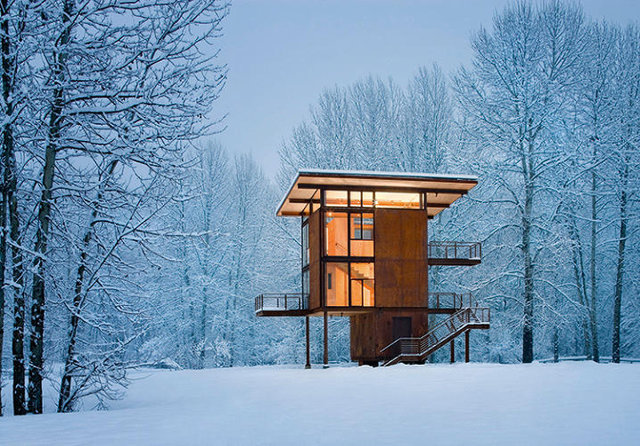
The Delta Shelter by Olson Kundig in Mazama, Washington.Image: Courtesy Olson Sunderberg Kundig Allen Architects/Taschen

If you’re determined to live on a sprawling piece of rural land, it’s probably more environmentally friendly to do so in a prefab house that’s designed to function off the grid. “Basically, a tiny house is sort of the suburban or maybe even rural version of a small apartment,” asRyan Mitchell, author of the book Tiny House Living, told Salon.

But trendy tiny dwellings more often come in this form than the variety people more desperately need: the kind that makes urban living affordable for those of us who aren’t oligarchs. “Lovely granny flats, Voltron head-cubes, and stories that tug at the heart-strings are nice, but support for these doesn’t amount to support for real micro-housing—or congregate housing developments, perhaps a better term for urbanist housing solutions,” Capps writes.

What cities need in micro-housing, he argues, is “at least the option to build for a range of buyers and renters, at a range of densities. When tiny-house enthusiasts go on about what are essentially single-family homes, they are confirming the status quo, if shrinking it a little.”

Ultimately, we need both. It’s true that crowded cities—especially those with a high concentration of young professionals who aren’t trying to fit an entire family into a 129-square-foot apartment—need affordable micro-units to alleviate intense pressure on the housing market. It’s perhaps no surprise that we don’t see that many of those designs yet, considering that even in housing-strapped cities like San Francisco,micro-apartments remain controversial. The prospect of allowing developers to pack people into a whole new definition of “cozy” worries some tenants rights advocates and even some psychologists.


read more…


http://www.fastcodesign.com/3032535/slicker-city/tiny-houses-have-a-not-so-tiny-problem?fullsite&partner=ps03101titles

Home Equity Grows | Bedford Hills Real Estate

According to NAHB tabulations of the third quarter Federal Reserve Flow of Funds, the real estate equity position of U.S. households (the difference between assets and liabilities) increased nearly 1.6% for the quarter.

The market value of real estate held by U.S. households increased $180 billion dollars during the quarter, while liabilities (home mortgages) remained virtually unchanged. The value household-owned real estate, including owner-occupied and second homes, totaled $20.4 trillion for the quarter. Total home mortgage debt outstanding stands at $9.4 trillion.

Recent developments in terms of housing values and mortgage debt outstanding have been largely driven by tight lending conditions and steadily increasing home prices. Rising home prices, in particular, have boosted household balance sheets in recent years.

Chart1

To account for inflation in the quarterly series and measure changes in real values, it is also useful to examine owner’s equity in real estate as a percentage of the value of household real estate. The higher the ratio, the more favorable is the financial position of U.S. households with real estate. The current reading of 53.9% is a slight improvement over the prior quarter. The ratio has steadily improved from the 36.7% reading in the first quarter of 2009 during the depths of the Great Recession.

Chart2

This type of improvement in the balance sheet of U.S. households with real estate generally corresponds with the ongoing recovery in housing. It is likely that tight lending conditions have led to pent-up housing demand, which could release with further improvement to the economy.


read more…


http://eyeonhousing.org/2014/12/home-equity-grows-during-the-third-quarter/


Households Show Willingness to Take on Most Forms of Debt | Bedford Hills Real Estate

Data released by the Federal Reserve Board indicates that consumer credit outstanding increased over the month of October 2014. The data released by the Federal Reserve Board covers most short- and intermediate-term credit extended to individuals, excluding loans secured by real estate. According to the release, total consumer credit outstanding expanded by a seasonally adjusted annual rate of 5%. Both revolving credit, which is largely composed of credit cards, and non-revolving credit, mostly auto and student loans, grew over the month. Revolving credit increased by a seasonally adjusted annual rate of 1% ($11 billion) while non-revolving credit grew by 6%, $148 billion.

Over the past year, revolving credit rose by 3% while non-revolving credit has grown by 8%. Data from the Federal Reserve Bank of New York confirms the growth in consumer credit outstanding. It also shows that the portion of consumer debt that is secured by housing also rose. However, the increase in housing secured consumer debt outstanding reflects an increase in mortgage debt outstanding, while the total amount of outstanding home equity lines of credit fell over the year.

According to the figure below, auto loans recorded the largest percentage increase over the year, rising by 11% between the third quarter of 2013 and the third quarter of 2014. However, the size of the increase ranked third behind student loans and mortgages. Meanwhile, student loans recorded both the second largest year-over-year growth rate, 10%, and the second highest growth level, $99 billion. Credit cards, a component of revolving credit outstanding, recorded the smallest rate of positive growth, 1% and $8 billion. By virtue of its size, mortgage debt outstanding recorded the largest increase, growing by $234 billion over the year. However, this translates into annual growth rate of 3%. Although home equity lines of credit recorded a larger percentage drop, 4%, relative to mortgages its total decline, $23 billion, was much smaller than the increase in mortgage debt.Presentation1


read more…


http://eyeonhousing.org/2014/12/households-show-willingness-to-take-on-most-forms-of-debt/