Daily Archives: November 20, 2013

A Bubble in Rising Texas Markets? | Waccabuc Real Estate

Trulia, the national real-estate data-crunching outfit, has been maintaining a “bubble watch” since May, 2013, tracking local markets where home prices are rising fast enough that the dollar signs threaten to outrun the “market fundamentals.” This week, Trulia’s bubble watch list puts four Texas metropolitan areas in its top ten, including the coastal markets of Houston and San Antonio.

Trulia chief economist, Jed Kolko, reports on the organization’s data in Forbes: “At the metro level, home prices are above their fundamental value in 17 of the 100 largest metros. Most of these overvalued metros are only slightly so: Of the 17 overvalued metros, just two–Orange County and Los Angeles–look at least 10% overvalued. (Austin rounds up to 10% but is actually slightly below.) Several California metros also stand out for having both overvalued prices AND sharp price increases, including Orange County, Los Angeles, Oakland, and Riverside-San Bernardino.” (For the full story, see “Trulia: Home Prices Are Simmering, Not Bubbling.”)

The Houston market, according to the Trulia report, is presently overvalued by 6% after rising 13.9% in the past year. San Antonio, the report says, is overvalued by 4% after rising by 11.1%.

Those numbers don’t qualify those cities for bubble status, even by Trulia’s reckoning—somewhat arbitrarily, Trulia reserves the “bubble” label for areas where it considers the prices to be more than 10% above what Trulia believes justified by underlying demand and production. But even so, Texans are taking exception to the inclusion of three Texas cities on the top ten list. Market watcher Steve Cook notes the controversy on his Real Estate Economy Watch blog (for Cook’s full post, see “Smile when you say ‘bubble,’ mister“).

“Dr. James Gaines, an economist with the Real Estate Center at Texas A&M University, responded that concerns about a price bubble in Texas’ housing markets are overblown,” writes Cook. “He said some of the recent increases are just making up for several years in the recession when Texas home prices were declining or flat.”


http://www.jlconline.com/home-prices/a-bubble-in-rising-texas-markets-.aspx

Florida Sinkhole Destroys Another Pair of Homes | Cross River Homes

Florida’s porous limestone geology claimed two more victims last week as a 50-foot sinkhole opened up in a Dunedin, Florida, neighborhood. Awakened at night by a loud sound, the family first feared an intruder, homeowner Michael Dupre told a reporter: “I grabbed a rifle and start walking through the house so I could see what was going on,” he said. “And I hear the banging. … As I approach the back of the house and I see our back screen room just sticking out 3 feet off the ground, I knew instantly it opened up.” (The full report by Shyann Malone, WTSP-TV, Tampa-St. Petersburg, Fla., is carried at the USA Today website: see, “2 houses likely lost because of Florida sinkhole.”)

Ironically, repair work at the location had just begun a few days before, according to a report in the Tampa Tribune (for the full story, see: “Sinkhole swallows parts of two Dunedin homes,” by Stephen Thompson). The paper reports: “The Dupre family has been engaged in a months-long court battle with its insurance company, Citizens Property Insurance Corp., after a sinkhole was discovered on the property two years ago, said the family’s attorney, Jason Salgado.” Citizens had proposed a repair plan calling for a deep-compaction grout injection, at an estimated cost of around $100,000, the paper reports, while the family was holding out for a more costly intervention that would have involved shallow grouting as well, along with a possible installation of support pilings.

Nature beat the engineers and lawyers to the punch, however; last week, demolition and backfill was the only work being done. Most of the Dupre family’s household possessions were lost, USA Today reports (for the full story along with TV coverage by Eric Glasser of WTSP-TV, see “Crews demolish 1 home that Fla. sinkhole claimed“).

Sinkholes are widespread in Florida, USA Today notes—and especially common in Dunedin, where the city actually maintains a list of sinkhole locations. The majority of Florida sinkhole reports come from a region sometimes called “sinkhole alley,” which includes the counties of Hernando, Hillsborough, and Pasco.

But as the Los Angeles Times notes, Florida’s geology makes sinkholes a risk throughout the state, experts say (see “Is there any place in Florida safe from sinkholes? Technically, no,” by Soumya Karlamangla). Still, events like this one stand out: “The people who have been around the city for quite a while, in excess of 30 years, have no recollection of anything ever this big, probably by a factor of three or four times,” Dunedin city engineer Thomas Burke said. “For us, this is a major, major situation.”

Going forward, Floridians may have more and better information about the sinkhole risk in specific locations: This month, the Florida Geological Survey started a study that experts hope will result in a detailed statewide map of the risk—eventually. The Suwanee Democrat reports on that story here: (“Florida Geological Survey begins sinkhole vulnerability study“). “Field work commenced with documenting multiple sinkholes on private landowner’s property in the pilot study area of Suwannee, Columbia, and Hamilton counties,” the Democrat reports. “The data will be part of Geologic Information System data that will be compiled and processed in the study … The project is a three year study that will produce two maps: one in the pilot area and the other statewide. The pilot study is slated to end in May 2014, at which point the statewide assessment will begin.”


http://www.jlconline.com/erosion-control/florida-sinkhole-destroys-another-pair-of-homes.aspx


Ideas to Protect Coasts from Storm Surge | Katonah NY Homes

In locations prone to storm surge flooding, zoning and code rules adopted at the state and local level require special measures to make homes safer from damage or destruction in a major storm. But hundreds of thousands of houses, commercial buildings, public structures, and industrial facilities already exist in flood-threatened areas, and fixing one building or facility at a time could take centuries—at a cost that boggles the minds of policy-makers.

So the Federal Government is looking to industry and academia for solutions that might work at a neighborhood scale, or even a regional scale. So far, policymakers are still at the brainstorming stage: This week, Shaun Donovan, U.S. Secretary of Housing and Urban Development, selected 10 project concepts from a candidate pool of 41 proposals submitted by teams of experts. It’s all part of the “Rebuild by Design” competition, launched last June by HUD as an effort of the Hurricane Sandy Task Force.

Reports the Washington Post: “The winning ideas include an array of strategies for making the coastline more resilient in an age of rising seas, including natural breakwaters that could take the punch out of storm surf headed for Staten Island, a ring of water-trapping canals and parks for Hoboken, N.J., and channels in Long Beach, N.Y., that would help drain Long Island’s coastal bays during storms or periods of heavy rain.” (For the full Post item, see: “Federal officials pick 10 ideas for making NY, NJ coastlines more resilient after Sandy,” by Associated Press).

Of course, there’s no guarantee that all of the ideas will ever become reality—or even that any of them will. Some could require billions of dollars in public funding—although other proposals, like the “Big U” concept suggested by Danish architecture firm Bjarke Ingals, might not. The Danes argue that major, big-ticket public works are hard to accomplish and may do more harm than good. Instead, they’re proposing a medley of smaller projects that address flood risks at the neighborhood or street level, which could be constructed independently on different schedules.


http://www.jlconline.com/stormwater-management/ideas-to-protect-coasts-from-storm-surge.aspx


Post content to Facebook business page daily to optimize engagement, leads | Bedford Hills Real Estate

How often should real estate agents post to their Facebook business page?

Oh boy. People have definite opinions on this subject. The thing is, they are opinions.

Opinions based on personal biases. Opinions based on personal preferences. Opinions based on statistical evidence?

In at least half of the cases, no. I’m seeing “experts” spouting advice on posting frequency from all over the spectrum, including: no more than once a week no more than three days a week daily multiple times a day Frankly, in my opinion (you knew you’d get it from me, right?), real estate agents should stick to statistical facts, not individual preferences, when it comes to posting frequency.

And honestly, real estate agents think they overcontact people when, in fact, they grossly undercontact people. The thing is, when it comes to Facebook posting frequency, there are multiple elements involved.

How often Facebook puts your posts into your followers news feeds


– See more at: http://www.inman.com/next/make-posting-to-facebook-business-page-a-daily-habit-to-drive-engagement-leads/#sthash.aV7AUMRi.dpuf

Freddie Mac: Housing will remain generally affordable | Pound Ridge Real Estate

The next year brings a bevy of unprecedented changes to the mortgage market as it shifts from a refinance to purchase business.

Despite all of this, in an environment of rising interest rates and tightening loan criteria, Freddie Mac still believes most of the nation’s housing will remain affordable. The issue that remains, is getting responsible mortgages to the homeowners who deserve them.

Frank Nothaft, chief economist at Freddie, released the enterprise’s 2014 outlook report in conjunction with a HousingWire webinar he participated in.

“The big shift ahead will occur as the single-family mortgage market begins transitioning from a rate-and-term refinance dominated market, to the first purchase-dominated market we’ve seen since 2000,” Nothaft said. “The emerging purchase market should gather momentum in the coming year.”

The webinar, titled Competitive lending in the Qualified Mortgage world, also took a hard look at the challenges lenders will face after the ruling comes into effect in January.

Craig Crabtree, general manager of Equifax Mortgage Services, spoke at length of the critical importance of underwriting and outlined the types of mortgage products that would likely be prohibited under the QM.

This aspect of great underwriting standards will need to be carefully balanced against the need to shorten closing times to under 30 days. Regional banks, for example, should re-approach their underwriting methodology to seek greater efficiency in writing new mortgages.


http://www.housingwire.com/articles/28039-freddie-mac-housing-will-remain-generally-affordable

Pattern-Happy Personality in Los Angeles | Bedford Corners Real Estate

thousand square feet of blank space might feel intimidating to some, but this apartment’s empty walls and cookie-cutter materials turned out to be a dream come true for Ariane Bartosh. The Los Angeles designer and painter used the space as a blank canvas on which to showcase her love of color, pattern and texture. Now hand-drawn patterns and vintage wallpaper adorn the walls and colorful, quirky furniture fills the apartment with unmistakable personality.
Houzz at a Glance Who lives here: Ariane Bartosh Location: Silver Lake neighborhood of Los Angeles Size: 1,200 square feet; 1 bedroom, 1 bathroom Budget: $35,000, including labor, furniture and materials

Bartosh had just started on her own as a designer when she found this apartment, so she used it as an opportunity to show off her personal style, painting ready-made white curtains with fabric paint and filling the living room with pink, salmon and orange hues. A 1960s German light fixture — one of several in the house — adds glam to the white ceiling.
Rug: Flokati.com; wall paint: Petal Bloom, Pratt & Lambert
Most of the furniture is a result of Bartosh’s passion for vintage. The armchairs are Italian Techno chairs from the 1980s, reupholstered in a plush salmon corduroy. She found the vintage Milo Baughman sofa for a steal ($1,000!) on eBay and upholstered it in orange fabric from Osborne & Little. “I’ll find things I like on 1stdibs. And obviously I can’t afford it,” Bartosh says. “So I’ll hunt eBay until I find exactly what I’m looking for.”

7 Strategies for a Well-Designed Kitchen | Chappaqua Real Estate

What’s the most important room in your house? For me it’s the kitchen. I love to eat, cook and spend time with family, and the kitchen is where I can do it all. With today’s busy schedules, mealtimes are often the only times families have to spend with one another. So how can you have the perfect kitchen for your lifestyle, stay within your budget and maximize resale value?
One of the most important steps in any project is starting with a great design. It’s not just about looks, it’s more about function and adding value to your life. More than any other room in the house, a kitchen has to be well thought out, carefully configured and designed to accommodate multiple functions. You probably spend more time in your kitchen than any other room, and that’s exactly why it’s so important to start with a great design. Consider these seven ways to get there.

1. Avoid isolation. For many of today’s families, the kitchen is the heart of the home and should be a place where people can gather, entertain and relax — not just cook. That’s why an open plan, like in this kitchen, works so well.
The open plan isn’t your only option, but it isn’t going anywhere yet. Consider your family’s needs carefully before choosing a kitchen plan, and know that if resale is an option for you, most buyers these days are looking for an open kitchen.
Open vs. Closed Kitchens — Which Style Works Best for You?
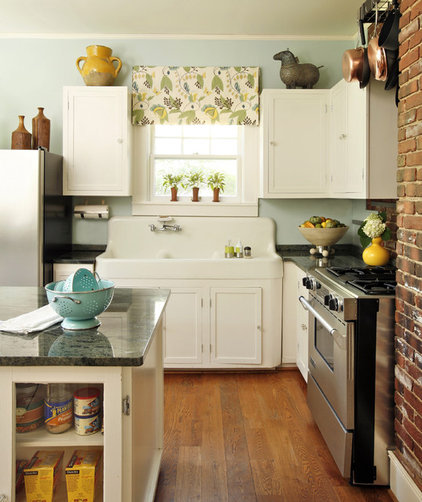
2. Plan a functional layout. If you like to cook and enjoy making meals for family and friends, there is nothing more frustrating than a kitchen that doesn’t function well. Most designs today follow the basic kitchen work triangle of the sink, refrigerator and range to maximize functionality. But take your own needs into account too. Plenty of counter space for prep, especially next to appliances, like in this kitchen, can make your cooking routine go much more smoothly.
Read more about kitchen layouts
3. Choose a good location. If you plan to make your kitchen the heart of your home, choose a location that connects it with all the other major circulation points. Having your kitchen anchor your home’s great room or provide access to the garage through a mudroom or laundry room is a great way to achieve this.