via jeffbullas.com

Talking email marketing strategy can be a bit like talking religion or politics at a party. Everyone has their own (very strong) opinions about what does — or does not — work.
You’ve heard it all before:
“Don’t send anything on weekdays, on the weekends, or after 5 pm, because people aren’t at their computers.”
“Don’t email on Mondays because your prospects are too busy, and avoid Fridays because everyone is winding down for the weekend.”
“And be sure to stay away from the lunch hour. In fact, the best time to email is on Tuesday at 10:13 am.”
I call B.S.
The fact is, your industry, your business, and your audience have unique demands and desires. You’ve got to test (and test, and test) what works in your world, and then test some more.
My experience of email marketing
Because I’m impatient, I like to send out emails as soon as have something to send, whether it’s on a Sunday night or Thanksgiving day. And I get responses: I’ve had editors email me back at 10 pm, and last year I had an editor request a phone meeting on Christmas Eve.
That’s all fine and good for my magazine writing, but what about emailing my list? I have a email list of about 2,200 writers who are interested in hearing about my e-course, e-books, and mentoring, as well as getting the scoop on freebies like contests and webinars.
I recently decided, on a Saturday afternoon, to hold a contest to see who could come up with the best topic idea for my first podcast.
Within four hours, more than 500 people had opened the email, and a couple dozen writers had sent in their suggestions. By Tuesday, I had a winner and posted the resulting podcast on my blog.
Looks like people were checking their email on the weekend after all — and taking action, too.
So this past weekend, I did a little experiment. On Sunday at 11:23 am — probably one of the worst times to send a marketing message, according to conventional wisdom — I sent out an email announcing that I was holding a contest to promote my newest e-book.
Within 30 minutes, I had 97 opens, 16 clicks, and 8 sales. Within an hour, the numbers had increased to 212 opens, 39 clicks, and 11 sales. By 3:23, I had 484 opens, 93 clicks, and a total of 27 sales.
By the time I went to bed early that evening, I’d sold 53 e-books. The next day, Monday, I sold 30 more.
After-hours marketing: The experts speak
To be clear, this is not proof of anything.
Maybe if I had sent out the email on Monday or Tuesday, I would have gotten the same results — or even better. But still, the old saw that “no one is checking their email or buying on the weekend” doesn’t seem to hold.
To find out if others had the same experience, I asked around. I looked for seasoned marketers who had good results emailing their lists on weekends, after hours, and on holidays.
- Hope Clark of Funds for Writers sends out her newsletters on Friday by 10 pm. “I settled on this release date after feedback from many readers over the years, and I feel I’ve found a happy balance for all concerned,” she says. She finds that her readers with 9-5 jobs enjoy relaxing with the newsletter on Saturday.
- Max Librach of the Groupon-like business Gluten-Free Saver posts deals on Sunday and sends out email blasts on the offers the following Saturday and Sunday. “The workweek is filled with the split testing of subject lines, headlines and email copy, so that our weekend [mailings] are as optimized as possible,” he says. “By sending subscribers the most optimized message over the weekend, we are able to reach people who are too busy during the week to purchase the deal.”
- Dan Bischoff of Lendio.com says, “We often send our newsletter out on Sundays, although we continue to test the best days. Sundays seem to have lower open rates but better click through rates, with people spending more time reading content.”
- Jeff Kear of Planning Pod finds that the best time to email prospects depends on whether they’re business clients or consumers: B-to-B companies do best emailing during the week when people are at their desks, while B-to-C businesses do better mailing after hours and on weekend mornings when prospects are checking their personal email accounts.
- Alessandra Souers of One Click Ventures, which sells mostly fashion products, says her email program includes morning/midday/afternoon sends on weekdays, but her company saw so much success with Thursday, Friday, and Sunday evening email specials that they’ve integrated them into their regular schedule as well. “Holidays such as Memorial Day have also been huge for us,” she adds.
So I’m not the only one: Smart marketers are constantly testing sending emails on different days and times, and not shrinking from sending evening and weekend email messages.
My take is that you never know when someone is going to be at their computer and ready to buy — so why knock yourself out trying to figure out “the very best minute” to email? And why apply a hard-and-fast “waiting” rule, when you’ve got something of value to pass along to your audience?
Also, there’s this amazing thing about email: If the recipient is not available right when you send it, the email will be sitting there waiting for them when they are ready.
Most small business seem to have a strong dislike for budgeting. The feeling is that budgets are just a time wasting distraction from the things that really need to get done. You probably have similar feelings toward budgeting. And you’re right.
Budgeting is a waste of time if you do it the way most small business owners do it. You know the way – where you do a “mathematical” budget by increasing revenues and expenses and come up with a “magical” net earnings figure that you don’t really believe, or even know how to actually achieve.
But the truth is that you CAN create a budget that is useful for you. One that actually helps you create the financial results you want and helps you identify what actions you need to take in order to keep driving toward your targeted financial results.
What is the path to an effective budget? Here are seven quick steps. Follow along and it won’t even feel like you’re creating a budget:
Step One
The first step is to create your revenue budget. The way to do this in a meaningful way is to start with the number of customers you have historically served in your budget period. For example, if you serve 75 customers in a month, this would form the starting point if you were budgeting for an upcoming month.
Step Two
Determine your average transaction size in the past for the period you are trying to budget for. For example, if your average transaction size has been $250 in similar recent periods.
Step Three
Based on your historical number of customers for the period and average transaction size and given your planned marketing and sales efforts, decide what you feel is an appropriate target for number of customers and average transaction size. For example, if you have an upcoming marketing campaign scheduled that will generate a number of new leads compared to the number you would normally expect you should adjust your target number of customers upward to reflect this.
Step Four
Multiply your target number of customers, and average transaction size together.
You have just created a revenue budget for your business by actually looking at the elements that create revenue. Even more important, you have created granular targets (number of customers and transaction size) that will guide you every day in your budget period to knowing if you are on track to create that revenue or not. If not, where you are falling behind. For example, not enough customers, average transaction size smaller than planned, etc.
Step Five
Use the targets you just set for the number of customers and average transaction size and your anticipated direct costs to determine your budgeted direct costs. For example, if you are expecting an increase of $2 per additional transaction, make sure you account for this in your budgeted direct costs.
Based on the budgeted revenue and direct costs you have now created, you have determined your budgeted gross profit (revenue minus direct costs) which you will have available to cover your budgeted overhead.
Step Six
Examine your historical overhead costs for the budget period. For each major overhead item, adjust it up or down as appropriate based on actual changes you know are coming, or that you anticipate.
You have now created your budget for overhead expenses.
Step Seven
Subtract your budgeted overhead from the gross profit budget you created in step five and there you have it.
You have just created a useful, relevant budget in seven quick steps.
How Do You Use It To Create The Financial Result You Want?
So now that you’ve created your budget from the ground up, it’s time to use it – daily.
The biggest element of driving toward achieving your budgeted financial results is to ensure you meet your budgeted revenue targets. This requires you to monitor the actual number of customers you have served and the actual average transaction size you have generated. Then you need to compare both these amounts to your target number of customers and average transaction size.
By monitoring and comparing in this way, you will know daily, weekly, monthly – as often as you care to look – how closely on track you are toward creating your target financial results.
Then you can take quick (almost instantaneous) action to bring your actual results back on track to match your targets.
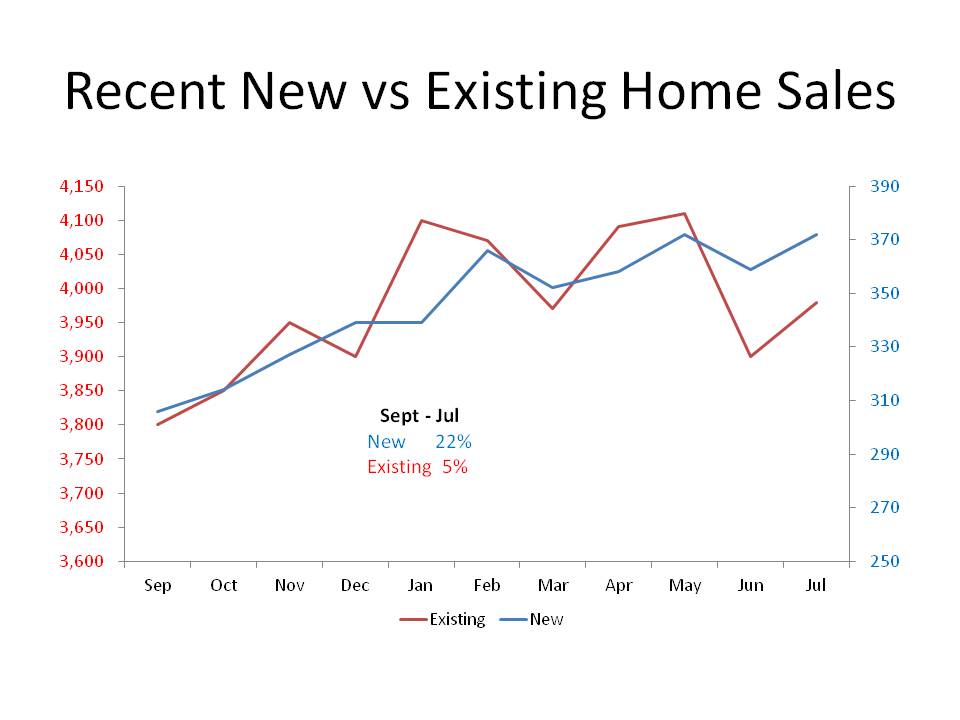
New home sales increased to 372,000 per year on a seasonally-adjusted annual basis in July, which ties the revised May 2012 rate for the highest level since the end of the home buyer tax credit in early 2010. Monthly data does have more statistical variations so looking at a quarterly moving average shows sales have been increasing since September 2011.
New home sales have improved markedly better than existing home sales since early fall 2011. New home sales have increased 22% since then while existing home sales have progressed less than 5% in the same period. This most recent period is a significant change in performance between the two sectors within the weak recovery. From peak to trough, new home sales fell 80% between July 2005 and February 2011 while existing home sales dropped at maximum of 54% between September 2005 and July 2010.
Some of the better improvement in new home sales is due to the low availability of existing homes especially at the lower end of the price spectrums. New homes also offer the latest in technology, energy savings and minimum maintenance offsetting any bargain pricing because of distress. Up to this point, new home prices have had a bottom dictated by the cost of land and building, but as home prices begin to recover, the bottoms rise and building new homes becomes possible again.