via reuters.com

As we discussed last week, the fields of behavioral economics and behavioral finance were created in the hopes of gaining a better understanding of how real people make financial decisions in real life.
Fortunately for all of us, these fields — which draw from the behavioral sciences, economics and personal finance — have generated some findings that are anything but academic. These findings include some powerful insights for those of us trying to make decisions about buying and selling our homes.
Following on last week’s top four behavioral economics insights for homebuyers, here are a handful of the field’s top takeaways for sellers, to help manage your own mindset and to optimize the way you market your home to buyers:
1. Don’t let overconfidence lead to overpricing. Real estate agents are the only commissioned salespeople I know of who, as a general rule, spend much of their time trying to talk their clients down in pricing their product. Why? Because real estate agents know that listing a home at too high a price causes unnecessary woe, drama and failure. Set the listing price too high, and a home will lag on the market, attracting lowball offers. The end result is often a price reduction, or even (worst case) the home doesn’t sell at all.
Overpricing can result from the same overconfidence and overoptimism that causes buyers to make lowball offers on great homes in a hot market and inspires investors to day trade, erroneously thinking they have superhuman stock picking skills. In fact, when you study up on successful amateur day traders, it becomes clear that what they have is less innate skill and more the willingness to voraciously, constantly research the companies and the markets — many, for hours every single day. Many have also placed rules on themselves specifically to counter their own human emotions and irrational tendencies.
And that’s precisely how home sellers can and should deactivate overconfidence when it comes to pricing: Commit to the exercise of sitting down with your agent and poring over the data about what’s going on in your market, the data about what homes have recently sold for in your area, even the data on how long it takes the average home in your market to sell and what the list price-to-sale price ratios are in your area.
It takes time and discipline, but while you’re looking through the comps, your agent can show you the potential rewards: Every market has well-priced, well-marketed homes that sell quickly.
2. Understand the endowment effect. Lest you think, like so many do, that the above point is great for all those other clueless sellers, but certainly doesn’t apply to your innate, uncanny eye for knowing what homes are truly worth, allow me to introduce you to a little something called the endowment effect. Behavioral economist Dan Ariely explains it as follows:
“Simply put, the endowment effect shows that we value the things we own more than identical products that we don’t own. This causes a mismatch between buyers and sellers, where buyers are often willing to spend less than the seller deems an acceptable price.”
Just knowing that what you think is your personal prowess for price-setting is actually a thought fallacy that researchers have known about for years might help you stay committed to making your pricing decision based on the data rather than your fallible gut.
3. Consider offering rebates and credits. Beyond using behavioral econ and finance knowledge to optimize your own decisions, smart sellers can take clues from these fields as to how to max out their marketing to buyers. One such clue is this: Offer rebates, or closing-cost credits.
Retailers and big brands have long known that offering a rebate makes buyers feel better — and less hesitant — about making a purchase, giving them the sense that they will get a bonus or a gift for spending.
This same effect applies with real estate: If you can price your home competitively with similar, nearby listings and offer a closing-cost credit to the eventual buyer, you boost your home’s attractiveness and ability to compete with other listings considerably, reducing the amount of cash a buyer will have to bring in to close the sale and making it that much easier for a buyer to get off the fence.
4. Tell prospective buyers a story. The Atlantic recently did a deep dive into consumer implications of behavioral economics. The article revealed that buyers are more inclined to make purchases where the circumstances of the marketing actually tell the buyers a story that makes them feel like they are getting a bargain, as happened when Williams-Sonoma put a $500 bread maker next to a $300 one and realized that no one bought the expensive one, but sales of the lower-priced machine doubled because of the deal people thought they were getting.
I’m going to take this one further: Don’t just tell a story to make buyers feel like they are getting a good deal when they’re not. But do provide materials to tell buyers the story of the deal they are getting: Keep a binder in the property with the competitive comparables that you believe your home is priced well against. Market your home with photos and descriptions that surface the value your home holds compared to the competition.
And don’t stop there: Stage your home in a way that tells your buyers the story of the life they could lead in your home, whatever that ideal life is for the average buyer who wants a home like yours. And consider writing a love letter about your home and your neighborhood, telling buyers the story of how well loved the home was, and creating a compelling sense of well-being around it.
The company’s stock jumped $7.20 to $34.20 on Thursday. It opened at $32.85.
Realogy Holdings said its IPO of 40 million shares priced at $27 per share, at the high end of the projected range of $23 to $27 per share.
The Parsippany, N.J., company, whose other brands include ERA and Sotheby’s International Realty, raised $1.08 billion from the offering. That makes it the third-largest U.S. IPO of the year, according to Renaissance Capital.
Realogy plans to use the proceeds it receives from the IPO, along with available cash, mostly to pay down debts. The company’s total debt was approximately $7.34 billion as of June 30.
After the market closed Thursday, the rating agency Standard & Poor’s raised Realogy’s credit grade one notch, from CCC to B, citing the company’s plans to pay off roughly $1 billion in outstanding debts.
Realogy, which is controlled by private equity firm Apollo Global Management, said in a filing with the Securities and Exchange Commission that it believes the residential real estate market is in the beginning of a recovery. The company said it sold 13 percent more homes during the first eight months of the year, compared with the same span in 2011.
Signs of a recovery are a welcome sight for Realogy, which saw its revenue drop $2.4 billion from 2006 through 2011 as the housing market faltered. The company said it worked during those lean years to reduce costs, which included making job cuts and consolidating or closing offices.
Realogy had about 15,000 employees at the beginning of 2006. By the end of 2011, it was down to approximately 10,400. The company also consolidated or closed 358 brokerage offices during that time.
Like many companies working their way back from the damage that the recession and housing market downturn inflicted, Realogy still needs to improve its financial performance. The company’s loss widened in 2011 mostly on high interest expense obligations, while its revenue was basically flat at $4.09 billion.
It is giving the underwriters a 30-day option to buy up to an additional 6 million shares, less underwriting discounts and commissions.
Realogy’s stock is trading under the “RLGY” ticker symbol.
As Paul Ryan and Joe Biden crisscross the country discussing health care, jobs and the economy, they’re campaigning for more than the vice presidency. They’re also entrenched in a battle for the right to reside at Number One Observatory Circle.
While tourists flock to 1600 Pennsylvania Ave. to check out public portions of the president’s abode, the vice president’s residence is not open for public tours. The 9,150-square-foot, three-story Victorian home was built in 1893 for the superintendent of the United States Naval Observatory. The home was so impressive that, in 1929, the chief of naval operations booted the superintendent so he could live there himself.
New addition
A dedicated home for the vice president is actually a rather new phenomenon. In 1789, John Adams became the nation’s first vice president; for the next 185 years, VPs and their families lived in their own homes or, on occasion, lavish hotel suites. The associated costs and security logistics made this custom increasingly impractical.
Finally, in 1974, Congress voted to make the house at the Naval Observatory the official vice president’s residence.
President Ronald Reagan and First Lady Nancy Reagan visit Vice President George H. W. Bush and Second Lady Barbara Bush in the VP residence. Source: Wikipedia
It took another three years before a vice president actually moved into the home. Vice President Gerald Ford became President Ford before he could use it; his vice president, Nelson Rockefeller, already had a lavish Washington, DC home and never used the house as his residence, although he did host several parties there. Rockefeller’s enormous wealth enabled him to donate millions of dollars worth of furnishings to the home.
Walter Mondale was the first vice president to move into the home. It has since housed the families of Vice Presidents Bush, Quayle, Gore, Cheney and Biden. Each new resident of the White House is offered a $100,000 decorating stipend, and additional funds are raised privately. There’s no such allowance for vice presidents; donations to the nonprofit Vice President’s Residence Foundation pay for decorating expenses.
Personal touches
During the Dan and Marilyn Quayle years, foundation funds were used to add a swimming pool and carry out renovations that made the property wheelchair accessible.
Al and Tipper Gore moved into the mansion with four children — one in college and three still at home — and three dogs.
The Gores worked with two well-known designers to update the home: Albert Hadley for the interiors and Ben Page for the gardens. The Gores gravitated toward warm yellows and reds. They used the house to showcase an eclectic collection of antiques, some they brought with them, some borrowed from the State Department. Still other furniture belongs to the residence, including an Empire dining room table donated by Rockefeller and American crafts collected by Joan Mondale. The Gores also had hedges planted around the home so it wasn’t so visible from the street and worked to replace non-indigenous species on the 72-acre grounds with native plants.
The entry foyer at Number One Observatory Circle. Lynne Cheney gives a tour of the Naval Observatory. Source: Wikipedia
Dick and Lynne Cheney preferred a palette that was clean and light: pale celadon, taupe, off-white. Washington designer Frank Babb Randolph guided them through the process of reupholstering furniture, shopping for rugs and creating custom window treatments. Veeps and their families are allowed to borrow artwork from national galleries and museums; Lynne Cheney, in particular, relished this privilege and did most of her “shopping” at the Smithsonian’s Hirshhorn Museum.
As for the most recent resident of One Observatory Circle, Vice President Biden is said to be particularly fond of the home’s outdoor entertaining areas. Chatting with reporters prior to an April 2010 luncheon with foreign leaders, Biden quipped that he’d never have anything bad to say about Quayle, his often-mocked predecessor, because Quayle was responsible for having the pool installed at the vice presidential estate.
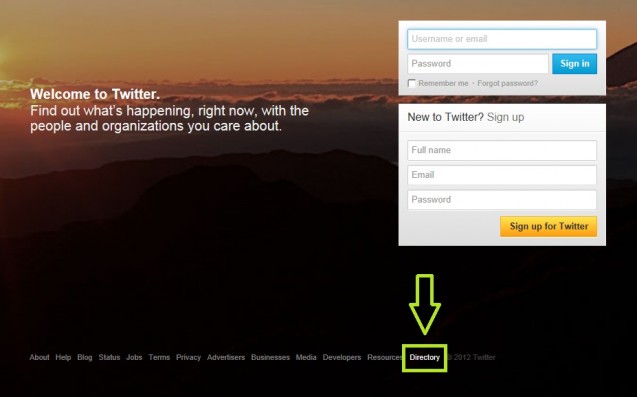
- In a world where altruistic social gathering doesn’t pay the bills, Twitter continues to make changes that it hopes will drive more traffic directly to the Twitter domain and bolster its value to advertisers. The most recent update comes in the form of an alphabetical user directory. The link to the directory was quietly added to the the default home page for visitors to Twitter not already logged into the service.
According to Matt McGee in his recent article for Marketing Land:
Twitter launched the user directory a few weeks ago, but hasn’t made a formal announcement about it. That’s likely because it exists more for search engines than for Twitter users.
Basically, Twitter is aiming to draw people who are searching Google, Bing, Yahoo, etc., for someone in particular. As the bots crawl their way through the new directory, more Twitter profiles should start showing up in search. That’s a step in the right direction, maybe.
Twitter is still struggling with the basic issue of no real reason to spend lots of time hanging out in the Twitter Web space. Users spend the most time on Twitter setting up their profile. Once it’s set, they either build up a personalized twitter stream that they keep track of on a mobile app or some other Twitter client application, or they never really get the point and let the profile languish, unused.
Even when a search result brings a user back to the Twitter domain, the realistic expectation is that they will skim the profile, make a decision to follow or not, and move on.
For those of you who love the news, information, and conversation constantly buzzing through your Twitter stream, what could Twitter do to make its space more appealing? What would it take for you to spend your time interacting with the twitterverse in the Twitter-owned domain?36

Intraday Data provided by SIX Financial Information and subject to terms of use. Historical and current end-of-day data provided by SIX Financial Information. Intraday data delayed per exchange requirements. S&P/Dow Jones Indices (SM) from Dow Jones & Company, Inc. All quotes are in local exchange time. Real time last sale data provided by NASDAQ. More information on NASDAQ traded symbols and their current financial status. Intraday data delayed 15 minutes for Nasdaq, and 20 minutes for other exchanges. S&P/Dow Jones Indices (SM) from Dow Jones & Company, Inc. SEHK intraday data is provided by SIX Financial Information and is at least 60-minutes delayed. All quotes are in local exchange time.

You may know where your dollar will stretch more when buying groceries or filling up your gas tank. But do you know the places where you can get more house for your buck?
$300,000 is a large sum of money, but in some cities — think San Francisco or New York — it’ll barely cover a 1-bedroom apartment. However, in a few other places, $300,000 can be the final bid on a brand-new 4-bedroom place. See what we mean below:
Spokane, WA
130 W 28th Ave, Spokane WA
For sale: $299,000
Square footage: 2,724The second-largest city in Washington, Spokane sits on the eastern side of the state, nestled next to Idaho. Built in 1932, this Spokane house for sale underwent a full renovation in 2007 and has 4 bedrooms and 3 baths.
Dallas, TX
18671 Gibbons Dr, Dallas TX
For sale: $299,000
Square footage: 3,216Boasting over 3,000 square feet of living space, this Dallas home for sale is the largest on the list with 4 bedrooms, 4 bathrooms and a 2-car garage, not to mention additional space in a huge media/game room. Built in 1998, the home is situated just two minutes from the nearest highway.
Nashville, TN
929 Bresslyn Rd, Nashville TN
For sale: $299,900
Square footage: 2,604The current owners of this Nashville home have owned it since 1965 and have kept the property in pristine condition. The brick split-level has 5 bedrooms, one of which could be used as a mother-in-law suite.
Atlanta, GA
1579 Gilstrap Ln NW, Atlanta GA
For sale: $299,900
Square footage: 2,301This 2004-built home for sale in Atlanta has an open floor plan centered around a large kitchen with granite countertops, island breakfast bar and stainless steel appliances. The 3-bed, 3-bath home has hardwood floors and crown molding details throughout.
Pittsburgh, PA
109 Heidcrest Dr, Pittsburgh PA
For sale: $300,000
Square footage: 2,300This colonial-style home for sale in Pittsburgh has a large wrap-around porch and sits on a quarter-acre lot. Inside the 4-bedroom, 2.5-bathroom home features hardwood floors in the main living areas and wall-to-wall carpet in the bedrooms.