Tag Archives: Katonah Real Estate

Katonah Real Estate

Foreclosure Hot Spots are Far from Healed | Katonah NY Homes

Data reports showing prices zooming in Florida and California markets that once led the foreclosure hit parade mask the reality that prices fell so far in some of those metros they still have a long way to go to reach their peaks in 2007-if they ever do so.

Many markets lost more than 60 percent of equity and the latest November price report from Lender Processing Services shows how far some have to go. Big differences between peak-to-current prices are a measure of how many homeowners are underwater and still far from the point when they will be free of negative equity, the single greatest factor in foreclosures.

Moreover, such great differences between 2007 and current prices locks an entire generation of owners into their existing homes and makes it impossible to refinance or sell.

Peak to current price differences in the largest states that are still hurting: Florida 40.1 percent; Arizona 37.4 percent; California 35.9 percent; Illinois 30.1 percent; Georgia 27.7 percent and Michigan 26.1 percent.

Perk to current price differences in the largest metros that are still hurting: Las Vegas 53.9 percent; Riverside/ San Bernardino 44.8 percent; Orlando 43.4 percent; Sacramento 41.8 percent; Miami 40.5 percent; Phoenix 38.5 percent; Tampa 37.7 percent; and Oxnard 34.8 percent.

Connecting the Dots on the Social Experience | Katonah NY Realtor

Your B2B firm trumpets its engaged, active customers. These customers, the sweet center of any successful business, generate a significant portion of your firm’s revenue. These same customers serve as references; speak at industry conferences; share ideas and feedback about your company. When they broadcast positive feedback (public or private), that precious message makes the rounds in your firm’s C-suite. In return, these customers will be thanked with some great company swag in appreciation … maybe even be featured on your company’s website.

Is that all? Really? 

With all that back-and-forth communication, how often do customer suggestions and ideas actually make a difference in your company? More specifically, how often does what your customers say to your firm about your company’s processes, products or services serve as a catalyst for real change in your operations? I thought so.  But really, how could it?  

Many large organizations have created what I like to call a “Social Media Muddle.” They have a plethora of social media tool experiments underway: newsletters and blogs for customer communications, twitter and Facebook for customer interaction, LinkedIN for promotions, sometimes even an online customer community to provide all of the above and more.  But … all these different social outreach and listening opportunities are run by different departments, and are completely and utterly divorced from core operations and processes. Product development, customer care and R&D most likely do not have direct access to information they crave – the voice of the customer.

 So while your social customers are actively sharing information about their needs in many places – public and private, online and offline – your company keeps on keeping on, just doing things according to plan. A plan that is not adjusting and adapting to ever-changing customer needs.

Chappaqua and Katonah Lead in 2012 Average Sold to Ask Price | RobReportBlog

Chappaqua and Katonah Lead in Average Sold to Ask Price | RobReportBlog

Average 2012 Sold to Ask Price
93.72%Armonk
95.68%Chappaqua
93.10%Pound Ridge
93.07%North Salem
93.42%Bedford NY
93.66%South Salem
92.68%Bedford Hills
94.91%Mount Kisco
95.17%Katonah

4 Reasons to Convert Your Facebook Business Profile into a Page | Katonah NY Realtor

Have you ever gotten a Facebook friend request from something other than a person?  I have… several times… recently.  There are countless businesses operating in Facebook as user profiles rather than pages.  In the early days, those enterprising business owners that could see serious potential in Facebook had no option but to launch a profile for their business.  Over the years the connections have brought success, so there is little motivation to change a good thing.  Lots of small business owners have only had time and energy to learn their way around a profile, so they stick with what they know and understand when it comes to their Facebook presence.  Whatever the reason may have been to launch a business profile, there are 4 very huge reasons to make the switch to a business page.

Reason #1: You are in violation of the Facebook user agreement and run the risk of losing access to all of your hard work.

Here it is as stated on the Facebook Help page:

Maintaining a personal account for anything other than an individual person is a violation of Facebook’s Statement of Rights and Responsibilities. If you don’t convert your noncompliant account to a Page, you risk permanently losing access to the account and all of its content.

Exact wording from the Statement of Rights and Responsibilities:

Registration and Account Security

Facebook users provide their real names and information, and we need your help to keep it that way. Here are some commitments you make to us relating to registering and maintaining the security of your account:

  • You will not provide any false personal information on Facebook, or create an account for anyone other than yourself without permission.
  • You will not create more than one personal account.
  • If we disable your account, you will not create another one without our permission.
  • You will not use your personal timeline primarily for your own commercial gain, and will use a Facebook Page for such purposes.
  • You will not transfer your account (including any Page or application you administer) to anyone without first getting our written permission.
  • If you select a username or similar identifier for your account or Page, we reserve the right to remove or reclaim it if we believe it is appropriate (such as when a trademark owner complains about a username that does not closely relate to a user’s actual name).


Facebook does have a way to convert a profile to a page, enabling you to keep your user name and connections and not start again from scratch.  If this first reason is enough for you, scroll down to the bottom of the post for all the links and info you need to start converting to a business page.

Reason #2: You have no way of tracking your effectiveness on a profile.

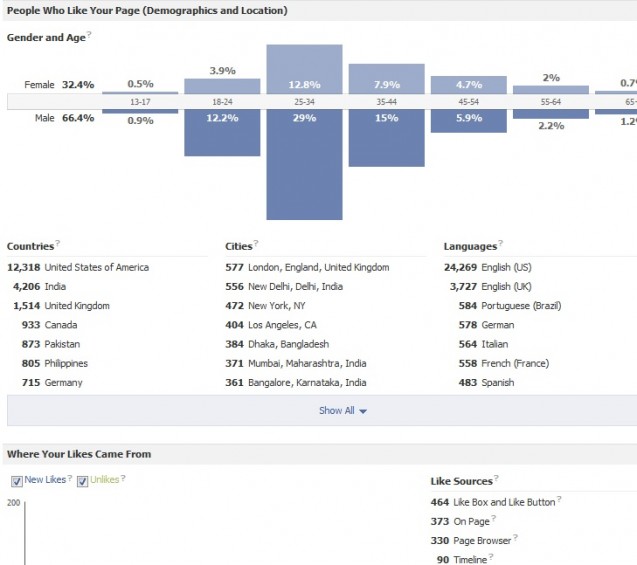
How many people like your business is only the beginning.  To get the most out of the time and effort you put into Facebook, you need to be able to determine the makeup of your fan base, their consumption habits, and how well your message propagates beyond the people you are directly connected to.  Since Pages are designed for business use, they come with tons of data not available to a user profile.  The page “Insights” provide up to date information about what kind of interaction and reach each post on the page timeline generated.  Insights will break down your fan base by gender, age, location, and how they came to land on your page.  This kind of data enables you to stop shooting in the dark and serve up content that keeps your business connections buzzing.

FB Page Demographics


 Reason #3: Your profile has no access to advertising and promotion.

Facebook’s billion users is a huge draw for any business looking to expand their customer base.  But reaching the right people at the right time is tricky.  A user profile is designed for personal one on one relationships and was never intended to reach large groups of people.  The most powerful tool offered by Facebook for reaching it’s vast user base is advertising and promotion.  That tool is only available to business pages.  If you want to reach Facebook users that you do not already have some connection to, you need to break free of the profile and get access to the business promotional tools.

 Reason #4: You will miss out on Graph Search opportunities.

Facebook search will fundamentally change the way users navigate the topics and connections that interest them most.  Soon users will be able to search for restaurants their friends like.  But if you are interacting with your Facebook connections as a “friend” with a user profile rather than a restaurant with a business page, you could wind up pointing your friends to other restaurants rather than their friends pointing them back to your business.  So long as you operate you business on Facebook as a user profile, your business will be defined by search as a friend.  In order for new people to discover your business via Graph Search, you need your business on a page that people can “like.”

So, how do you convert your profile to a business page?

Here is the basic info from Facebook Help:

When you convert your personal account to a Facebook Page, we’ll transfer your current profile picture and add all your friends and subscribers as people who like your Page. Your account’s username will become the username for your Page, and the name associated with your personal account will become your Page’s name. If you want your Page to have a different name, consider creating a new one.

No other content will be carried over to your new Page, so be sure to save any important content before beginning the conversion:

  1. Download your timeline information. You can download a file that contains all of your sent and received messages and all of the photos and videos you’ve uploaded to Facebook.
  2. Appoint a new group admin to any groups you manage. You’ll be unable to manage groups once the conversion begins.

When you’re ready, start converting your personal account to a Facebook Page.


How the Crash Battered America’s Housing Stock | Katonah Real Estate

Spending on home improvements and repairs totaled $275 billion in 2011, down 4 percent from 2009 levels and some 16 percent below the market peak in 2007. Loss of home equity with the onset of the housing crash contributed to the decline in home repairs, according to a new study by the Harvard Joint Center for Housing Studies.

With the decline in spending on discretionary projects, home improvement expenditures per owner in 2011 stood well below levels averaged over the previous decade. In fact, per-owner spending fell from about 25 percent above the decade average in 2007 to about 10 percent below that level in 2011,

Near the top of the list of causes for the decline in home improvement spending is the loss of home equity resulting from the unprecedented plunge in house prices during the housing crash. After several years of strong house price appreciation, homeowners nationwide had almost $13 trillion in equity in 2006, or almost $170,000 per owner on average. By 2011, however, aggregate home equity had dropped by half to $6.5 trillion, or $87,000 per owner.

Since home equity is a major source of wealth for most owners, sharply lower house values make owners feel less wealthy and therefore less likely to spend in general and on improvements in particular. And with less equity available and credit still tight, households are finding it more difficult to get financing for projects. In 2011, owners with under 20 percent equity in their homes spent about 22 percent less on average on home improvements and about 30 percent less on discretionary projects than owners with at least 20 percent equity. In fact, owners with some but less than 20 percent equity spent about the same as those with zero or negative equity in that year. Owners without mortgages-primarily older owners-also spent about the same as owners with less than 20 percent equity.

In 2011, the Harvard study found that more than a million distressed properties came back onto the housing market, including 760,000 lender-owned units and 300,000 short sales. Lenders improved about a third of their foreclosed properties prior to sale, with an average expenditure of about $6,500 per unit. About 60 percent of owner-occupant purchasers undertook improvements, averaging $11,100, while investors spent even more per unit on average than either lenders or owner-occupants, $15,600.

The Harvard study also noted the role investors are playing turning foreclosures into affordable rentals. Some 4.4 million formerly owner-occupied units were shifted to the rental market between 2007 and 2011. Another 4.6 million were vacant in 2011 and may become part of the rental stock as demand continues to grow.

The unexpected investor expenditures to improve the quality of America’s single family housing stock came as the nation began to experience what the Harvard study calls an “uptick” in the deterioration of housing quality at the outset of the housing crash. In 1997, 4.4 percent of owner-occupied homes were considered inadequate, the study said. By 2007, these same units accounted for almost 8 percent of homes that were no longer owner-occupied (i.e., stood vacant or were converted to rental or nonresidential uses), indicating their increasing deterioration. Even more telling is that these inadequate units accounted for almost 17 percent of the homes that were demolished within the decade.

The study also tracked lender spending to restore REO properties for sale. During the housing downturn, the plunge in house prices precipitated a wave of foreclosures in many metropolitan areas. The foreclosure process often takes years to complete, wreaking havoc on mothballed and backlogged properties. But once foreclosure is completed, banks and other institutions typically invest in repairs to get the homes ready for sale and back into active use.

According to Joint Center estimates, lender expenditures on distressed properties amounted to $1.7 billion in 2011, with Atlanta, Las Vegas, Orlando, Phoenix, and Riverside posting the highest shares of spending . Local housing market conditions dictate the average amount that banks and institutions expend to prepare distressed properties for the market. In 2011, lenders invested considerably more per property in higher-priced markets such as Denver, Los Angeles, Portland, Raleigh, and Washington, DC. In large measure, this disparity reflects the fact that properties in these markets often need to be in better condition to sell at a competitive price within a reasonable amount of time.

By comparison, in depressed Rust Belt metros such as Cleveland, Detroit, Milwaukee, and Pittsburgh, improvement spending per REO property was less than a third of outlays in more competitive markets.

“Renovating foreclosed or abandoned homes benefits the entire neighborhood. Joint Center research has shown that home prices in neighborhoods with higher levels of improvement spending appreciate more rapidly, explaining why investing in blighted neighborhoods has been a national priority in dealing with the foreclosure crisis,” said the report.