The administration introduced HARP 2.0 in the fall, which among other things eliminated the loan-to-value limits on certain loans refinanced by Fannie Mae and Freddie Mac. Those changes were put in place in March and appear to have made an impact, though that impact is muted. A robust HARP could reduce the cost of homeownership for roughly 3 to 4 million borrowers, thereby prevent some foreclosures in areas experiencing a fledgling together a recovery, boost confidence in the housing market and help to modestly stimulate the economy.
Below is a chart that shows the share of outstanding loan balances that prepay (CPR) on Fannie Mae mortgage pools issued in 2008 at various coupon rates. Each coupon represents a group of borrowers and roughly corresponds to rate on their mortgages (minus servicing costs and fees). The average mortgage rate on the 30-year fixed rate mortgage is graphed in red.
In the chart below, it is apparent that the prepayment rate on most coupons began to rise in mid-2011 as mortgage rates fell. However, the higher coupons were slower to respond and the 7.0% coupon was nearly flat until March of 2012 despite rates that had slid from roughly 4.6% to nearly 3.9%. This pattern is counterintuitive and breaks from historic norm as higher coupons have more to gain by refinancing. For example, the monthly savings for a person refinancing from 7% to 4% is proportionally greater than a borrower who refinances from 5% to 4%.
Market analysts as well as staff at the regulators and the agencies noted this pattern and have been working to identify factors that keep high rate borrowers from refinancing. Some of the “frictions” that have been identified include:
- 2nd lien holders not re-subordinating their loans; that is, the holders of 2nd loans being either unwilling or unable to agree to allow the 1st lien to keep its favored status after the refinance, something that is normally lost if the 1st lien is modified.
- Mortgage insurance companies who won’t port MI contracts to the refinanced loan
- Requiring new representation and warrants for any new servicer, but not the original servicer.
- Loan level pricing adjustments, which can add 0.75% to the upfront cost of a loan for HARP loans up to $1,500, and
- Appraisal fees
There is mixed opinion about which of these factors is most constraining for HAMP eligible borrowers. The majority of mortgage insurers now allow the transfer of policies on HARP refinances, while the largest banks, who hold nearly 70% of 2nd liens, allow for re-subordination. That leaves a large portion of the universe of 2nd liens, though, and there are reports of companies that buy up the 2nd lien debt for well below value and act as a debt collector. Loan level pricing adjustments can be financed, but would add roughly 19 basis points to the annual rate and a $400 to $500 appraisal could be enough to hinder a cash-strapped borrower. However, for a borrower refinancing from 7% to 4%, the additional 19 basis points may not explain the reluctance to refinance unless financing to the fee is not an option. Most analysts agree that the servicing issue may carry weight, though. The constraint on new servicers reduces competition and allows same-servicers to charge higher rates, which some analysts have quantified as greater than half a percentage point for some borrowers.
With the implementation of HARP 2.0 in March, one can see from the chart above that prepayments on the highest coupon (7.0) jumped from 23.3% to 30.7% between April and May of this year, suggesting that the elimination of LTV limits had an impact. The spread between all coupons and the 5.0 coupon eased over this period. However, the counter intuitive ranking of prepayment speeds relative to coupons is persistent, though smaller, which suggests that frictions remain that limit refinancing of HARP eligible loans with higher coupons. Furthermore, between May and June, the rate of prepayment growth eased, plateaued, or declined for all coupons, suggesting that the benefit of HARP 2.0 may have peaked or is close to it.
The benefits of a robust HARP program are many-fold for the housing market, particularly those local markets that experienced the sharpest price decline and where many homeowners remain underwater. While HARP 2.0 appears to have had an effect, there are several measures that may provide further help by restoring competition and confidence to the market place.
Tag Archives: Bedford NY Real Estate
Best Social Networks for Renters | Bedford NY Real Estate
Being a renter has its ups and downs. Finding an apartment now, when more people than ever are choosing to rent, is not easy. Fortunately, today’s technology and social media offers some great ways to make the whole process easier and quicker. You can tour apartments virtually, review listings in your area without leaving your couch or buying a newspaper, and read reviews by others who’ve lived in the area. Since there are so many different websites that promise to help, it’s easy to get lost in them. Here are reviews of 6 social media sites for renters. Use this to decide which networks will work for you!
RentSocial
Currently in Beta, RentSocial features a sleek, easy-to-navigate design. Once you sign in, you get a profile with saved rental properties, friends also on the network, and a message center. Each rental property has its own page, which includes reviews, photos, general information, prices, floor plans, pet information, contact information, and more. The site also makes it easy for landlords to add properties. The drawback with this site, though, is that it’s so new that not a lot of people use it yet. If you’re looking to rent in a large city like Minneapolis, you’ll find some listed properties. However, you won’t find as many as you would on other rental search sites.

Apartable
Also featuring a navigable design, Apartable is a little bit simpler than RentSocial. Instead of having a whole profile page, you just have an account where you can save apartments. Apartment pages show mostly the same information – price, amenities, images, square footage, and more. The drawback on this site is also the fact that it is quite new. There are many apartment listings for major cities such as Chicago or Boston, but not as many or none in non-major cities.

10ants
10ants is a social network for renters to connect with neighbors. We’ve all been in that situation where you need a baby sitter, or you’d like to share WiFi with a neighbor to reduce costs, or you’re trying to set up a group to play a game. On 10ants.com, you can post messages for others in your building to read. Each building gets its own home page, or “Bulletin Board”, where people can leave notes and questions for each other. While this sounds like a wonderful idea, it would appear that there’s not a lot of activity on the site, making it not as useful as it sounds.

Rental Wall
The Rental Wall site is for all types of rentals, from apartments to vacation homes to timeshares. Also in beta, the site is trying to catch its footing. The layout of each building or offer is nice, with the contact information readily available, and a large area for photos. However, it’s hard to find many properties to look at, as it doesn’t have many listings yet.
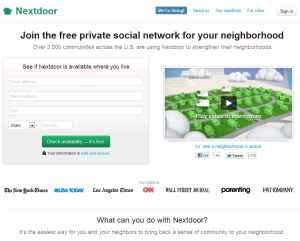
Next Door
Like 10ants but newer and sleeker, Next Door tries to create a sort of online community hangout spot. Instead of buildings, though, this site focuses on communities. It serves as a place for residents to meet, post events, share advice and recommendations, and more. Again, depending on where you live, your community may or may not be included in the new site. However, you can recommend that they create a space for your community and invite neighbors.

Although Facebook doesn’t have a certain area devoted to renters, it can be used by those looking for a new apartment. Especially if you’re looking at a popular apartment building, the landlords may have a Facebook Page set up for tenants and others to get together and talk about the building and the area. Try searching for your city, such as the City of Minneapolis, or your apartment building, such as the Eitel Building, or community. Searching for the neighborhood may bring up community pages, local business pages, association pages, and more.
Bedford NY Real Estate | Are You Getting the Most Bang for Your Buck?
Everyone wants to know if they are optimizing their budget and one of the best ways to find out is to ask your peers. Of course, actually doing that is a pretty time consuming endeavor. That’s why we are stoked ActiveRain did just that.
Back in January ActiveRain surveyed more than 2,000 agents and brokers to find out what software and marketing tools real estate professionals are using in their business and how much they are spending.
What did they find?
- Social media, SEO, and blogging are the highest areas of participation, but the lowest spend.
- Direct mail continues as the largest offline marketing channel with very high spend.
- 26% of agents are spending money with national real estate web sites like Zillow, Trulia and Realtor.
- The average real estate agent spends $75 per month on their website.
- 21% of agents are using e-signature services and spending $37 per month.
Check out this infographic to find out more.
Data provided by ActiveRain.com. Join 215,590 Real Estate Agents on the world’s largest Real Estate Social Network.
How does this compare with your budget? Do you plan to make any changes after seeing these figures? Tell us about it in the comment section below.
Tammy Faye Bakker Messner’s Spirit Lives on in Newly Listed Dream House | Bedford NY Realtor
Behind the Numbers: Rising Hopes on New-Home Sales | Bedford NY Real Estate
Sales of new homes rose in May, fed by consumers taking advantage of record-low interest rates and limited supply.
As we report, sales climbed 7.6% from April to a seasonally adjusted annual rate of 369,000, the Commerce Department said Monday. May’s sales surged 20% from a year ago and struck the highest level since April 2010.
Sales are on track to beat the 306,000 homes sold last year, which was the lowest level since record keeping began in 1963.
On another bright note, prices for new homes rose 5.6% in May from the same month a year ago. Meanwhile, just 4.7 months of homes are available at current rates, leading some industry watchers to warn a supply shortage could loom in coming months. The current supply, which has fallen from 14.3 months in early 2009, is below the six months considered to be stable for supply/demand.
The improvement in the new-home market — which makes up just 10% or so of all home sales — comes as the hard-hit sector appears to have hit bottom.
To be sure, sales of both new and existing homes face a bumpy road to recovery, particularly given that the economy appears to be cooling. In May the country added just 69,000 jobs — the worst growth of the year — and the unemployment rate moved up to 8.2%. Tight credit standards, meanwhile, continue keeping would-be buyers out of the market, as do low appraisals.
Here’s what industry watchers think:
Michael Gapen, economist, Barclays: “The persistent decline in both the level of new-home inventories and months’ supply of inventories is one of the main factors behind the gradual firming of home builder sentiment in recent months, something we see as consistent with the improved pace of new home start activity. Overall, we see the May new homes sale report as yet another data point that supports our view that housing is in a moderate recovery phase.”
Dan Oppenheim, builder analyst, Credit Suisse: “We expect new home sales to continue to trend higher in the coming months, and think this should help to alleviate recent investor concerns about a slowing in sales.”
Paul Diggle, economist, Capital Economics: “While the tightness of supply conditions is positive for the house price outlook, the bigger picture is still that the housing recovery is proceeding very slowly. After all, new-home sales are about 55% below a healthy level of 850,000 and at the recent rate of improvement it would take more than seven years to return to that point.”
Jobless Claims News for the Bedford New York Real Estate market
In each Economic Update, the Research staff analyzes recently released economic indicators and addresses what these indicators mean for REALTORS® and their clients. Today’s update discusses unemployment insurance claims and home prices.
- Initial claims for unemployment insurance are moving in the wrong direction, with more people needing unemployment checks. The latest figure, though not good, still implies net job creation in the economy.
- A total of 387,000 initial claims were filed, following the previous week’s upward revised claims estimate of 389,000. This is the 4th week that the 4-week average has been rising.
- In normal economic times, initial jobless claims hovered at around 300 thousand while the generated about 200 thousand jobs monthly.
- If claims moves up to 400,000 (as it is doing now) we will see modest job gains. If the figure rises above 450,000 then the economy would on net be losing jobs.
- In separate housing news, aside from home sales figures as reported by NAR, the home price index is rising at a faster pace according to new government data. According to FHFA, home prices rose 0.8 percent in April and are higher by 3.0 percent from one year ago. The Mountain states are booming with 6.5 percent gain. This index essentially uses the same formula as Case-Shiller, so other home price measurements in the upcoming months will also show healthy and accelerating home price gains. Low inventory also bodes well for future home price growth.
Impact of Student Debt on Future Housing Demand | Bedford NY Real Estate
At May’s midyear legislative meetings held by the National Association of Realtors in Washington, DC, a panel of experts in a session titled “Shifting Demographics and Housing Choice: A Whole New World?” discussed future housing market demand and trends to keep in mind as we think about the future of housing in the U.S.
The biggest takeaway was that baby boomers will increasingly contribute to housing supply as they age, yet echo boomers are in a difficult position to absorb the inventory. The echo boomers, also called Millennials, are those currently ages 17 to 31, and account for 62 million people. And although future housing demand highly dependents on different rates of household formation among Echo Boomers, this generation is in a precarious position.
In addition to having seen the worst housing downturn, these younger buyers have been hit hard by the recession. Faced with an uncertain job market, no real income growth, tighter mortgage lending rules, and mounting student and credit card debt, it is no surprise that some of them do not put priority on homeownership.
The concern over student debt is particularly alarming. According to a number of recent research studies, college seniors who graduated with student loans each owed an average of $25,250, up significantly from an average of $12,750 in 1996. Parents have accumulated student debt as well, $34,000 on average. The aggregate amount of student loan debt in the U.S. is over $1 trillion currently. The pace at which debt is mounting adds to the concern. Between March 31, of this year and 2011, student loan debt rose by $64 billion. However, over the same period, all other forms of household debt fell by $383 billion. Put another way, since the peak in household debt in the third quarter of 2008, student loan debt has increased by $293 billion, while other forms of debt fell by $1.53 trillion.
The rise in student debt is attributable to rising cost of education. Since 1978, the cost of tuition in the U.S. has increased more than 900 percent, 650 points above inflation. Between1990 and 2010 alone, tuition rose by 116 percent while the median household incomes inched a mere 2.1 percent.
There are some variations across states though. California ranks 46th among the 51 states – with average student debt at $18,113. New Hampshire ranks 1st with highest average debt at $31,048. Also, in California, about 48 percent of 2010 graduating class had student debt, while in New Hampshire 3 out of 4 students had student loans. But even within California, student debt ranges widely, particularly between public and private institutions. While debts from public colleges reaches $24,000, some private college students have walked out with over $50,000 in student debt . Figure 1 depicts the change in total cost of attendance and average debt of graduates for the last decade for California institutions for 4-year or above college education. One startling point to note is that total cost of attendance has been growing faster than average student debt of graduates. One reason for that may be that parents are picking up more of the costs.
So, how does the increasing student debt play into home buying process? Student loan payments are included in Debt-to-Income ratio. The ideal 33 percent of debt-to-income includes student loan payment, car payment, credit card payments and the monthly mortgage payment. Table 1 below provides a simple estimate of the impact of student loan debt on one’s ability to afford a mortgage payment. With recent discussion around doubling of current student loan interest rates from 3.4 to 6.8 percent on July 1, there are two scenarios included. The first one looks at the impact of an average $19,000 loan facing recent California graduates and the second scenarios illustrates the impact of higher student loan debt, $50,000. In both cases, student loan payment increases with doubling of interest. While the average student debt impacts mortgage payment by 2 percent, the larger debt has a 7 percent impact on the mortgage payment. In either case, student loan payments matter in evaluating debt-to-income ratio for potential new homebuyer.
Given the already very large federal deficit an additional government spending in form of interest rate subsidy to students must be viewed cautiously. Such issues as college administration staff and salaries, which may be raising overall tuition must also be examined. Still, it is worth analyzing the growing student debt load and its potential impact to future home buying.
Rents Climb In Downturn, Demand Up | Bedford NY Real Estate


Currently in Beta, RentSocial features a sleek, easy-to-navigate design. Once you sign in, you get a profile with saved rental properties, friends also on the network, and a message center. Each rental property has its own page, which includes reviews, photos, general information, prices, floor plans, pet information, contact information, and more. The site also makes it easy for landlords to add properties. The drawback with this site, though, is that it’s so new that not a lot of people use it yet. If you’re looking to rent in a large city like Minneapolis, you’ll find some listed properties. However, you won’t find as many as you would on other rental search sites.
Also featuring a navigable design, Apartable is a little bit simpler than RentSocial. Instead of having a whole profile page, you just have an account where you can save apartments. Apartment pages show mostly the same information – price, amenities, images, square footage, and more. The drawback on this site is also the fact that it is quite new. There are many apartment listings for major cities such as Chicago or Boston, but not as many or none in non-major cities.
10ants is a social network for renters to connect with neighbors. We’ve all been in that situation where you need a baby sitter, or you’d like to share WiFi with a neighbor to reduce costs, or you’re trying to set up a group to play a game. On 10ants.com, you can post messages for others in your building to read. Each building gets its own home page, or “Bulletin Board”, where people can leave notes and questions for each other. While this sounds like a wonderful idea, it would appear that there’s not a lot of activity on the site, making it not as useful as it sounds.
The Rental Wall site is for all types of rentals, from apartments to vacation homes to timeshares. Also in beta, the site is trying to catch its footing. The layout of each building or offer is nice, with the contact information readily available, and a large area for photos. However, it’s hard to find many properties to look at, as it doesn’t have many listings yet.
Like 10ants but newer and sleeker, Next Door tries to create a sort of online community hangout spot. Instead of buildings, though, this site focuses on communities. It serves as a place for residents to meet, post events, share advice and recommendations, and more. Again, depending on where you live, your community may or may not be included in the new site. However, you can recommend that they create a space for your community and invite neighbors.
Although Facebook doesn’t have a certain area devoted to renters, it can be used by those looking for a new apartment. Especially if you’re looking at a popular apartment building, the landlords may have a Facebook Page set up for tenants and others to get together and talk about the building and the area. Try searching for your city, such as the