via jeffbullas.com

US ECONOMY SHRINKS: GDP FALLS 0.1% IN Q4
Pete Souza/Official White House photo
The advance estimate for fourth-quarter U.S. GDP is out.
The economy contracted 0.1 percent in Q4 versus economists’ consensus expectations of a 1.1 percent expansion.
Personal consumption growth came in at 2.2 percent – slightly higher than consensus estimates of 2.1 percent – but was driven largely by a 13.9 percent advance in the consumption of durable goods.
Government spending was the largest driver of the economic contraction in the fourth quarter, subtracting 1.33 percentage points from Q4 GDP growth and falling 6.6 percent. Federal spending fell 15.0 percent, led by a 22.2 percent drop in defense spending. Federal spending on nondefense items was actually up 1.4 percent. State and local spending fell 0.7 percent.
The drawdown in private inventories was the second culprit behind the contraction, subtracting 1.27 percentage points from Q4 GDP growth after adding 0.73 percentage points to Q3 GDP growth.
5 Must-Haves For Social Media Management
Social media has grown from a curiosity to an integral piece of corporate strategy in the space of only a few years. Nearly overnight, companies have brought on whole teams of specialists to craft effective social media strategies and manage multiplying numbers of social media accounts. Companies are hungry for better social media tools to engage their constituents. Below is a list of five features key to delivering on a social media strategy.
1. SCHEDULING
Social media doesn’t sleep, but that doesn’t mean you don’t have to! Ensure your social media management tool of choice allows you to schedule messages in advance. So, even while you are in meetings with clients in New York, you can schedule messages to go out to your customers in Tokyo during their workday.If you want to take scheduling to the next level, look for a tool that offers the ability to schedule large batches of messages at once. This will be an incredibly useful time-saver when it comes to managing campaigns or contests that require heavy messaging around a certain period of time
2. GEO
When it comes to interacting with your customers, those in different locations may have different needs, speak different languages or follow different trends. You’re going to want a tool that optimizes your searches and filters your searches by language to help you curate relevant content for different demographics.3. KEYWORDS
Social media is also an effective way for businesses to keep their finger on the pulse. Setting up keyword search streams provides insight into what your customers think is trendy. This can assist with the development of a marketing strategy that focuses on your customer’s lifestyles and personal preferences.Keywords are useful for keeping track of competitors’ activities but they’re also useful for tracking brands that are complementary to your offering. If your product or service is often purchased in conjunction with another product or service, keep an eye on the complementary product’s social media activity to take advantage of promotions or recent sales, as these are potential leads ready to be converted.
4. COLLABORATION
It takes two to tango, especially when it comes to being social. Collaboration is key when it comes to developing and executing an effective social media campaign. Ensure your social media management tool enables you to seamlessly collaborate with your team to ensure you execute an integrated social media management strategy.5. REPORTING
Gone are the days of social media purely being about “building buzz.” It is now a line item in budgets as companies invest resources in these channels and there is an expectation for reports which show ROI for social media outreach.Make sure your tool has the ability to analyze important metrics such as click-through rates on shortened links, clicks by region and top referrers. It’s also important to have access to Facebook Insights and Google Analytics.
The most effective tools will provide the ability to access in-depth granular metrics on the efficacy of your social media programs. This will allow you to determine which messages resulted in the highest number of conversions, which platform is providing the greatest return and which time of day is most effective to drive traffic.
WHAT IT TAKES TO GO PRO
Social media is here to stay and to maintain a competitive advantage, businesses need to stay abreast of this ever-evolving space. I’ve recently completed the training and become a Certified HootSuite Professional and have found that HootSuite is a tool many find very useful. I am also familiar with TweetDeck and Adobe Social. The point is, there are products out there to meet your needs.What are you using to satisfy these 5 Must-haves?

A U.S. housing-market revival may prove illusory and the threat of further weakness remains, said Robert Shiller, a professor at Yale University and co-creator of the S&P/Case-Shiller index of property values.
“The housing market has been declining for something like six years now, it could go on, that’s my worry,” Shiller told Tom Keene in a Bloomberg Television interview today in Davos, Switzerland. “The short-term indicators are up now, it definitely looks better, but we saw that in 2009.”
The property market has shown signs of recovery and homebuilding has rebounded as low borrowing costs spur buyer demand, bolster prices. Values rose 7.4 percent in November from a year earlier, the ninth straight increase and the biggest gain since May 2006, Irvine, California-based data provider CoreLogic said last week.
“It’s a good housing market in the sense that mortgage rates are very low and prices have come down to normal levels, so yes, it’s a good time to buy if nothing bad happens,” Shiller said. “But it’s also a very bad housing market in that most of the mortgages are being supported by the government, and we have the Fed and this buying program. It’s a very abnormal market. There’s a lot of uncertainty going forward.”
The average rate for a 30-year fixed mortgage fell to 3.38 percent in the week ended Jan. 17 from 3.4 percent, McLean, Virginia-based Freddie Mac (FMCC) said that day. The average rate dropped to a record 3.31 percent in November. New-home sales in December picked up to a 385,000 annual rate, according to the median forecast of economists surveyed by Bloomberg ahead of a Commerce Department report tomorrow.
Attending Davos
The S&P/Case-Shiller index of property values in 20 cities increased an annual 4.3 percent in October, the biggest 12-month advance since May 2010, the group said on Dec. 26. The next report is due on Jan. 29.
Data on Jan. 22 showed sales of U.S. existing homes unexpectedly fell in December. Purchases fell 1 percent to a 4.94 million annual rate last month, the National Association of Realtors said. The median forecast in a Bloomberg survey was for a gain to a 5.1 million rate.
Shiller, who spoke while attending the World Economic Forum’s 2013 annual meeting, also said that while global economic conditions are “a little better,” there are still risks to the recovery.
“We’ve been five years in a slow economy, and it could go quite a bit longer,” he said. “We’ve seen gross domestic product growth at sub-normal levels.”
He added, “I think we’re pretty far from irrational exuberance, maybe 50 years
HARRISBURG, Pa. (AP) — Advances in hydraulic fracturing technology have powered the American natural gas boom. And now hydraulic fracturing could be increasingly powered by the very fuel it has been so successful in coaxing up from the depths.
Oil- and gas-field companies from Pennsylvania to Texas are experimenting with converting the huge diesel pump engines that propel millions of gallons of water, sand and chemicals thousands of feet down well bores to break apart rock or tight sands and release the natural gas trapped inside.
It’s the latest way for drillers to become consumers of the product that they are making broadly available in large amounts — and extremely cheap. Production has increased so much that natural gas has flooded the market, dragging down prices and forcing companies to pull back on their plans to expand drilling while looking for new ways to use gas.
After the conversion, the engines will run on cheaper natural gas, or a blend of diesel and natural gas. That brings down costs and, theoretically, cuts down the sooty exhaust that comes from burning diesel.
“You’re going to see this spreading quite rapidly across the industry,” said Douglas E. Kuntz, president and CEO of Pennsylvania General Energy Co., based in tiny Warren, Pa. “As the technology evolves, you’ll see more companies across the country doing more natural gas fueling of this equipment.”
A number of increasingly cost-conscious oil- and gas-field companies are already using natural gas to run their trucks and drilling rigs. But what makes the conversion of the hydraulic fracturing pump engines to natural gas particularly challenging is the sheer number of engines running at once, and the amount of horsepower necessary to power the pumps.
PGE and contractor Universal Well Services, of Meadville, Pa., are converting a 16-engine pumping unit — called a “frack spread” — so that the engines will accept a blend of 70 percent natural gas and 30 percent diesel. It should be complete by May and is estimated to cost less than a quarter of what it would if it was powered by diesel alone.
Houston-based Apache Corp., one of the nation’s largest independent oil and gas exploration companies, has worked with Halliburton Co., Schlumberger Ltd. and Caterpillar Inc. to develop similar technology.
A 12-engine unit — the first full frack spread that is operating in the field, according to Apache — just completed two Granite Wash wells near Elk City, Okla. Another unit is in the process of being completed.
“Today we’ve said, ‘we’ve seen enough testing.’ We’ve decided this is how we want to frack with all of our fleets and we’re going to start with two permanent conversions,” said Mike Bahorich, Apache’s executive vice president and chief technology officer.
PGE will be able to use field gas, drawn from pipelines that connect to its nearby Marcellus Shale wells in north-central Pennsylvania, and save trips by fuel-hauling trucks. For now at least, Apache will have to truck in compressed natural gas or liquefied natural gas to run its new frack spreads, but it hopes to start using the cheaper field gas in the future, Bahorich said.
It also may provide a way for drilling companies to improve their image on environmental issues after sustaining criticism for air quality problems around gas wells and the practice of lacing hydraulic fracturing fluids with chemicals.
The U.S. Environmental Protection Agency calls reducing pollution from diesel engines one of the county’s most important air quality challenges. Diesel engines can produce large quantities of smog-forming nitrogen oxides and soot, which can cause lung and heart problems. Soot also plays a significant role in climate change, researchers say.
Saving the truck trips will improve air quality, but the size of the benefit from replacing diesel engines with natural gas is less clear, according to environmental advocates.
That’s because new diesel engines are subject to strict environmental standards and natural gas-powered engines give off only slightly less pollution, said Joe Osborne, legal director of the Pittsburgh-based Group Against Smog and Pollution.
Regardless, the economic benefit appears enormous for an industry that used more than 700 million gallons of diesel domestically in hydraulic fracturing last year, according to Apache estimates.
The cost to convert the engines is far less than the roughly $3.5 million per frack spread that Apache can save if it completes 140 planned wells in a year with the two units, Bahorich said.
For PGE and Universal, the cost of conversion and engineering will be several million dollars, said Roger Willis, Universal’s president. After that, the fuel price savings are eye-popping: A gallon of diesel fuel costs about $3.60, while equivalent amount of the natural gas blend replacement currently costs about 47 cents, Kuntz said.
PGE, which plans to drill 35 to 40 new Marcellus Shale wells in 2013 all with the natural gas-powered frack spread, expects to save 750,000 gallons of diesel a year, or 55 percent of the diesel in its fracking operations.
“Keeping this frack spread busy over the course of a year, you’ll be on the positive side in less than a year,” Kuntz said.
I was beyond dismayed to receive an email this morning from LinkedIn, indicating that they are retiring their (in my opinion) best feature: LinkedIn Answers.
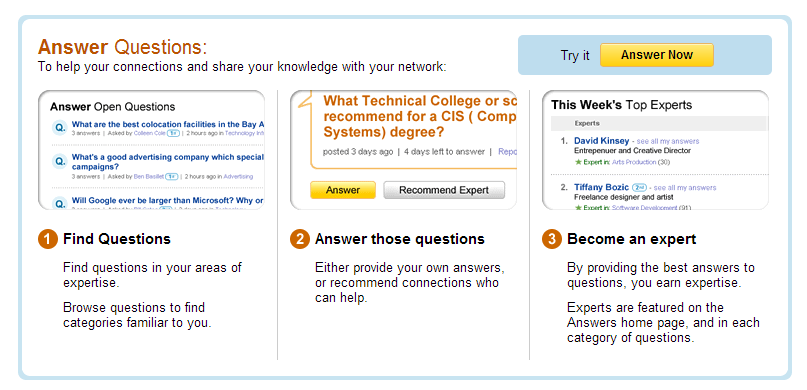
LinkedIn Answers is (was) a Quora-type question and answer forum, where business people could ask for advice in a variety of topical categories. In turn, professionals could answer questions in their area of expertise, which in my experience, was THE best lead-generating activity one could do on LinkedIn.
Why LinkedIn Answers was the Best
LinkedIn Answers was better than any question and answer forum on the web for several reasons:
1) Credibility: Nowhere else on the web can you get an answer to a question and immediately click through to review the person’s entire professional history. This provided an instantaneous and thorough way to evaluate the credibility of the advice given.
LinkedIn Answers also helped professionals add credibility to their LinkedIn profiles. The act of answering a question generated an activity item on one’s profile, which also showed up in the news feed of their connections. Additionally, after answering enough questions in a category, one could earn “Expert” status and be featured on the Answers homepage and in those categories.
2) Focus: The questions and answers being traded on LinkedIn Answers were about business. Although other question and answer sites have categories for business, there are none that are as business-focused and as widely used by business professionals in the world. Because of LinkedIn’s enormous worldwide presence, one could find an expert to answer even the most obscure/niche business questions through LinkedIn Answers.
3) Organization: Today’s LinkedIn email suggests asking questions in groups and via polls. This is highly ineffective for two reasons. First, groups are incredibly noisy places where people constantly try to promote themselves. In my experience, very little “real” discussion occurs in groups. Secondly, Polls have no categorization and are only viewed by connections. In LinkedIn Answers, I could ask my question in a specific category and get an answer from an expert in that category, regardless of whether I was connected to them or not.
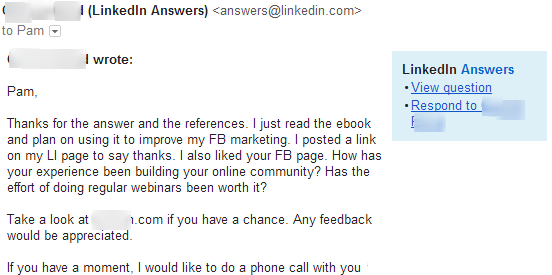
4) Lead Generation: In the experience of my colleagues, clients, and myself, LinkedIn Answers was hands-down THE best lead generation tool on the site – perhaps even on the entire web. The psychological concept of reciprocity never failed me when I was answering questions on LinkedIn Answers. If I took the time to give a very thorough and helpful answer, the asker would nearly always write me back a personal message of thanks, and would often either ask to have a further discussion (hello, LEAD!), connect with me and follow me elsewhere (increasing my exposure to their network), and/or share my content with others (because it helped them so much). The “pay it forward” and “give to get” concepts that go along with answering questions on LinkedIn Answers never failed to get me leads and enhance my business presence on the web.
Irreplaceable Value
Where can I go for all of that now? Nowhere.
How LinkedIn Killed its Best Feature
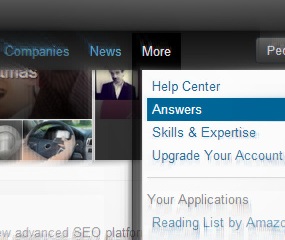
LinkedIn greatly diminished the potential of its Answers feature by hiding it. It didn’t even have it’s own menu item in the site’s main navigation. One had to click on the “More” menu item at the far right to find it.
I kid you not, just last night I gave a presentation about LinkedIn to 27 business professionals, of whom nearly all were members of LinkedIn. When I asked who had heard of LinkedIn Answers, not a single hand went up. I then proceeded to tell them about the feature and show them examples of how it had produced leads for me. Many were beyond excited to try it.
I now have to message them all and tell them that LinkedIn decided to remove this incredibly valuable lead-generating tool, and that there is nothing on the web as nearly as relevant for business people as this forum was.
What Great Feature will LinkedIn Kill Next?
First they nixed the Events feature (which was GREAT for driving business people to events like seminars and webinars), and now they killed their best lead-generator.
What feature do you think they will remove next?