New home sales declined in September for the first time since April. The U.S. Census Bureau and the Department of Housing and Urban Development said sales of newly constructed homes were sold at a seasonally adjusted annual rate of 959,000 units, a 3.4 percent decline from the prior month. Further, the 1,011,000 sales reported in August were revised down to 994,000. Nonetheless, sales are still up 32.1 percent from one year ago.
Sales were below all the predictions from the Econoday panel of analysts. Those ranged from1.0 million to 1.05 million. Their consensus was 1.016 million units. Econoday said its consensus forecast had fallen short of actual sales in each of the previous five months.
On a non-adjusted basis there were 75,000 new homes sold during the month compared to 82,000 in August and 56,000 in September 2019. Slightly less than one-third of the homes sold (24,000) were ready for occupancy while the remainder were almost equally divided between homes under construction and homes for which construction had not been initiated.
For the year-to-date 618,000 homes have sold. This represents a 16.9 percent increase over the 529,000 homes sold in the first nine months of last year.
The median price of a home sold during the month was $326,800 and the average price was $405,400. The respective sales prices in September of last year were $315,700 and $372,100.
At the end of the reporting period there were an estimated 284,000 new homes available for sale, a 3.6-month supply at the current sales pace. A year earlier the 321,000 available homes were projected to be a 5.3-month supply.
Sales of newly constructed homes declined by 28.9 percent in the Northeast compared to August and were 5.9 percent lower on an annual basis. In the Midwest sales were down 4.1 percent for the month but rose 34.8 percent year-over-year. There was a 4.7 percent decline in the South although the annual increase was 27.4 percent. The West posted the only monthly gain, 3.8 percent, and sales were 49.7 percent higher than in the prior September.
The Covid-19 pandemic has pushed real estate sales activity and prices to new records in New York’s Hamptons, North Fork and Long Island regions.
The median sales price of a Hamptons home spiked 40% year-over-year in the third quarter, according to a report Thursday from Douglas Elliman. That price, $1.2 million, is the highest in 15 years, since the company began tracking prices in the region.
Sales also were up more than 50% in the third quarter, compared to the same time last year, the data showed. That’s the largest year-over-year sales increase in nearly seven years.
Sales also were up 40.2% compared to the second quarter, the report found.
“Sales surged quarter over quarter, rebounding quickly from the restraint of spring market activity at the onset of the Covid crisis,” according to Jonathan Miller, chief executive of real estate appraisal firm Miller Samuel and author of the Douglas Elliman reports.
Sales of luxury homes, defined as the top 10% of the market, were up 38.6% in the third quarter compared to the second, Elliman found. Year-over-year, sales were up 48.8%.
Luxury prices dipped 9.7% to $5.8 million from the second-quarter number of $6.4 million, the report showed. But year-over-year, prices rose 65.7%.
The North Fork has also seen increased demand in the third quarter because of concerns over Covid-19, according to Elliman.
In that part of Long Island, the number of sales was up 71% quarter-over-quarter and 41.3% year-over-year, according to the report. In addition, the median sales price rose 18.1% to $702,500 in the third quarter, compared to the previous quarter, the highest level in more than 14 years of tracking.
Luxury sales in the North Fork rose 71.4% in the third quarter, from 14 in the second quarter to 24 in the third. The median sales price for high-end homes was $1.97 million, a 29.3% year-over-year rise, Elliman found.
At the same time, the total volume of sales in both areas was up 101.5% in the third quarter, compared to the same time the previous year, according to the third-quarter report for the Hamptons and North Fork from Brown Harris Stevens.
Sales for the third quarter amounted to more than $973 million, compared to $483 million in the same quarter of 2019, according to the report, also released Thursday.
“The easing of restrictions at the end of [the second quarter] had a dramatic impact on Q3 2020, and the market embraced a frenetic pace, resulting in a doubling of the dollar volume of Q3 2019,” Philip V. O’Connell, managing director of Brown Harris Stevens in the Hamptons, said in the report. “The end of Q3 2020 has settled into a strong market, which we expect to continue throughout the year.”
Sales on Long Island, overall, also surged in the third quarter, according to Elliman.
The number of closed sales was up 56.9% quarter-over-quarter, with the median sales prices up 6.6% to $500,000, the report showed.
On the luxury side, sales increased 56%, from 459 in the second quarter to 716 in the third, Elliman found. The median sales price jumped 12.3% to $1.24 million in the third quarter, compared to $1.1 million the previous quarter.
With the recent increases in the price of many residential construction materials, and in particular softwood lumber, NAHB wanted to get a better understanding of how these price increases are impacting remodelers. In the Q3 2020 Remodeling Market Index (RMI), remodelers were asked to report on material shortages, if any, as well as material price changes over the last six months.
Results show that a significant share of remodelers (77 percent) report a framing lumber shortage, with 25 percent reporting a serious shortage and 52 percent reporting some shortage (Figure 1). In recent months the cost of softwood lumber has jumped to extraordinary levels. In fact, the Producer Price Index (PPI) for softwood lumber has nearly doubled over the last five months (90.9 percent increase), the largest increase since 1975 for the seasonally adjusted series. This price increase has undoubtedly impacted lumber’s availability for remodeling projects and for home construction, in general.
Behind framing lumber, at least 60 percent of remodelers report shortages for three other materials: windows and doors (65 percent), plywood (63 percent), and oriented strand board (OSB) (61 percent) – all construction products commonly derived from softwood lumber. At least 17 percent of remodelers report having a serious shortage for all three of these materials.
At least 40 percent of remodelers report shortages for four other materials: millwork (45 percent), plumbing fixtures & fittings (44 percent), trusses (43 percent), and cabinets (41 percent) – three of which involve lumber. Very small shares of remodelers report shortages on clay brick (10 percent), concrete brick and block (11 percent), steel (lightweight for framing) (12 percent), and structural insulated panels (SIP) (another 12 percent). It is important to also note that 34 percent of remodelers report that they are experiencing shortages for ‘other’ materials not listed. Many reported appliances as the ‘other’ material.
Remodelers were also asked to specify how much total material costs have changed over the last six months for a typical project. Results show that 25 percent of remodelers report cost increases of 20 percent or more (Figure 2).
Boosted by historically low mortgage rates, existing home sales, as reported by the National Association of Realtors (NAR), rose for a fourth consecutive month in September and reached its highest level in more than 14 ½ years.
Total existing home sales, including single-family homes, townhomes, condominiums and co-ops, increased 9.4% to a seasonally adjusted annual rate of 6.54 million in September, the highest level since May 2006. On a year-over-year basis, sales were 20.9% higher than a year ago.
The first-time buyer share decreased to 31% in September from 33% both last month and a year ago. However, price gains threaten this share in the future. The September inventory level fell to 1.47 million units from 1.49 million units in August and is down from 1.82 million units a year ago.
At the current sales rate, the September unsold inventory represents a 2.7-month supply, down from 3.0-month in August and 4.0-month a year ago. This low level supply of resale homes is good news for home construction.
Homes stayed on the market for an average of just 21 days in September, an all-time low, down from 22 days last month and 32 days a year ago. In September, 71% of homes sold were on the market for less than a month.
The September all-cash sales share was 18% of transactions, unchanged from last month but up from 17% a year ago.
Tight supply continues to push up home prices. The September median sales price of all existing homes was $311,800, up 14.8% from a year ago, representing the 103rd consecutive month of year-over-year increases. The median existing condominium/co-op price of $272,700 in September was up 9.9% from a year ago.
Regionally, all four regions saw month-over-month gains for existing home sales in September, ranging from 7.1% in the Midwest to 16.2% in the Northeast. On a year-over-year basis, sales grew in all four regions as well, with the Northeast seeing the greatest gain (22.9%).
Though sales have flourished and demand remains strong due to low mortgage rates, the imbalance between housing supply and demand could hamper future sales. Low inventory will not only continue to drive up home prices but also hurt affordability and homeownership attainment. Though housing starts remain at solid pace, more listings and home construction are still needed to meet this rising demand.
Trump (Johnny Milano for The Washington Post via Getty Images
The Trump Organization is considering selling its sprawling Westchester, N.Y., estate, according to people familiar with the matter, after years of unsuccessful development attempts that ended with an agreement to preserve part of the property.
The New York attorney general’s office has said it is examining whether any benefits Mr. Trump received from that agreement were improper as part of a broader investigation of alleged fraud by the president and his businesses.
Trump representatives have had conversations with local brokers about the possibility of a sale, the people said. The 213-acre property, known as Seven Springs, isn’t currently listed publicly. While President Trump has previously valued the property at more than $200 million, local agents estimated the property would trade for around $50 million or less. They said much of the previously perceived value was likely tied up in prior failed development plans, including a proposed residential subdivision.
A Trump Organization spokeswoman called Seven Springs “one of the largest, most valuable and most iconic properties in Bedford.” She added, “If the right opportunity presents itself, the Trump family would certainly entertain it.”
The Trump Organization has owned Seven Springs since 1995, when it purchased the property for $7.5 million. At the time, local agents said it was a bargain. Although it had been on the market for a year and was viewed as something of a white elephant, other major properties in Westchester County had sold for multiples of that amount.
Mr. Trump first attempted to build a golf course on the property but encountered fierce local opposition. The Trump Organization then pursued building a residential subdivision of luxury homes.
A 2011 Trump financial document values the property at $261 million, based on what it said was an assessment by Mr. Trump, his associates and outside professionals. It said the figure comes from the funds he would receive as homes were constructed and sold, plus the value of the existing mansion and other buildings.
Those homes were never built. Local real-estate agents said Mr. Trump had a particularly difficult time getting his plans approved because the property straddles several municipalities—Bedford, New Castle and North Castle.
In late 2015, Mr. Trump entered into an agreement with the nonprofit North American Land Trust not to develop 158 acres of the property. That area included 95 acres of mature forest and 52 acres of herbaceous meadows, according to the agreement. Under such agreements, known as conservation easements, a property owner can deduct the land’s value in exchange for not developing it.
If the property were sold, the new owner would be bound by the terms of the easement, according to the agreement.
As part of its fraud investigation into the president and his company, the office of New York Attorney General Letitia James has said it is examining whether the value of the easement was improperly inflated to get a larger tax dedication.
The Trump Organization has said the investigation by Ms. James, a Democrat, is all about politics. Eric Trump said on Twitter that Ms. James’s “sole focus is an anti-Trump fishing expedition that she promised during her campaign.”
A 2016 appraisal, prepared by real-estate services firm Cushman & Wakefield for tax purposes at the request of Eric Trump, valued the property at $56.5 million and the easement at $21.1 million, according to court papers.
The estate dates to around 1919, when it was built for Eugene Meyer, a former chairman of the Federal Reserve, first president of the World Bank and onetime publisher of the Washington Post. The main house, designed by architect Charles A. Platt, is constructed from sandstone quarried on the property. Artisans from Italy were tapped to ensure that the home’s 60 rooms, including 15 bedrooms and two service wings, were opulently designed, according to the Trump Organization website.
The Trump Organization estimates that the mansion spans about 50,000 square feet, making it one of the largest homes in the area. It has three pools, including an indoor pool cased in white marble, as well as a large wine cellar, an antique bowling alley and carriage houses. A second home on the property, built in Tudor style in 1919, was constructed by H.J. Heinz of the Heinz Ketchup empire, who was a friend of Mr. Meyer’s.
Mr. Trump famously allowed representatives of the late Moammar Gadhafi, the then-Libyan leader who was in New York to address the United Nations General Assembly, to pitch a Bedouin-style tent on the property in 2009. After local opposition, the leader didn’t stay there.
The Trump Organization website says Seven Springs is now used as a family retreat.
A nearby property owned by horse-racing enthusiasts Barry K. Schwartz, the co-founder of Calvin Klein Inc., and his wife, Sheryl Schwartz, spans about 740 acres, nearly three times the size of the Trump property, and is on the market for $100 million. A mansion less than 20 miles away in Pocantico Hills, N.Y., that was owned by the estate of David Rockefeller, the venerable chief executive of Chase Manhattan Bank, sold for $33 million in 2018. It sits on roughly 75 acres.
Freddie Mac (OTCQB: FMCC) today released the results of its Primary Mortgage Market Survey® (PMMS®), showing that the 30-year fixed-rate mortgage (FRM) averaged 2.80 percent, the lowest rate in our survey’s history which dates back to 1971.
“Mortgage rates remain very low, providing homeowners who have not already taken advantage of this environment ample opportunity to do so,” said Sam Khater, Freddie Mac’s Chief Economist. “Mortgage rates today are on average more than a full percentage point lower than rates over the last five years. This means that most low- and moderate-income borrowers who purchased during the last few years stand to benefit by exploring refinancing to lower their monthly payment.”
News Facts
30-year fixed-rate mortgage averaged 2.80 percent with an average 0.6 point for the week ending October 22, 2020, down from last week when it averaged 2.81 percent. A year ago at this time, the 30-year FRM averaged 3.75 percent.
15-year fixed-rate mortgage averaged 2.33 percent with an average 0.6 point, down from last week when it averaged 2.35 percent. A year ago at this time, the 15-year FRM averaged 3.18 percent.
5-year Treasury-indexed hybrid adjustable-rate mortgage (ARM) averaged 2.87 percent with an average 0.3 point, down from last week when it averaged 2.90 percent. A year ago at this time, the 5-year ARM averaged 3.40 percent.
The PMMS is focused on conventional, conforming, fully-amortizing home purchase loans for borrowers who put 20 percent down and have excellent credit. Average commitment rates should be reported along with average fees and points to reflect the total upfront cost of obtaining the mortgage. Visit the following link for the Definitions. Borrowers may still pay closing costs which are not included in the survey.
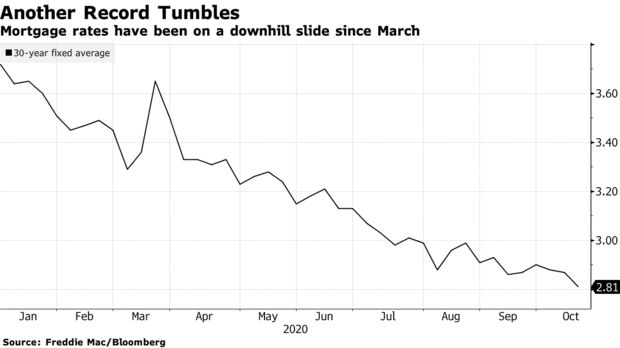
Mortgage rates in the U.S. have hit another record low.
The average for a 30-year, fixed loan dropped to 2.81%, down from 2.87% last week and the lowest in almost 50 years of data-keeping, Freddie Mac said in a statement Thursday. It was the 10th record low this year. The previous one — 2.86% — held for about a month.
The slide in borrowing costs that began in March, as fears of the coronavirus drove investors to the safety of Treasuries, shows no signs of stopping. The Federal Reserve has signaled it will hold its benchmark rate near zero through at least 2023. That should keep a lid on mortgage rates, which have been below 3% since July.
Cheap loans have been fueling a housing rally that has bolstered the pandemic economy, even amid persistent job losses. Purchases have soared and millions of current homeowners have been able to save money by refinancing. Home ownership has become increasingly un affordable. For those who can’t afford big down payments, mortgage insurance has become a fact of life. For all its expense, mortgage insurance doesn’t deliver the level of protection it should. The government should do what’s needed to reduce the unnecessarily high cost.
But surging demand for the scarce supply of properties on the market is pushing up prices, putting home ownership out of reach for many Americans. And lenders have tightened credit standards, presenting another potential obstacle for would-be buyers.
“It’s important to remember that not all people are able to take advantage of low rates, given the effects of the pandemic,” Sam Khater, Freddie Mac’s chief economist, said in the statement.
Rent prices in top cities are down “substantially” compared to last year — especially in San Francisco, according to Realtor.com.
City landlords are slashing rent prices to attract tenants as they lose renters to cheaper, quieter suburbs during the coronavirus pandemic. In the most dramatic cities studio rent prices fell 31% compared to last year, according to Realtor.com’s September rent prices report.
“This is likely a reflection of people with flexibility, like renters, choosing to relocate elsewhere or even possibly move in with friends and family to save money in a period of economic uncertainty, with flexibility that changes like remote work have allowed them to move elsewhere to places that are more affordable,” said Danielle Hale, chief economist at Realtor.com.
San Francisco rent prices were the hardest-hit by the pandemic as big tech companies in Silicon Valley required or allowed workers to work remotely — first during lockdowns, and then long-term, in many cases.
The median studio apartment in San Francisco is going for 31% less than it did last year, now only $2,285. One bedroom apartments cost 24.2% less than last year at only $2,873 a month (the first time they’ve ever hit under $3,000, according to Zumper, a San Francisco-based listing company). In nearby San Mateo, Santa Clara and Alameda rents dropped 9%-19%. Rents were less volatile for larger apartments, the Realtor.com study found.
But almost two hours outside San Francisco in Sacramento, rent prices are actually rising 10%-16%. Sacramento was the top out-of-metro location where Bay area renters searched for apartments year-to-date, according to Zumper’s 2020 migration report. Sacramento was also tied as the sixth most common migration destination in the country, according to Opendoor, a San Francisco-based iBuyer that operates in Sacramento and 20 other markets.
“People from the Bay area may be moving to Sacramento if they don’t have to commute into the office every day,” said Hale.
Top 10 markets with largest one-bedroom rent prices decreases. Data by Realtor.com. Graphic by Chelsea Lombardo/Yahoo Finance.
Pushing for occupancy before seasonal slowdown
Rent prices dropped significantly in major cities all across the country, plummeting up to 15% for studio apartments in places like New York City, Pittsburgh, Boston and Honolulu, and 12% in Seattle, according to Realtor.com. Rent cuts were less steep for one-bedrooms, between 7% and 12% in most cities.
“Apartment owners are pushing to get occupancy as high as possible before leasing activity suffers the seasonal slowdown that occurs during the cold weather months,” said a statement by Greg Willett, chief economist of RealPage, a Texas-based property management software company. “In some cases, they are cutting rents in an attempt to capture bigger shares of total demand.”
Meanwhile, rent rose in unlikely places such as Tulsa, Okla., which had a staggering 36% hike in studio rent increases. Rent in suburbs that many Americans have never heard of, like Hillsboro, Fla., Montgomery, Pa. and Essex, N.J., rose about 19%-29%.
“Even prior to the pandemic, there was a movement from larger metros to smaller metros…,” said Odeta Kushi, deputy chief economist for First American Financial Corporation, a California-based title insurance, settlement services and risk solutions company. “This trend has been accelerated by the pandemic as younger households look for more space and are increasingly able to work from home.”
After a sharp decline in the spring, home building has staged a dramatic rebound. In fact, supported by low mortgage rates, an evolving geography of housing preferences, and favorable demographic tailwinds, housing demand has improved so quickly that the current difference between the pace of newly-built single-family home sales and for-sale single-family construction custom framing starts has reached a historic level. The fact that sales are outpacing construction starts to this degree indicates additional home building lies ahead.
The following graph shows the benchmark Census measures of home construction, the seasonally adjusted annual rates of single-family starts and single-family home sales. Starts account for the beginning of construction of homes, whether that construction is for a home already under a sales contract, being built for-sale, being built for-rent, or undertaken for a construction contract (a custom build on an owner’s lot). New home sales are signed sales contracts for new builds, whether that home has started or completed construction (new home sales is thus a counterpart to the NAR pending sales index, rather than existing home sales, which account for closed contracts).
The reason that starts outpace sales on the chart below is because, as noted above, starts represents all home builds. Thus, while the measure of new home sales represents only the more narrow for-sale class, housing starts also include custom builds and built-for-rent construction.
The consequences of the virus-induced 2020 downturn (the Great Disruption?) is seen clearly at the end of the graph, particularly the V-shaped nature of the impact on housing. While both measures have staged impressive rebounds, the sales measure has completely closed the gap between the two series.
However, the actual effect is larger. For an apples-to-apples comparison of the rates of for-sale construction and new home sales, we need to filter the starts series to remove custom builds and built-for-rent single-family construction. Using Census quarterly data of these construction types, I interpolated the quarterly data into monthly, seasonally adjusted data and then subtracted this new series from the existing Census data series. The new data series, single-family for-sale starts, allows for a precise comparison of the pace of home building in the for-sale sector relative to sales, as graphed below.
The new series is much closer to the sales data, with just occasional periods of notable difference amid the statistical noise. The adjusted data makes clear how great the current difference is between sales (red) and starts (blue). This gap is unprecedented in the 20 years of data presented here, and there is no comparable period in the data going back to 1963. Plotting the difference between the monthly rates of for-sale starts and sales yields the following series, which peaks in the most recent data.
The degree to which current new home sales are outpacing starts is clear in the above graph. These data are consistent with Census estimates and NAHB surveys that indicate builders are selling homes that have not begun construction in greater numbers. Indeed, the count of such home sales is up 69% compared to a year ago, an incredible jump. To place the current data into context, I smoothed the data using 6-month moving averages. While this dilutes somewhat the scale of the current gap, it shows three relevant periods over the last two decades where sales and for-sale starts disconnected.
As seen above, the first period occurred during the housing boom when for-sale starts exceeded sales, leading to an inventory overhang that was part of the housing crisis preceding the Great Recession. The second separation occurred as single-family starts plummeted during the Great Recession and sales, helped by the three stages of the federal home buyer tax credit, reduced excess inventory (new home months’ supply peaked at 11.1 during the spring of 2008).
These two prior periods happened in an overbuilt environment. The script is flipped today. Months’ supply for new homes is down to a lean 3.3, and existing home months’ supply (per NAR data) is at a very tight 2.8. Thus, the third period of separation between for-sale starts and new home sales occurring now is a signal of the degree to which home building will need to play catch-up with current demand.
As with other economic impacts related to the virus, prior trends have been accelerated. With home building, the last decade (the Long Recovery) was characterized by underbuilding due to supply-side limitations such as labor availability and law/regulatory cost impacts. The lagging pace of construction, relative to current sales, is an intense, compressed version of these general economic trends, with builders citing lumber and material issues as delaying some, current construction projects.
Because builders do not want to contract home sales that they will not be able to deliver effectively, the current, historic gap between elevated sales volume and improving if relatively lower construction rates means that the pace of growth for new home sales will need to slow and/or the rate of home building will need to increase to balance the market. Strong levels of the NAHB/Wells Fargo HMI measure of home builder confidence are consistent with this expectation, for starts at least.
In the meantime, the current gap between for-sale starts and sales is unprecedented. Moreover, this gap is not the only historic, current data reading of the housing industry. The NAHB/Wells Fargo HMI reached a data series high in September.
And the gap between median newly-built and existing home prices, which peaked near $95,000 three years ago, has closed and inverted. According to NAR data, the median price for a resale single-family home was $315,000, higher than the Census reported median of $312,800 for newly-built homes. That inversion has only occurred one other time over the last two decades (June 2005).
In sum, low levels of existing inventory, rising resale prices relative to new construction, strong builder confidence, and sales exceeding for-sale starts point to solid levels of home construction in the months ahead.
Home building sustains jobs (approximately 2.9 per home built and 0.75 per $100,000 in remodeling), which means more residential construction employment gains in the near-term. In fact, over the next two to three months residential construction will likely post a year-over-year gain for employment, a notable sign of strength for housing in the recovering economy.
Freddie Mac (OTCQB: FMCC) today released the results of its Primary Mortgage Market Survey® (PMMS®), showing that the 30-year fixed-rate mortgage (FRM) averaged 2.81 percent, the lowest rate in our survey’s history which dates back to 1971.
“Low mortgage rates have become a regular occurrence in the current environment,” said Sam Khater, Freddie Mac’s Chief Economist. “As we hit yet another record low, the tenth record this year, many people are benefitting as refinance activity remains strong. However, it’s important to remember that not all people are able to take advantage of low rates given the effects of the pandemic.”
News Facts
30-year fixed-rate mortgage averaged 2.81 percent with an average 0.6 point for the week ending October 15, 2020, down from last week when it averaged 2.87 percent. A year ago at this time, the 30-year FRM averaged 3.69 percent.
15-year fixed-rate mortgage averaged 2.35 percent with an average 0.5 point, down from last week when it averaged 2.37 percent. A year ago at this time, the 15-year FRM averaged 3.15 percent.
5-year Treasury-indexed hybrid adjustable-rate mortgage (ARM) averaged 2.90 percent with an average 0.2 point, slightly down from last week when it averaged 2.89 percent. A year ago at this time, the 5-year ARM averaged 3.35 percent.
The PMMS® is focused on conventional, conforming, fully-amortizing home purchase loans for borrowers who put 20 percent down and have excellent credit. Average commitment rates should be reported along with average fees and points to reflect the total upfront cost of obtaining the mortgage. Visit the following link for the Definitions. Borrowers may still pay closing costs which are not included in the survey.