How Pinterest Helped a Mom Win Major Brands as Clients | Cross River Realtor
Leave a reply

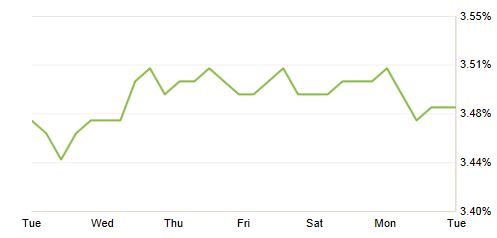
Mortgage rates for 30-year fixed mortgages rose this week, with the current rate borrowers were quoted on Zillow Mortgage Marketplace at 3.47 percent, up from 3.46 percent at this same time last week.
The 30-year fixed mortgage rate hovered between 3.44 and 3.5 percent for the majority of the week, dropping to the current rate this morning.
“Mortgage rates fell slightly early last week as markets reacted to economic uncertainty in Cyprus, but later rebounded as the country emerged with a bailout plan.” said Erin Lantz, director of Zillow Mortgage Marketplace. “This coming week, we expect some volatility related to political uncertainty in Italy, but with a shortened U.S. trading week, we expect the impact to be muted.”
Additionally, the 15-year fixed mortgage rate this morning was 2.64 percent, and for 5/1 ARMs, the rate was 2.28 percent.
What are the rates right now? Check Zillow Mortgage Marketplace for up-to-the-minute mortgage rates for your state.
*The weekly rate chart illustrates the average 30-year fixed interest rate in six-hour intervals.
Florida, California, New York, Illinois and New Jersey were home to four out of ten distressed properties in the nation in January, an indication of how far east America’s foreclosure nightmare has moved.
CoreLogic reported that the overall shadow inventory is down 28 percent from its peak in January 2010, when it reached 3 million homes. Current residential shadow inventory as of January 2013 was at 2.2 million units, representing a supply of nine months. This figure represents an 18-percent drop from January 2012, when shadow inventory stood at 2.6 million units.
“The shadow inventory continued to drop at double the rate in January from prior-year levels. At this point in the recovery, we are seeing healthy reductions across much of the nation,” said Anand Nallathambi, president and CEO of CoreLogic. “As we move forward in 2013, we need to see more progress in Florida, New York, California, Illinois and New Jersey which now account for almost half of the country’s remaining shadow inventory.”
“The shadow inventory is declining steadily as properties are moving through the distressed pipeline,” said Dr. Mark Fleming, chief economist for CoreLogic. “States like Arizona, California and Colorado are experiencing significant declines year over year in the stock of serious delinquencies, a positive sign for further improvement in the shadow inventory.”
As of January 2013, shadow inventory was at 2.2 million units, or nine months’ supply, and represented 85 percent of the 2.6 million properties currently seriously delinquent, in foreclosure or REO.
Of the 2.2 million properties currently in the shadow inventory (Figures 1 and 2), 1 million units are seriously delinquent (4.1 months’ supply), 798,000 are in some stage of foreclosure (3.2 months’ supply) and 342,000 are already in REO (1.4 months’ supply).
The value of shadow inventory was $350 billion as of January 2013, down from $402 billion a year ago and down from $381 billion six months ago.
Over the twelve months ending January 2013, serious delinquencies, which are the main driver of the shadow inventory, declined the most in Arizona (40 percent), California (33 percent), Colorado (27 percent), Michigan (25 percent) and Wyoming (23 percent).
CoreLogic estimates the current stock of properties in the shadow inventory, also known as pending supply, by calculating the number of properties that are seriously delinquent, in foreclosure and held as real estate owned (REO) by mortgage servicers, but not currently listed on multiple listing services (MLSs). Transition rates of “delinquency to foreclosure” and “foreclosure to REO” are used to identify the currently distressed unlisted properties most likely to become REO properties. Properties that are not yet delinquent, but may become delinquent in the future, are not included in the estimate of the current shadow inventory. Shadow inventory is typically not included in the official reporting measurements of unsold inventory.
Average home prices in metropolitan Washington were up by double-digit percentages in three out of the past four months, and some have begun to wonder if they are heading toward unsustainable levels.
How can prices in some neighborhoods be back to where they were at the peak of the housing market? How can there be bidding wars again where potential buyers have to be prepared to make an offer — often with an escalation clause — at the open house? How can it be so difficult for a first-time homebuyer to find a house in her price range that is not too far from her job?
Are these all signs that we’re headed for another bubble here in the Washington area, even as much of the rest of the country is just beginning to feel recovery in their housing markets?
The short answer is no. At least not the kind of bubble we experienced in 2002 through 2006. A critical difference between the current market and the overheated market of the middle of last decade is the nature of the mortgage market.
Stricter underwriting standards have limited the pool of potential homebuyers to those who are most qualified and most likely to be able to pay loans back. The demand this time is based more closely on market fundamentals. And the price growth we’ve experienced recently is “real.” Or “more real.”
Prices aren’t up everywhere across the region. In parts of the District, Arlington and Alexandria, average prices have returned to peak levels. For some neighborhoods and product types, demand is high and multiple offers are common.
However, prices in many neighborhoods remain far below what they were six or seven years ago. Prices have been pushed higher in neighborhoods closest to jobs and transportation and where supply is more limited.


Pinterest is perfect for businesses with small marketing budgets, and you can improve SEO and drive traffic by optimizing your images.
The image-based social media site is an online bulletin board that lets you collect and share images by “pinning” them to virtual boards. It has been one of the fastest-growing consumer Web properties — according to comScore, it ranked 28th among U.S. Internet users in January, with about 30 million unique visitors.
Pinterest users spend more money, shop more frequently, and purchase items more often and in larger quantities than users on any other social network. If you believe that Pinterest is a viable social media marketing platform for your business and your initial attempt at using it hasn’t yielded the positive results you were looking for, it’s time to optimize your presence — starting with the images you post.
Maximize your Pinterest image optimization
Here are 18 great tips about growing your brand with Pinterest marketing through image optimization, brought to you by PinnableBusiness.com.
- File names become your image titles, so name them accordingly. Names with lots of letters and numbers won’t rank as well.
- Pin from a variety of different sources, not just from your own site. Re-pinning, liking, and commenting all play a role in where your image will appear.
- Pinning gives you the best opportunity to go viral. Uploading is okay, but not as beneficial.
- After you upload an image, you should edit your pin to add a link. Pinterest doesn’t automatically add any links to uploaded pins, so it’s important to do this to drive traffic.
- Pinterest descriptions can be up to 500 characters, but longer ones annoy many users. Use a short caption that incorporates major keywords, and add more info in the pin’s comment section.
- Research Pinterest to see what catches your eye and compels you to engage with an image, and try to replicate that feeling with your own images. More engagement leads to more followers, and more followers equals more power.
- Remember that Pinterest is a social media platform, not an advertising platform. Comment, like, and repin other people’s images.
- Create a variety of different boards and make sure the titles of the boards are keyword-rich. A board named “Stuff I Like to Do” isn’t as effective as “Birdwatching in Seattle”.
- Add the “Follow” and “Pin It” buttons to your website. The key to social media is empowering people to share your content.
- Be yourself and express your personality and that of your brand. Communicate your unique voice through the images you post.