We’re proud to present a great little animation video by our friend Theo Kitchener from Australia. It’s safe to say that Theo’s vision and ideas have been substantially influenced by The Automatic Earth, not in the least when we spent quite a bit of quality time together in Melbourne earlier this year (with both Theo and many more new-found friends of TAE) and had a number of great discussions in between Nicole’s lectures in the city.
There are certainly things we would see somewhat differently, like for instance we don’t necessarily share all of Theo’s optimism, however contagious it may be – as is evident in the animation -, for a better society built more or less seamlessly on the ruins of our present one. But frankly, those differences pale in comparison with the broad extent to which our respective views do meet, and certainly with the sheer quality and artistic skillset that oozes from this wonderful little jewel.
I’d go as far as to say that even if you disagree with every single point made here, you should still find plenty to enjoy and admire. Hats off to Theo!
We were told that the global financial crisis of 2008 happened because irresponsible borrowers couldn’t afford to pay back their loans. This is true, but it was also part of a much deeper problem. The issue is that our economic system is based on the need for continuous, perpetual growth. It’s highly likely that we’re already in the beginnings of something much worse than a depression, even if bankers and governments won’t admit it yet.
Fortunately, we don’t need to hear it from them. We can tell that something is going on, we have the internet and we can share information amongst ourselves. And thankfully, if we try hard enough, we could just end up with something much much better than what we have now. I’m no expert, however I am someone who’s done several years of reading on these topics and I really want everyone else to know what’s going on, and understand the risks and the opportunities. It’s only fair.
So let’s look at how our banking system really works. It’s commonly believed that banks lend out money that they already have from invested savings. That would’ve encouraged a fairly stable system of banking. Instead, we have what’s called a fractional reserve banking system. This means that banks can loan out almost all the money that gets deposited with them. For example, when you put $100 in one bank, they lend $90 of it to someone else, who then puts that $90 in their bank.
Now there’s $190 where there used to be $100. That $90 lent out will also be deposited and $81 lent again. In this way, money ends up being multiplied between ten and a hundred times. Sounds crazy right? Less than 1% of the money in the economy is actual notes and coins, the rest are just numbers on computers, created as debt. This system rapidly increases the amount of money in the economy, which fuels economic growth, allowing most of us the ability to pay back our debts with interest. But only so long as the economy keeps on growing.
One reason it won’t is that ever since the Industrial Revolution, economic growth has been largely dependent on cheap fossil fuel supplies, which are now dwindling. When we first started drilling for oil, it was easy to find. It just spurted up out of the ground. We’ve only been drilling intensively for about 150 years, and oil is no longer easy to find. Now, we drill down crazy deep through earth and ocean using expensive and risky technology. It used to cost one barrel of oil to get about 100 barrels of oil out of the ground. These days one barrel only gets us 10 barrels back, and declining. And that means it’s not cheap anymore.
The truth is, we’re living on a planet that has finite resources. We’ve always opted to extract the easiest resources first, while using more and more each year. Eventually the use of these finite resources has to peak and then decline as their extraction gets harder and more expensive. And according to the Association for the Study of Peak Oil and Gas, the global peak happened in 2008. Now, this doesn’t mean we’re running out of oil, it just means we’re running out of cheap oil.
Daily Archives: September 16, 2012
More lenders offering FHA 203(k) rehab loans | North Salem NY Real Estate
With distressed and bank-owned properties often in need of work to make them move-in ready, more lenders are offering renovation loans backed by the Federal Housing Administration.
Irvine, Calif.-based Impac Mortgage says it will offer both standard and streamline FHA 203(k) loans through its consumer lending division starting in September.
Sherman Oaks, Calif.-based Prospect Mortgage is opening a correspondent lending division to help lenders serve customers in search of FHA renovation loans.
“With so many REO and foreclosure properties available today, renovation lending has grown from a niche product to one of the best financing solutions in today’s market,” said Doug Long, president of Prospect Mortgage Retail and Correspondent Lending, in a statement.
Correspondent lenders originate and fund loans in their own name and, after closing, sell those loans to other, larger lenders.
“Through our new correspondent division, we’re excited to share our experience — and our commitment to renovation opportunities — by helping lenders offer the 203(k) product to capture new business and help more homebuyers,” Long said.
The FHA Section 203(k) program insures loans made by FHA-approved lenders for the rehabilitation and repair of single-family properties. Prospect Mortgage’s new correspondent lending division will focus on funding FHA 203(k) loans.
Impac Mortgage — the “doing business as” name of Excel Mortgage Servicing Inc., a subsidiary of Integrated Real Estate Service Corp. — say’s it’s entered into a relationship with another company, RenovationReady, to provide services to home buyers who want to renovate or rehabilitate their homes.
RenovationReady, a joint venture between Granite Companies and Chadron Group LLC, provides property certification, loan fulfillment, and risk management services for banks and mortgage professionals originating renovation loans, including FHA 203(k) and Fannie Mae HomeStyle or HomePath loans.
“With 70 percent of America’s housing stock being built before 1992 and too many foreclosed properties damaged and uninhabitable, we see a tremendous opportunity to meet the demands of an underserved market,” said Impac Mortgage President William Ashmore in a statement.
Prospect Mortgage is backed by Sterling Capital Partners, a private equity firm with about $5 billion of assets under management and offices in Chicago, Baltimore, and Miami. Citing HUD data, Prospect Mortgage says it is the second-largest FHA 203(k) loan originator in the country.
“We’ve … achieved this position by focusing on our renovation lending platform and consistently supporting it with a team of sales and operations specialists with more than a quarter century of renovation lending expertise,” Long said.
In July 2011, Prospect Mortgage agreed to pay $3.1 million to settle allegations by federal housing regulators that the company entered into sham affiliated business arrangements in order to pay kickbacks to real estate brokers, agents, banks, mortgage servicers and others who referred business to it. The company denied the allegations and agreed to dissolve the affiliated businesses.
Real estate pros can deduct rental losses | Mount Kisco NY Real Estate
Tax form image via Shutterstock.
A recent court decision will make it easier for many individuals to qualify as real estate professionals for purposes of the IRS passive loss rules. This will enable more landlords to fully deduct their losses from real estate rentals.
The passive loss rules (“PAL rules”) are one of the most confusing areas of taxation. Under these rules, losses from real property rentals are classified as “passive activity losses.” These rules permit a rental property to deduct from his other non-passive income, such as salary or other business income, a maximum of $25,000 each year; and even this is phased out if the owner’s adjust gross income exceeds $100,000. Unused losses must be saved for future years.
Luckily for real estate professionals, they can qualify for a special exemption from the passive loss rules — an exemption nobody else can get. If you qualify, you may deduct any amount of rental activity losses you have for the year from your other income — such as real estate commission income — regardless of how high your income for the year may be.
To qualify as a real estate professional, you (or your spouse, if you file a joint return) must:
- spend more than half of your working hours during the year working in one or more real property businesses, and
- you (or your spouse, if you file a joint return) must spend more than 751 hours a year in one or more real property businesses in which you materially participate.
A real property business includes any real property development, redevelopment, construction, reconstruction, acquisition, conversion, rental, operation, management, leasing, or brokerage business.
Coming up with all these hours working in real estate can be very difficult for people who have other jobs. Indeed, it’s virtually impossible for a person with a full-time jot to qualify as a real estate professional under the PAL rules.
However, a Sept. 12 decision by the United States Tax Court makes it easier for some real estate pros to accumulate enough hours.
Fred Chambers, a civilian Navy employee, individually owned a rental property that produced losses. He also was a member and manager of a Tennessee LLC that owned several rental properties. The LLC also produced losses, 33 percent of which were allocated to Chambers. The only way Chambers could deduct all these losses from his active employee income was to qualify as a real estate professional.
To establish sufficient hours to qualify as a real estate professional, Chambers counted the time he spent managing his individually owned property and the time he spend managing the LLC.
The IRS argued that he shouldn’t have counted the LLC time because the LLC was a limited partnership for tax purposes and Chambers functioned as a limited partner. The PAL rules provide that all limited partnership interests are passive and thus time managing them can’t be used for purposes of the real estate professional exemption.
However, the Tax Court held that Chambers could count the hours he spent on the LLC in his total real estate professional hours.
The court held that Chambers should be viewed as a general partner because (1) under Tennessee laws LLC members may participate in management of the LLC, and (2) Chambers was required to participate in its management under the articles of organization and in fact did so.
Because Chambers established that he materially participated in the LLC, he could count the hours spent working on it for purposes of the real estate professional test (Chambers v. Commissioner of Internal Revenue, T.C. Summ. Op. 2012-91)
Unfortunately, even counting his LLC hours, Chambers was unable to qualify as a real estate professional. However, under this case, others who actively manage one or more LLCs that own real estate can count the hours they spend to help them qualify as real estate professionals.
10 Social Media Risks MOST Companies Are Too Afraid to Take | Waccabuc NY Realtor
There was a time when just being in social media was a risk for companies. I’m glad we’re (mostly) done with those days, but now we’re into a new era … the era of experimentation.
Oooh, I like this era! This is when people really start getting creative. And the more risks brands take, the more we learn what works and (unfortunately) what totally backfires.
What you’ll find in this post are the social media ideas that many brands wouldn’t touch with a ten foot pole; except, of course, for some special few who said, “Meh, screw it.” And boy do we love those people! Take a look at some risky social media moves that flout convention, and the brands that are pulling it off, anyway.
10 Risky Social Media Moves Real Brands Aren’t Afraid to Make
1) Loosening Up Enough to Make a Joke in B2B Marketing
Businesspeople don’t smile. They carry briefcases and march around with a withering stare of the utmost seriousness. Except the people at IMPACT Branding. Take a look at their latest Facebook timeline cover photo (which they update pretty frequently, check back often):
If you missed the honey badger meme, maybe you’ll enjoy a little something from the How I Met Your Mother genre:
Or if The Office is more your speed, they’ve had a little fun with Dwight “Bears, Beets, Battlestar Gallactica” Schrute, too:
Point is, everyone likes to laugh. Loosen up! As long as your jokes aren’t in poor taste — you know this by creating buyer personas in which you get to know your audience’s sense of humor — your readers will appreciate that you’ve infused a little levity into their day. Fact.
2) Loosening Up Enough to Make a Joke in Your “Boring” Industry
“It’s easy for them to be funny,” you say, “they work in branding and design!” You don’t have to work in a hip industry to be funny in social media. Take a look at General Electric’s Pinterest account if you want proof that “boring” industries can take a risk on humor, too. Here’s one of their latest pinboards:
This isn’t great just because it gets people chuckling … it actually expands GE’s audience by thinking about their industry in terms more people can understand. So no, maybe their engineers don’t love this (or maybe they do, because it’s hilarious), but they already have an audience of engineers. You’re not going to grow your reach if you don’t think outside the box!
3) Opening the Feedback Floodgates
Some brands are too scared to get into social media because it gives people a place to air their grievances. We get that. We don’t agree with it, but after hearing the refrain so much, we “get” it. Then there are the brands that take it one step further, and actually proactively open the feedback floodgates. Take a look at how UncommonGoods does it on its Facebook page, for example:
FHA temporarily eases guidance on condo approvals | Cross River NY Real Estate
The Federal Housing Administration eased some requirements for financing the purchase of condominium units through August 2014, according to a letter sent to lenders Thursday.
The new guidance is effective for all project approvals or reconsiderations submitted for review going forward.
To protect the dwindling emergency insurance fund, the FHA put stricter rules in place.
According to the changes made Thursday, no more than 15% of the total units can be delinquent by 60 days or more on their condo association fees. This was eased from a 30-day delinquency threshold. No exceptions to the new rule will be granted, the FHA said.
The agency still requires at least half of the units to be owner-occupied for projects completed more than one year ago. But the FHA released more specific guidance on how much investors can own on properties under construction or conversion. Investors can own up to 30% of the units on some of the projects in order to qualify for FHA financing.
Other guidance was given on insurance coverage, commercial space limitations and other details.
The Community Associations Institute, a trade group of community associations, pushed the FHA to revise the rules.
“It was determined that certain policy adjustments were needed to address current housing market conditions,” the FHA said in the letter.
CAI Chief Executive Officer Thomas Skiba said the revisions were needed sooner but is still “excellent news.”
“FHA has responded to the critical issues we’ve raised. By doing so, more Americans can obtain FHA-insured mortgages to purchase condominiums,” Skiba said. “This will spark home sales and help tens of thousands of condominium communities begin to recover from the housing slump, and that can only help the national economy.”
Is Bernanke driving investors toward housing? | South Salem NY Real Estate
All eyes and ears were on Federal Reserve chairman Ben Bernanke Thursday as the Federal Open Market Committee announced another round of quantitative easing in the form of mortgage-backed securities purchases.
What’s clear from Bernanke’s Q&A session with the media is that while savers are not gaining on their deposits under zero-interest-rate policies, the majority of the FOMC sees an advantage to creating stability in the housing sector through low interest rates to entice buyers.
“We are understanding of the fact that holders are receiving low returns,” Ben Bernanke said when asked about the hit savers are taking in today’s low interest rate environment. “But low interest rates support other assets that Americans hold such as homes.”
The Fed also remained committed to keeping the federal funds rate low through at least mid-2015 while saying Operation Twist will last throughout the rest of the year.
While fielding questions from the media, Bernanke subtly hinted that the chairman sees improvements in housing, and the Fed remains committed to ensuring those gains are not lost. “To the extent that home prices begin to rise, consumers will feel the market is healthier,” Bernanke said. As prices rise, people will be more likely to buy homes.”
Bernanke reaffirmed the reserve’s commitment to stroking the nation’s stubborn unemployment rate.
Katonah NY Real Estate | Fewer Americans underwater, but housing remains fragile: Obama Scorecard
[[Update 1: Corrects ….share of underwater mortgages declined from 25.2% in 4Q of 2012 to 4Q of 2011]]
The number of underwater borrowers is down from late 2011, but housing is far from on the mend, the Obama Administration said Thursday.
In the administration’s August Housing Scorecard, the report shows the number of upside-down borrowers falling 11% from late 2011 to the second-quarter of 2012.
CoreLogic data incorporated into the Treasury department’s scorecard puts today’s underwater borrower population at roughly 10.8 million, compared to 12.1 million in the fourth quarter of last year.
Overall, the share of underwater mortgages declined from 25.2% in 4Q of 2011 to 22.3% in the most recent housing scorecard.
Home prices also managed to rise for three consecutive months based on reports from the major home price indices produced by Standard & Poor’s, the Federal Housing Finance Agency and CoreLogic.
The average home price in 2Q hit $142,200, up from $139,000 in 1Q and $141,500 last year, according to data cited from the S&P Case-Shiller home price indices.
“With median sales prices the highest they’ve been since the earliest months of the administration, underwater borrowers down by 11% since the end of last year and more than half a million refinances through our enhanced Home Affordable Refinance Program so far this year, it is clear that we’re making progress,” said HUD acting assistant secretary Erika Poethig. “But with so many households still struggling to make ends meet, we have important work ahead. That is why we are asking the Congress to approve the president’s refinancing proposal so that more homeowners can receive assistance.”
Home inventory levels also fell from year ago levels with the market now containing a 6.4-month supply of existing homes, down from 9.3-months a year earlier, according to National Association of Realtors data cited by the government.
New and existing home sales also improved from last year, with 31,000 new homes sold in the most recent scorecard period, up from 24,800 a year earlier, HUD and the Census Bureau reported.
Existing home sales also rose to 372,000 units in the most recent quarterly report, up from 337,500 units a year earlier, according to NAR data cited by the scorecard.
More than 1 million HAMP mods canceled | Bedford Hills NY Real Estate
The 1 millionth Home Affordable Modification Program trial or permanent workout failed in July, according to the latest Treasury Department data released Thursday.
A total of 770,834 borrowers failed to finish either a three-month trial or were determined to not qualify for the program from June 2010 through July 2012.
Another 229,185 permanent modifications redefaulted after making the first three monthly payments during the trial process, according to the report.
Since it launched in March 2009, a total of more than 1 million mortgages made it through the trial stage, but just over 825,000 active permanent modifications remain active today. And the monthly amount of newly reported workouts dropped to just 16,767 in July since average roughly 25,000 per month at the end of last year.
Even with a recent expansion, for which there is no official estimate yet, the amount of total modifications will fall well short of the original 3 million to 4 million originally promised.
More than one-third of the HAMP failed trials and permanent mods end up being modified through another proprietary program. But roughly 16% of the trials end up going through foreclosure, according to the Treasury.
The Special Inspector General for the Troubled Asset Relief Program said less than $3 billion of the $29.9 billion set aside for HAMP was actually spent as of June 30.
Treasury Assistant Secretary for Financial Stability Tim Massad continued to say Thursday that the program established guidelines around which servicers built their own programs. But Mitt Romney has challenged them as part of his presidential campaign and vowed to end “the alphabet soup” when he takes office.
The Treasury also found that more servicers were improving their performance under HAMP. It gave back witheld incentive payments last year to Bank of America ($9.55 0.15%), JPMorgan Chase ($41.57 0.17%), and Wells Fargo ($36.13 0.58%).
In the second quarter, the Treasury disagreed with less than 2% of all participating servicer decisions in HAMP. At the start of last year, some servicers such as Ocwen Financial Corp. ($27.30 -0.13%) and One West Bank had disagreement rates near 7%.
“By shining a spotlight on individual servicer performance in key areas, and requiring improvements through our compliance process, the nation’s largest mortgage servicers are fixing their processes while being held publicly accountable,” Massad said.
Controlling the First Page: Using Social Media for Reputation Management | Bedford NY Real Estate
Most business owners are in the habit of occasionally searching for the name of their business or brand, via search engines like Google. If you’re not in that habit, then you probably ought to be, and in fact, you should do it frequently. You can rest assured that clients, and potential clients alike, are also doing their due diligence, checking up on your brand before making any kind of purchasing decision. As such, the information Google reveals about your brand is utterly vital.
Suppose a consumer searches for your brand and finds a Google search results page filled with information about what outstanding products you have, and how honest and ethical your standards of service tend to be. If that’s the case, then Google is clearly helping your brand to shine, and that’s bound to be great for business.
Then again, consider that, if the brand is tarnished with a litany of bad reviews or consumer complaints, then that could spell trouble. The brand’s online reputation is damaged, and you will likely see declining sales, lost customers, and other adverse effects.
All of this is to say that controlling the way your brand is presented on the Web—what some refer to as “reputation management”—is utterly crucial.
What Reputation Defense is All About
This may sound daunting; the task of controlling everything that is said about your brand on the Internet is surely a tall order. The good news is that you don’t have to control everything that is said. You only need to worry about what appears on the first page of Google search results.
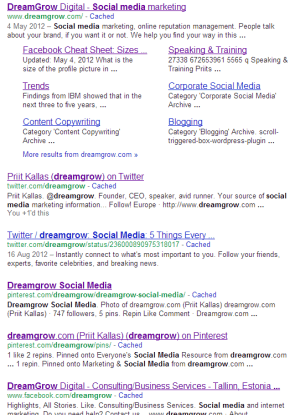
Study after study has revealed that the average Internet search user never clicks beyond that first page of search engine results. It’s that first page—the first ten results—that establish the online identity of your brand. Controlling the online reputation of the brand, then, is just about controlling the results shown on Google’s first search results page.
What’s more, making strategic use of social media can help populate those first ten listings, and assume total control of the first page.
Populating the First Page
The ultimate goal of brand reputation management is to ensure that you own or have some control over the first ten Google search listings, so that any negative reviews or consumer complaints are relegated to the second or third or fourth page. A great place to begin is by stocking up on social media accounts, attached to your brand name. If you control those accounts, and if the accounts are on the first page of Google, then you’re well on your way!

Begin by signing up for Facebook and Twitter accounts that include the exact name of your brand; these will surely be high-ranking Google listings. You cannot stop with simply signing up for the domains, however. You must also use them to generate content. Social media accounts that produce regular, fresh content will rank better, and stay atop the Google rankings more consistently, than an abandoned or content-free social media account.
Facebook and Twitter are fairly obvious social media accounts, but what about some of the second-tier social networking sites? Here, there lurk some surprises. For example, many brands will create YouTube accounts, as a way of achieving Google rankings, but YouTube accounts rarely rank in Google’s first page. Believe it or not, a Vimeo account offers much better Google rankings.
There is also the matter of photo sharing sites. Most of these accounts simply do not offer the kinds of Google rankings that brands need. If you are going to join a photo-sharing site, make it Flickr—the only site of its kind that consistently ranks within Google’s first two pages.
Finally, starting a blog is a great way to seize one of those spaces in the Google Top 10, but a couple of cautions are in order. The first caution is that, as with social media accounts, a stagnant blog will not yield the rankings you need; you must post new content to it on a regular basis. Second, blog with WordPress, not Blogger or Tumblr. Simply put: Google likes WordPress, so it is going to deliver those first-page rankings.
And What About Google+?
Naturally, Google+ is going to be vital for success in Google, as you can bet that the search engine will award its own social platform with a prime ranking position. Once more, though, don’t settle for simply signing up for a Google+ account. Actually use its +1 feature, encouraging friends and followers to hit the +1 button on your blog entries and corporate website. This will produce better rankings for those pieces of content—ultimately helping you tighten your grip on Google’s first page of search results!
Remember that controlling those first ten listings is effectively taking your brand reputation into your own hands—and social marketing can be a powerful tool in gaining that control.
Stay In the Know: 5 Great Social News Sites | Pound Ridge NY Real Estate
The popularity of social news sites has grown over the years. People are now using these sites more than ever to learn about what’s going on in the world.
Social news sites are similar to regular news sites in that they provide the news. The only difference is that the news is provided by users, and users get to vote on the stories to determine which news items are ranked highest on the site. Those stories that have the most results tend to be listed in the top ten.
If you’re not familiar with social news, this may be a whole new concept for your to grasp, but there are actually quite a few social news sites out there, so you may not know which ones to use. But have no fear, as the following are five of the best social news sites.
Digg
Digg is one of the more popular social news sites. On Digg, members can share news about almost any topic—from celebrity gossip all the way to politics. Users can then peruse the news being shared, and when the come across something that interests them, they can “digg” it. The more “diggs” a news story receives, the higher it ranks on the site.
Reddit is another popular social news site. It works similarly to Digg. Users share content on a variety of news topics. They also have the ability to create their own community (called subreddits). Information on Reddit can be actual news, or it can be something interesting that a user felt like sharing. Users get to vote on the best content on the site, and those that get the most votes will appear at the top of the site. Plus, users have the ability to comment on the news shared by others.
Delicious
Delicious is a social news site that allows you to bookmark interesting websites and share the information with your friends. You can save anything—web links, pictures, blogs, videos, and even tweets. The bookmarks that receive the highest number of votes are then placed on the home page for all to see.
Grow News
Interested in saving the planet and everything else eco-conscious? Now you can share your love of green with others. Grow News allows users to share information on eco-friendly related topics. Like the other social news sites, Grow News features the most popular stories on their home page, and these stories are determined by the number of votes they receive.
Newsvine
Newsvine is a compilation of popular stories from around the world. The news on this site is generated by the users, and the most popular stories are pushed to the top of the site. Any time you read an interesting news story on the web, you can share it with other people through Newsvine, or you can write your own news stories and share them on the site too.
Staying up to date on the news in the world is important, but if you don’t have time to read the newspaper, make sure to check out the happenings on one (or all) of these social news sites. It’s a great way to stay current on popular events while also having a say as to which content is shared.


This may sound daunting; the task of controlling everything that is said about your brand on the Internet is surely a tall order. The good news is that you don’t have to control everything that is said. You only need to worry about what appears on the first page of Google search results.
The ultimate goal of brand reputation management is to ensure that you own or have some control over the first ten Google search listings, so that any negative reviews or consumer complaints are relegated to the second or third or fourth page. A great place to begin is by stocking up on social media accounts, attached to your brand name. If you control those accounts, and if the accounts are on the first page of Google, then you’re well on your way!
Naturally, Google+ is going to be vital for success in Google, as you can bet that the search engine will award its own social platform with a prime ranking position. Once more, though, don’t settle for simply signing up for a Google+ account. Actually use its +1 feature, encouraging friends and followers to hit the +1 button on your blog entries and corporate website. This will produce better rankings for those pieces of content—ultimately helping you tighten your grip on Google’s first page of search results!


Interested in saving the planet and everything else eco-conscious? Now you can share your love of green with others. Grow News allows users to share information on eco-friendly related topics. Like the other social news sites, Grow News features the most popular stories on their home page, and these stories are determined by the number of votes they receive.
Newsvine is a compilation of popular stories from around the world. The news on this site is generated by the users, and the most popular stories are pushed to the top of the site. Any time you read an interesting news story on the web, you can share it with other people through Newsvine, or you can write your own news stories and share them on the site too.