Local Inventories | RobReportBlog | Armonk NY Real Estate
Armonk 8.33 months
Chappaqua 9.26 months
Bedford 15.51 months
Katonah 7.36 months
South Salem 9.8 months
North Salem 16.51 months
Pound Ridge 10.6 months
via trulia.com

Local Inventories | RobReportBlog | Armonk NY Real Estate
Armonk 8.33 months
Chappaqua 9.26 months
Bedford 15.51 months
Katonah 7.36 months
South Salem 9.8 months
North Salem 16.51 months
Pound Ridge 10.6 months
WHITE PLAINS, N.Y. (AP) — Police say a man stole nearly 300 large batteries from portable signs along New York highways, knocking out warnings and information to motorists.
Westchester County police say Angel Velez of the Bronx has been charged with grand larceny and other crimes. They say the batteries were worth $60,000. The signs are typically used to warn motorists of temporary traffic patterns or safety hazards.
The batteries weigh 55 to 96 pounds. Police believe Velez sold them to recycling centers for about $20,000.
The thefts occurred along the state Thruway and several parkways in Westchester.
State police and New York City police are investigating whether Velez is responsible for similar thefts in Rockland and Orange counties and the Bronx.
A call to Legal Aid, which is representing Velez, was not immediately returned.

Value is an aesthetic experience, says Krisstina Wise, broker-owner of the Austin, Texas, brokerage The GoodLife Team. It’s not just a product or service, she said, but how a brokerage makes a customer feel.
Wise and five other panelists will discuss how to make doing business in real estate “as easy as buying a latte” at Real Estate Connect New York City, which runs Jan. 16-18 at the Grand Hyatt New York. Wise will appear on an opening-day panel, “What does the industry need to do to make the ‘Latte Vision‘ happen?”
Krisstina WiseWise’s answer to that question revolves around value and her real estate raison d’etre: “To care, to make a difference.”
Customer experience, Wise says, should be a full one. An experience with a brokerage is analogous to walking into a coffee shop — it should be sensual, she said. Customers should “feel something.”
She scrubs that perspective against the 12-agent, two-office brokerage she founded in 2008 by asking questions like: What does our website look and feel like? Does our office space match our online presence? How quickly do we respond to leads? Do customers get more value than they expect?
“Real estate is about value,” Wise said. It’s not only about the quality of what customers get, she said, but also about the way they feel, which explains her brokerage’s six-point service manifesto and its clean, purple and sea green branding.
GoodLife Team branding from the brokerage’s website.
Wise spent her first 15 years as an agent with Austin-based Keller Williams Realty, one of the largest real estate franchisors in the U.S. By the time she set out on her own, she led a team of agents and was a national trainer.
Since then, The GoodLife Team has been held up as a model of the modern real estate brokerage for the transparent, innovative and forward-thinking way it operates.
In 2010, Inman News recognized The GoodLife Team as the most innovative brokerage of the year. This January, Apple profiled the brokerage for its incorporation of the iPad into its business.
In October, The GoodLife Team held an inaugural two-day conference, REiNVENTION, in Austin, that shed light on the brokerage’s inner workings, from marketing to technology to inspiration. Wise expects REiNVENTION to become a yearly event.
The conference was an opportunity to share with the real estate industry the working elements and systems of an actual working brokerage, Wise said. Sometimes it’s hard to know what practices that are taught on the conference circuit actually work, and how they work, because what’s being touted is not always what’s actually used by the person explaining a system or service.
REiNVENTION built on the momentum (and demand) from a mentor-like program Wise founded in 2010 in which she coaches and shares her insight with paying participants.
Real estate has fully entered the digital age, Wise said, and this has shifted the value propositions for agents and brokers, whether they like it or not.
“Brokerages have to get back to the basics of caring about the customer,” she said.
Providing value in a Web-based world is immensely complex, Wise said, which is why she maintains a single-minded focus on choosing technologies and systems that maximize agent productivity and client ease of use at The GoodLife Team.
She attends conferences around the country to find the best and most useful technology and systems to integrate into The GoodLife Team’s business, simplifying her agents’ lives so they can focus on serving their clients, she said.
The result, Wise said, is a six-part “G-core” real estate operating system The GoodLife Team works with:
- Salesforce. The customer relationship management system is the hub, Wise said. All leads automatically enter the program.
- Google Apps. All agents use Gmail for email, use collaborative Google calendars so everyone knows everyone else’s schedule, and Google Drive, which allows real-time collaborative sharing on brokerage documents. It’s part of a “nothing secret” way of operating, Wise said.
- Evernote. All tasks for the brokerage are managed with the cloud-based project management software; agents can check off items on their to-do lists seen by everyone else in the brokerage.
- Social media. The GoodLife Team has a Facebook business page, Twitter, YouTube and Pinterest accounts and a WordPress-powered blog that agents are encouraged to source for social media content.
- Mobile. Every agent has an iPad and this January The GoodLife Team is launching a new mobile-optimized website.
- Paperless. Last year, The GoodLife Team went completely paperless by integrating the paperless transaction management system Cartavi and e-signature platform DocuSign into its business. “Everything’s digital,” Wise said. “We have no file folders.”
Wise says she has a business philosophy of “failing forward.” Last year, The GoodLife Team went fully paperless. This year, she said, the challenge is to further simplify business operations.
“It’s a big vision,” she said, and “scary,” but “we have instances where we have three screwdrivers when only one is truly needed.”
When Wise has time to herself — which is not often, given that she’s also a wife and mother of two children — she enjoys reading the latest murder mysteries, running, and practicing the “art of doing nothing.”


The results of FHA’s annual audit sent a shock wave through the nation’s housing community Friday afternoon as even agency officials could not confirm that the higher borrowing costs it will charge borrowers will enough to cover losses.
The FHA reported on Friday that its annual audit shows that even if it stopped making any new loans immediately, the agency doesn’t have enough in reserve to cover expected losses on loans already in its portfolio. The result would lead to a $16.3 billion net worth deficit.
The agency announced it will raise premiums and sell delinquent loans as it seeks to avoid taking aid from taxpayers for the first time in its 78- year history, but when asked whether those steps will be enough to overcome the deficit, FHA Acting Commissioner Carol Galante declined to speculate on whether these measures would be enough to keep the agency from seeking Treasury assistance.
“At this point in time, it’s literally impossible to say whether we will or won’t need a draw,” she said during a briefing for reporters in Washington. “We are doing this to increase the likelihood that we will not.” More than 17 percent of all FHA loans were delinquent in September. The agency has lost $70 billion on loans it insured from fiscal years 2007 through 2009.
Most of the FHA’s price increases will go into effect in January. The annual premium FHA charges borrowers in return for guaranteeing loans will rise by 10 basis points on new mortgages, an average cost of about $13 per month for borrowers. The agency also will no longer allow some borrowers to stop paying premiums after 10 years. FHA will also provide deeper levels of payment relief for borrowers who receive loan modifications to avert foreclosure.
In addition, FHA will expand short sales for defaulting borrowers and continue auctioning off at least 10,000 delinquent loans every quarter, urging investors who buy them to take steps to keep families in their homes.
The premium increase comes on top of a significant hike in mortgage insurance premiums and tighter credit standards enacted late last year and earlier this year. The higher costs are driving borrowers who can qualify to use conventional financing, which may be accelerating the deterioration of the quality its portfolio.
Earlier this year, FHA raised upfront mortgage insurance premiums to 1.75 percent of the amount borrowed, due at closing and raised annual mortgage insurance premiums to as high as 1.25 percent a per year. FHA also refused to lend to borrowers with FICO scores below 530 and instituted a 10 percent down payment requirement for those with scores between 530 and 580.
Following implementation of the new policies, use of FHA loans declined. In January, FHA transactions accounted for 27.3 percent of all home purchase transactions. FHA-financed transactions were only 25.9 percent in August, according to the Campbell Surveys/Inside Mortgage Finance Housing Pulse. Ellie Mae also reported that the FHA share of mortgage originations declined, from 29 percent in August 2011 to 17 percent in September 2012. During the same period, conventional mortgages increased their market share of new from 61 to 72 percent.
Higher borrowing costs will affect first-time buyers more than others. FHA mortgages were used by 46 percent of first-time buyers in 2011. In September, the media FICO score of FHA borrowers was 701, according to Ellie Mae, whose software platform processes about 20 percent of all U.S. mortgage originations.
“Conventional mortgages are making a comeback while FHA mortgages are not,” said Thomas Popik, research director for Campbell Surveys in September. “Reasons for the growth in conventional mortgages include low rates, increased underwriting of high LTV mortgages by private mortgage insurers, and a price structure including insurance premiums that is cheaper than the FHA alternative.”
Housing organizations across the spectrum issued statements of concern about the audit. “While there is no doubt that the housing finance system needs to be reformed, the contributions that the FHA has made during this economic downturn underscore the need for a government backstop for both the primary and secondary mortgage markets. In times of crisis, private financial institutions have fled the marketplace and consistently failed to step up to the plate. Without government support for home purchasing and refinancing, the nation’s mortgage markets will grind to a halt, throwing the economy back into recession,” said Barry Rutenberg, chairman of the National Association of Home Builders (NAHB).
Mike Calhoun, president of the Center for Responsible Lending, said, “FHA has already instituted changes so that its current and more recent loans are projected to generate a profit. Those safeguards, along with the additional changes FHA announced today, should produce the additional revenue that will enable FHA to operate without a subsidy from taxpayers. Further restrictions, however, would undercut the ability of FHA to fulfill its mission.”
Said Debra W. Still, CMB, Chairman of the Mortgage Bankers Association (MBA): “While everyone had hoped for a better report, the news that the Fund has gone negative is not wholly unexpected, as last year’s report predicted there was a 50 percent likelihood this would occur. The characteristics and stresses on FHA’s pre-2010 books of business continue to be the source of losses, while books from 2010 onward are performing well.
“The good news is that the steps that FHA has taken to better manage its risk in recent years have succeeded in vastly improving loan performance on more recent vintages. The industry welcomed many of those changes and believes that policymakers can take further steps that would stabilize FHA single family programs, starting with a rigorous look at the data driving the actuarial results and an open, robust discussion over the future of the government’s role in housing finance.”
“Given the significant role that housing plays in the economy, policymakers need to take a long-term, holistic approach to housing finance reform and carefully gauge how it affects other efforts under way to get the nation’s fiscal house in order and achieve long-term economic growth.”
The median downpayment made by all homebuyers in 2012 was 9 percent, ranging from 4 percent for first-time buyers to 13 percent for repeat buyers. The median down payment was the lowest since 2009 but still far above the levels during the housing boom, when nearly half of first-time buyers made no downpayment at all.
First-time buyers who financed their purchase used a variety of resources for the down payment: 76 percent tapped into savings; 24 percent received a gift from a friend or relative, typically from their parents; and 6 percent received a loan from a relative or friend. Eleven percent tapped into a 401(k) fund, and 6 percent sold stocks or bonds. Ninety-three percent of entry-level buyers chose a fixed-rate mortgage, reported the National Association of Realtors.
Forty-six percent of first-time buyers financed with a low-downpayment FHA mortgage, and 10 percent used the VA loan program with no downpayment requirements. Forty-two percent cut spending on luxury items to buy their first home, 35 percent cut spending on entertainment and 27 percent cut spending on clothes.
In 2005, the median first-time home buyer scraped together a down payment of only 2 percent to buy a $150,000 home . Two years later, in 2007, the median downpayment by first-time buyers was still only 2 percent and 45 percent purchased with no money down – the same as in 2006. That year 43 percent of first-time home buyers purchased their homes with no-money-down loans.
After lenders tightened standards in the wake of the housing crash, the median down payment soared , reaching 11 percent in 2010-2011. First time buyers put about 5 percent down in 2011. Repeat buyers, pooling equity with savings, typically put down about 15 percent. Investment and vacation-home buyers have been paying higher down payments than those buying a primary residence. The median down payment for both was 27 percent, according to NAR’s 2011 Profile of Investment and Vacation Buyers.
“First-time buyers historically make small down payments, but repeat buyers like to put down 20 percent if they can to avoid paying mortgage insurance,” NAR’s Paul Bishop said. “The general loss in home value since the peak of the housing boom means many repeat buyers in recent years had to make smaller downpayments. Fortunately, prices have turned up this year and are showing sustained increases, so we’re on the road to a recovery in home equity.”
We recently teamed up with ClickZ to learn how marketers around the world are approaching mobile marketing and measurement, and where it’s headed next. We hope these stats will provide useful context for your planning in the coming year. Here are some of the key takeaways:
Mobile is now an important part of the integrated marketing mix
Mobile is no longer an add-on to a campaign, and for many it’s increasingly becoming a central focus.
- 87% of marketers are planning to increase emphasis on mobile during 2013, and belief in the power of mobile is rapidly growing stronger.
- Marketers have a broad mix of mobile tactics planned in the next year:
- 52% plan to create a mobile- or tablet-optimized website
- 48% plan to increase engagement in mobile advertising
- 41% hope to develop a mobile app
- 39% are planning to market a mobile app
For many, mobile measurement is still new territory
- More than half (59%) of marketers consider themselves either novice or inexperienced when it comes to measuring mobile. This presents an opportunity for organizations to invest in training and education today to stay ahead of the curve tomorrow.
- 58% of marketers are currently accountable for mobile metrics, and more than one-third are already sharing internal dashboards to show mobile marketing results.
Mobile measurement unlocks new opportunities
- 53% of marketers who analyzed their mobile metrics say there is a lot of untapped opportunity and plan to increase their mobile spending.
- Tools, technologies and talent are in demand: 68% of marketers plan to increase technology investment and ad spend, and 32% plan to focus more in talent.
A deeper look at mobile app measurement
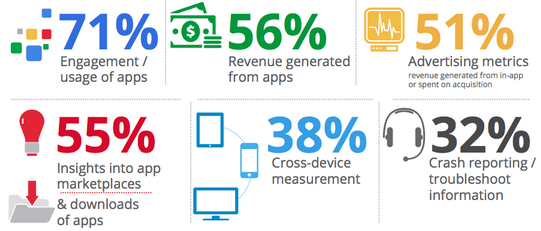
Here’s a look at the mobile app-related metrics that marketers say matter the most to them:As shown above, marketers are interested in measuring the full app lifecycle, which we’re excited to see as our new Mobile App Analytics covers a majority of the desired metrics marketers are seeking.The opportunity for marketers
This research shows the opportunity that mobile offers app developers and marketers to reach consumers on the go. Effective measurement across mobile sites, ads and apps will help marketers create winning strategies. Mobile’s role in marketing is becoming a central part of integrated campaigns and will only continue to grow. We know that marketers want simple tools that help them seamlessly integrate mobile into their marketing and measurement, and we’re working hard to create robust tools to help.
Q: I live in a 1940s house with a kitchen that has never been updated. I’m tired of doing the dishes by hand and would really like to get a dishwasher. I don’t have a garbage disposal and don’t really want or need one. I compost all my organic food waste.
Is it possible to get a dishwasher or am I doomed to continue with washing dishes by hand. Do I have to spend big bucks to have the kitchen remodeled? I’m pretty handy so if possible I’d like to do this myself using the existing kitchen cabinets.
The counters are 25 inches deep with tile countertops, and the counter height is 35 inches. There are two side-by-side banks of drawers to one side of the sink measuring 26 inches between the stiles. This seems to be a perfect place for a dishwasher. What do you think?
A: Yes, you can have a dishwasher in your kitchen. Furthermore, you can do most of the work yourself and save a bunch of money. Four things are necessary for a built-in dishwasher: a place for it; a water supply line; a drain line; and power. We’ll take these in order.
Cabinet space: Standard under-counter dishwashers are 24 inches wide, 24 inches deep and approximately 35 inches high with adjustable legs. We’ve installed a dishwasher in an opening a little less than 34 inches tall. Based on your description, it sounds as if it’ll be a tight fit, but a fit nonetheless. There are narrower models and also single-drawer models with different dimensions available if the standard size won’t work. We’re sure that with a little research you can find one that will fit your space.
The drawer banks are an ideal location. It’s best to locate a dishwasher close to the sink for easy access to water and waste lines. Often 1940s vintage cabinets were built in place. Getting your opening should be as easy as removing the drawers, cutting out the cross rails and cutting out the bottom of the cabinet with a reciprocating saw.
Water supply: A dishwasher needs hot water. The closest source is the hot water supply under the sink. Replace the shutoff valve with a new one that connects both the sink and the dishwasher to the hot water line. The new valve, also known as an angle stop, will have a vertical outlet to be connected to the faucet and a horizontal outlet to supply hot water to the dishwasher. Use a long braided wire hose available at plumbing supply houses, hardware stores and home centers for the connection. You may need to drill a hole in the side of the cabinet to route the hose from the shutoff valve to the dishwasher opening.
Drain line: The dishwasher will come with a hose used to connect the dishwasher to the drain under the sink. Normally the hose is connected to an inlet in the garbage disposal. Because you don’t have one and don’t want one a little simple plumbing is in order. Water empties from the sink, through a strainer, into a tailpiece connected to a p-trap and then into the waste line. To connect the drain hose replace the straight tailpiece you have now with a tailpiece that looks like a “Y.” Secure the drainage hose to the “Y” with a hose clamp.
Depending on the local plumbing view PIC Plumbing Services near you, to help install an air gap in the countertop. This will entail cutting a hole in the tile with a diamond-tipped hole saw attached to a drill. An air gap is a backflow preventer, keeping dirty water from re-entering the dishwasher. If an air gap is not required, the same thing can be accomplished by securing the drain line with a clamp at the top of the sink cabinet.
Here’s a YouTube video on drain lines and air gaps that we think is worth watching: .
Power: Local codes usually require a dishwasher to be on a separate circuit that may be shared with a garbage disposal. The size of the wire and the circuit breaker will depend on the load the dishwasher draws. To be safe, we use 12-gauge wire run to a duplex plug and protected by a 20-amp circuit breaker. If the electrical box is surface-mounted, use armored cable to run the line. This is the only part of the job that may not be appropriate for your do-it-yourself project. It depends on your experience and your level of comfort working with electrical wiring.
With the water, drainage and electrical in place, read the dishwasher manual for hookup instructions. In any case, because there is some question as to whether an air gap is required and there is new wiring involved, get a permit and have the job inspected.